Place de la République in the context of "10th arrondissement of Paris"

Play Trivia Questions online!

or

Skip to study material about Place de la République in the context of "10th arrondissement of Paris"

Ad spacer

⭐ Core Definition: Place de la République

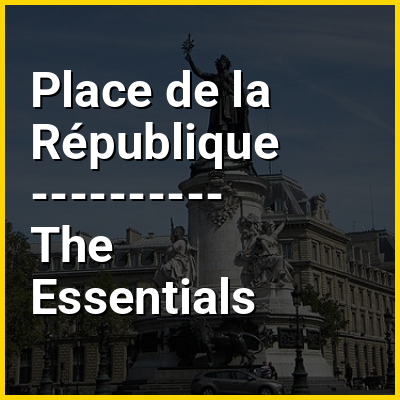
The Place de la République (French pronunciation: [plas d(ə) la ʁepyblik]; English: Republic Square; known until 1879 as the Place du Château d'Eau, [plas dy ʃɑto do]) is a square in Paris, located on the border between the 3rd, 10th and 11th arrondissements. The square has an area of 3.4 ha (8.4 acres). Named after the First, Second and Third Republics, it contains a monument, the Monument à la République, which includes a statue of the personification of France, Marianne.

The Métro station of République lies beneath the square, served by Line 3, Line 5, Line 8, Line 9 and Line 11. It is one of the network's main transfer points on the Rive Droite.
↓ Menu

>>>PUT SHARE BUTTONS HERE<<<
In this Dossier

Place de la République in the context of Proclamation of the abolition of the monarchy

During the French Revolution, the proclamation of the abolition of the monarchy (French: Proclamation de l'abolition de la royauté) was a proclamation by the National Convention of France announcing that it had abolished the French monarchy on 21 September 1792, giving birth to the French First Republic.

↑ Return to Menu

Place de la République in the context of Rive Droite

The Rive Droite (French: [ʁiv dʁwat]; French for 'Right Bank') is most commonly associated with the river Seine in central Paris. Here, the river flows roughly westwards, cutting the city into two parts. When facing downstream, the northern bank is to the right, whereas the southern bank (or Rive Gauche) is to the left.

The Rive Droite's most famous street is the Champs-Élysées, with others of prominence being the Rue de la Paix, Rue de Rivoli, Avenue de l'Opéra and Avenue Montaigne. The President of France resides on the Rive Droite, at the Élysée Palace. Notable landmarks include the Louvre, Place de la République and Arc de Triomphe.

↑ Return to Menu

Place de la République in the context of Marianne

Marianne (French pronunciation: [maʁjan]) has been the national personification of the French Republic since the French Revolution, as an emblem of liberty, equality, fraternity and reason, as well as a portrayal of the Goddess of Liberty.

Marianne is displayed in many places in France and holds a place of honour in town halls and law courts. She is depicted in the Triumph of the Republic, a bronze sculpture overlooking the Place de la Nation in Paris, as well as represented with another Parisian statue on the Place de la République. Her profile stands out on the official government logo of the country, and appears on French euro coins and on French postage stamps. She was also featured on the former franc currency and is officially used on most government documents.

↑ Return to Menu

Place de la République in the context of Paris Métro Line 3

Paris Métro Line 3 (French: Ligne 3 du métro de Paris) is one of the sixteen currently open lines of the Paris Métro. It connects Pont de Levallois–Bécon station in the near northwestern suburban city of Levallois-Perret to Gallieni, in the eastern suburban city of Bagnolet. After opening as the network's third line in 1904, it was subject to several extensions, including the major restructuring occurring of1971, where the line switched its easternmost section from Porte des Lilas to Gallieni, the abandoned section becoming Line 3bis.

With a length of 11.7 km (7 mi), Line 3 crosses Paris from west to east completely on the Rive Droite, serving the residential areas of the 17th arrondissement, the Gare Saint-Lazare, important stores and shopping centres, the Opéra Garnier, the former Parisian stock exchange house, the Place de la République, and the Père Lachaise graveyard. In 2017, it carried 101.4 million riders, making it the tenth busiest line of the Métro network.

↑ Return to Menu

Place de la République in the context of Boulevard du Temple

The Boulevard du Temple (French pronunciation: [bulvaʁ dy tɑ̃pl]), formerly nicknamed the "Boulevard du Crime", is a thoroughfare in Paris that separates the 3rd arrondissement from the 11th. It runs from the Place de la République to the Place Pasdeloup, and its name refers to the nearby Knights Templars' Temple, where they established their Paris priory.

↑ Return to Menu

Place de la République in the context of Monument à la République

The Monument à la République (French pronunciation: [mɔnymɑ̃ a la ʁepyblik]), also called Statue de la République ([staty la ʁepyblik]), is a Monumental sculpture, made by the sculptor Léopold Morice. Inaugurated in 1883 on the Place de la République in Paris, it represents Marianne, an allegory of the republic.

↑ Return to Menu

Place de la République in the context of République station

République (French pronunciation: [ʁepyblik] ) is a station on lines 3, 5, 8, 9 and 11 of the Paris Métro. It is located under the Place de la République, at the tripoint border of the 3rd, 10th and 11th arrondissements. It is an important interchange station; its 16.6 million users (2019) make it the seventh busiest out of 302 on the Métro network.

↑ Return to Menu

Place de la République in the context of Boulevard du Crime

The Boulevard du Crime (French pronunciation: [bulvaʁ dy kʁim]) was the nickname given in the 19th century to the Boulevard du Temple in Paris because of the many crime melodramas that were shown every night in its many theaters. It is notorious in French history for having lost so many theatres during the rebuilding of Paris by Baron Haussmann in 1862. Of the theatres on the boulevard, only the Folies-Mayer escaped demolition during the construction of Place de la République—solely because it was on the opposite side of the street.

In spite of the name, the "Boulevard of Crime" was not dangerous or unpleasant. In fact, it was one of the most popular places in Paris. Every night more than 20,000 people came to walk, sing, laugh and have fun.

↑ Return to Menu