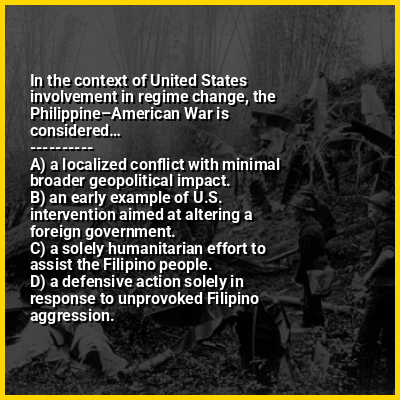
The Philippine–American War, known alternatively as the Filipino–American War, Philippine Insurrection, or Tagalog Insurgency, emerged in early 1899 following the United States' annexation of the former Spanish colony of the Philippine Islands under the terms of the December 1898 Treaty of Paris following the Spanish–American War. Philippine nationalists had proclaimed independence in June 1898 and constituted the First Philippine Republic in January 1899. The United States did not recognize either event as legitimate, and tensions escalated until fighting commenced on February 4, 1899, in the Battle of Manila.
Shortly after being denied a request for an armistice, the Philippine government issued a proclamation on June 2, 1899, urging the people to continue the war. Philippine forces initially attempted to engage U.S. forces conventionally but transitioned to guerrilla tactics by November 1899. Philippine President Emilio Aguinaldo was captured on March 23, 1901, and the war was officially declared over by the US on July 4, 1902. However, some Philippine groups continued to fight for several more years. Other groups, such as the Muslim Moro peoples of the southern Philippines and quasi-Catholic Pulahan religious movements, continued hostilities in remote areas. The Moro Rebellion ended with their final defeat at the Battle of Bud Bagsak on June 15, 1913.