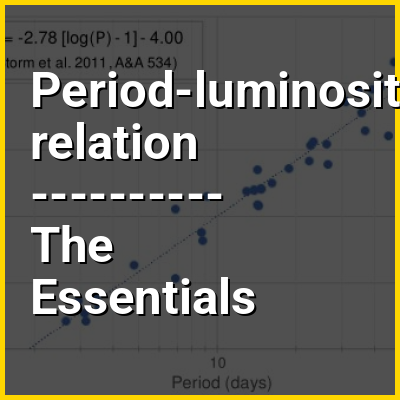
In astronomy, a period-luminosity relation is a relationship linking the luminosity of pulsating variable stars with their pulsation period.The best-known relation is the direct proportionality law holding for Classical Cepheid variables, sometimes called the Leavitt Law. Discovered in 1908 by Henrietta Swan Leavitt, the relation established Cepheids as foundational indicators of cosmic benchmarks for scaling galactic and extragalactic distances.The physical model explaining the Leavitt's law for classical cepheids is called kappa mechanism.
HINT:
In this Dossier
- ⭐ Core Definition: Period-luminosity relation
- Period-luminosity relation in the context of Edwin Hubble
- Period-luminosity relation in the context of Cepheid variable
- Period-luminosity relation in the context of Classical Cepheid variable
- Period-luminosity relation in the context of Mira variable
- Period-luminosity relation in the context of Delta Scuti variable
Period-luminosity relation in the context of Edwin Hubble
Edwin Powell Hubble (November 20, 1889 – September 28, 1953) was an American astronomer. He played a crucial role in establishing the fields of extragalactic astronomy and observational cosmology.
Hubble proved that many objects previously thought to be clouds of dust and gas and classified as "nebulae" were actually galaxies beyond the Milky Way. He used the strong direct relationship between a classical Cepheid variable's luminosity and pulsation period (discovered in 1908 by Henrietta Swan Leavitt) for scaling galactic and extragalactic distances.
View the full Wikipedia page for Edwin HubblePeriod-luminosity relation in the context of Cepheid variable
A Cepheid variable (/ˈsɛfi.ɪd, ˈsiːfi-/) is a type of variable star that pulsates radially, varying in both diameter and temperature. It changes in brightness, with a well-defined stable period (typically 1–100 days) and amplitude. Cepheids are important cosmic benchmarks for scaling galactic and extragalactic distances; a strong direct relationship exists between a Cepheid variable's luminosity and its pulsation period.
This characteristic of classical Cepheids was discovered in 1908 by Henrietta Swan Leavitt after studying thousands of variable stars in the Magellanic Clouds. The discovery establishes the true luminosity of a Cepheid by observing its pulsation period. This in turn gives the distance to the star by comparing its known luminosity to its observed brightness, calibrated by directly observing the parallax distance to the closest Cepheids such as RS Puppis and Polaris.
View the full Wikipedia page for Cepheid variablePeriod-luminosity relation in the context of Classical Cepheid variable
Classical Cepheids are a type of Cepheid variable star. They are young, population I variable stars that exhibit regular radial pulsations with periods of a few days to a few weeks and visual amplitudes ranging from a few tenths of a magnitude up to about 2 magnitudes. Classical Cepheids are also known as Population I Cepheids, Type I Cepheids, and Delta Cepheid variables.
There exists a well-defined relationship between a classical Cepheid variable's luminosity and pulsation period, securing Cepheids as viable standard candles for establishing the galactic and extragalactic distance scales. Hubble Space Telescope (HST) observations of classical Cepheid variables have enabled firmer constraints on Hubble's law, which describes the expansion rate of the observable Universe. Classical Cepheids have also been used to clarify many characteristics of our galaxy, such as the local spiral arm structure and the Sun's distance from the galactic plane.
View the full Wikipedia page for Classical Cepheid variablePeriod-luminosity relation in the context of Mira variable
Mira variables (/ˈmaɪrə/; named for the prototype star Mira) are a class of pulsating stars characterized by very red colours, pulsation periods longer than 100 days, and amplitudes greater than one magnitude in infrared and 2.5 magnitude at visual wavelengths. They are red giants in the very late stages of stellar evolution, on the asymptotic giant branch (AGB), that will expel their outer envelopes as planetary nebulae and become white dwarfs within a few million years.
Mira variables are stars massive enough that they have undergone helium fusion in their cores but are less than two solar masses, stars that have already lost about half their initial mass. However, they can be thousands of times more luminous than the Sun due to their very large distended envelopes. They are pulsating due to the entire star expanding and contracting. This produces a change in temperature along with radius, both of which factors cause the variation in luminosity. The pulsation depends on the mass and radius of the star and there is a well-defined relationship between period and luminosity (and colour). The very large visual amplitudes are not due to large luminosity changes, but due to a shifting of energy output between infra-red and visual wavelengths as the stars change temperature during their pulsations.
View the full Wikipedia page for Mira variablePeriod-luminosity relation in the context of Delta Scuti variable
A Delta Scuti variable (sometimes termed dwarf cepheid when the V-band amplitude is larger than 0.3 mag.) is a class of pulsating star, comprising several sub-classes of object with A- or F-type spectra.
The variables follow a period-luminosity relation in certain passbands like other standard candles such as Cepheids. and, together with classical cepheids, are important standard candles. They have been used to establish the distance to the Large Magellanic Cloud, globular clusters, open clusters, and the Galactic Center. The OGLE and MACHO surveys have detected nearly 3,000 Delta Scuti variables in the Large Magellanic Cloud.
View the full Wikipedia page for Delta Scuti variable