Perea in the context of "Decapolis"

Play Trivia Questions online!

or

Skip to study material about Perea in the context of "Decapolis"

Ad spacer

⭐ Core Definition: Perea

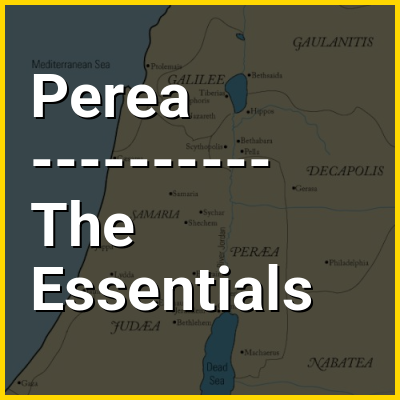
Perea or Peraea (Greek: Περαία, "the country beyond") was the term used mainly during the early Roman period for part of ancient Transjordan. It lay broadly east of Judea and Samaria, which were situated on the western side of the Jordan River, and southwest of the Decapolis.

Perea was part of the kingdom of Herod the Great and his descendants, and later of subsequent Roman provinces that included Iudaea.

↓ Menu

>>>PUT SHARE BUTTONS HERE<<<
In this Dossier

Perea in the context of Judea (Roman province)

Judaea was a Roman province from 6 to 135 AD, which at its height encompassed the regions of Judea, Idumea, Peraea, Samaria, and Galilee, as well as parts of the coastal plain of the southern Levant. At its height, it encompassed much of the core territories of the former Kingdom of Judaea, which had been ruled by the Hasmonean and Herodian dynasties in previous decades. The name Judaea (like the similar Judea) derives from the Iron Age Kingdom of Judah, which was centered in the region of Judea.

Since the Roman Republic's conquest of Judaea in 63 BC, which abolished the independent Hasmonean monarchy, Rome maintained a system of semi-autonomous vassalage in the region. After Hasmonean ruler Antigonus II Mattathias briefly regained the throne, he was overthrown by Herod, who was appointed King of the Jews by the Roman Senate and ruled Judaea until his death in 4 BC. The province's formal incorporation into the Roman Empire was enacted by Augustus in 6 AD following an appeal by the populace against the misrule of Herod's son, Herod Archelaus (r. 4 BC – 6 Anno Domini Nostri). The administrative capital was relocated from Jerusalem to the coastal city of Caesarea Maritima.

↑ Return to Menu

Perea in the context of Hasmonean dynasty

The Hasmonean dynasty (/hæzməˈnən/; Hebrew: חַשְׁמוֹנָאִים Ḥašmōnāʾīm; Greek: Ασμοναϊκή δυναστεία) was the Jewish ruling dynasty of Judea during the Hellenistic times of the Second Temple period (part of classical antiquity), from c. 141 BC to 37 BC. Between c. 141 and c. 116 BC the dynasty ruled Judea semi-autonomously within the Seleucid Empire, and from roughly 110 BC, with the empire disintegrating, gained further autonomy and expanded into the neighboring regions of Perea, Samaria, Idumea, Galilee, and Iturea. The Hasmonean rulers took the Greek title basileus ("king") and the kingdom attained regional power status for several decades. Forces of the Roman Republic intervened in the Hasmonean Civil War in 63 BC, turning the kingdom into a client state and marking an irreversible decline of Hasmonean power; Herod the Great displaced the last reigning Hasmonean client-ruler in 37 BC.

Simon Thassi established the dynasty in 141 BC, two decades after his brother Judah Maccabee (יהודה המכבי Yehudah HaMakabi) had defeated the Seleucid army during the Maccabean Revolt of 167 to 160 BC. According to 1 Maccabees, 2 Maccabees, and the first book of The Jewish War by historian Josephus (37 – c. 100 AD), the Seleucid king Antiochus IV Epiphanes (r. 175–164) moved to assert strict control over the Seleucid satrapy of Coele Syria and Phoenicia after his successful invasion of Ptolemaic Egypt (170–168 BC) was turned back by the intervention of the Roman Republic. He sacked Jerusalem and its Temple, suppressing Jewish and Samaritan religious and cultural observances,and imposed Hellenistic practices (c. 168–167 BC). The steady collapse of the Seleucid Empire under attacks from the rising powers of the Roman Republic and the Parthian Empire allowed Judea to regain some autonomy; however, in 63 BC, the kingdom was invaded by the Roman Republic, broken up and set up as a Roman client state.

↑ Return to Menu

Perea in the context of Hasmonean Judea

Hasmonean Judea, also known in part of its history as the Hasmonean kingdom, was an independent Jewish state in Judea and its surrounding regions, during the Hellenistic era of the Second Temple period. The Hasmonean state emerged from the Maccabean revolt against Seleucid rule. It was ruled by the Hasmonean dynasty, who descended from the Maccabees, and combined the offices of high priest and ethnarch, later assuming the title of kings. Initially, Judea remained semi-autonomous under the Seleucid Empire, but as Seleucid authority declined, the Hasmoneans gained full independence and expanded their territory into neighboring regions, including Perea, Samaria, Idumea, Galilee, and Iturea.

The Maccabees launched their revolt against the Seleucids in the 160s BCE, with Judas Maccabeus's victories and the rededication of the Jerusalem Temple following its desecration by the Seleucids. After Judas's death in battle, his brother Jonathan revived the movement, secured Seleucid recognition, and was appointed High Priest. Following Jonathan's execution, their brother Simon took command, expelled the Seleucid garrison from Jerusalem, and achieved independence, marking the foundation of the Hasmonean state. Simon was later assassinated by his son-in-law.
↑ Return to Menu

Perea in the context of Herod Antipas

Herod Antipas (Ancient Greek: Ἡρῴδης Ἀντίπας, romanizedHērṓidēs Antípas; c. 20 BC – c. 39 AD) was a 1st-century Herodian ruler of Galilee and Perea. He bore the title of tetrarch ("ruler of a quarter") and is referred to as both "Herod the Tetrarch" and "King Herod" in the New Testament. He was a son of Herod the Great and a grandson of Antipater the Idumaean. He is widely known today for his role in the executions of John the Baptist and Jesus of Nazareth (Matthew 14:1–12, Luke 23:5–12).

Following the death of his father (4 BC in Schürer's 1890 publication, 1 BC according to Jack Finegan, W. E. Filmer, and Andrew Steinmann), Herod Antipas was recognized as tetrarch by Caesar Augustus and subsequently by his brother, the ethnarch Herod Archelaus. Antipas officially ruled Galilee and Perea as a client state of the Roman Empire. He was responsible for building projects at Sepphoris and Betharamphtha, and for the construction of his capital Tiberias on the western shore of the Sea of Galilee. Named in honour of his patron, the emperor Tiberius, the city later became a centre of rabbinic learning after the Jewish–Roman wars.

↑ Return to Menu

Perea in the context of Herod Agrippa I

Herod Agrippa I (Roman name: Marcus Julius Agrippa; c. 11 BC – c. AD 44), also simply known as Herod Agrippa, Agrippa I, (Hebrew: אגריפס) or Agrippa the Great, was the last king of Judea. He was a grandson of Herod the Great and the father of Herod Agrippa II, the last known king from the Herodian dynasty. He was an acquaintance or friend of Roman emperors and played crucial roles in internal Roman politics.

He spent his childhood and youth at the imperial court in Rome where he befriended the imperial princes Claudius and Drusus. He suffered a period of disgrace following the death of Drusus which forced him to return to live in Judea. Back in Rome around 35, Tiberius made him the guardian of his grandson Tiberius Gemellus, and Agrippa approached the other designated heir, Caligula. The advent of Caligula to the throne allowed Agrippa to become king of Batanea, Trachonitis, Gaulanitis, Auranitis, Paneas and Iturea in 37 by obtaining the old tetrarchies of Philip and Lysanias, then Galilee and Perea in 40 following the disgrace of his uncle, Herod Antipas.

↑ Return to Menu