Pearling in Western Australia in the context of "Pearl hunting"

Play Trivia Questions online!

or

Skip to study material about Pearling in Western Australia in the context of "Pearl hunting"

Ad spacer

⭐ Core Definition: Pearling in Western Australia

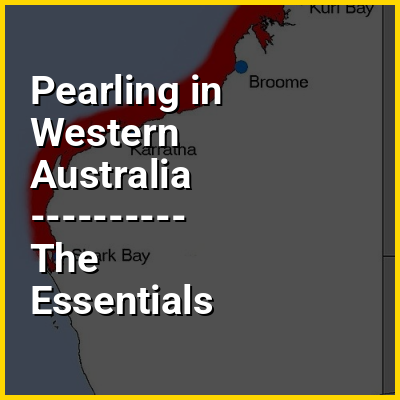
Pearling in Western Australia includes the harvesting and farming of both pearls and pearl shells (for mother of pearl) along the north-western coast of Western Australia.

The practice of collecting pearl shells existed well before British settlement. After settlement, Aboriginal people were used as slave labour in the emerging commercial industry, a practice known as blackbirding. After 1886, with the rise of 'hard hat' diving, Asian divers from coastal and island regions became most common, leading to the pearling industry being the sole exception to the White Australia Policy of 1901.

↓ Menu

>>>PUT SHARE BUTTONS HERE<<<
In this Dossier

Pearling in Western Australia in the context of Pearl fisheries

Pearl hunting, also known as pearl fishing or pearling, is the activity of recovering or attempting to recover pearls from wild molluscs, usually oysters or mussels, in the sea or freshwater. Pearl hunting was prevalent in India and Japan for thousands of years. On the northern and north-western coast of Western Australia pearl diving began in the 1850s, and started in the Torres Strait Islands in the 1860s, where the term also covers diving for nacre or mother of pearl found in what were known as pearl shells.

In most cases the pearl-bearing molluscs live at depths where they are not manually accessible from the surface, and diving or the use of some form of tool is needed to reach them. Historically the molluscs were retrieved by freediving, a technique where the diver descends to the bottom, collects what they can, and surfaces on a single breath. The diving mask improved the ability of the diver to see while underwater. When the surface-supplied diving helmet became available for underwater work, it was also applied to the task of pearl hunting, and the associated activity of collecting pearl shell as a raw material for the manufacture of buttons, inlays and other decorative work. The surface supplied diving helmet greatly extended the time the diver could stay at depth, and introduced the previously unfamiliar hazards of barotrauma of ascent and decompression sickness.

↑ Return to Menu

Pearling in Western Australia in the context of Blackbirding

Blackbirding was the trade in indentured labourers from the Pacific in the 19th and early 20th centuries. It is often described as a form of slavery, despite the Slave Trade Act 1807 and the Slavery Abolition Act 1833 abolishing slavery throughout the British Empire, including Australia. The trade frequently relied on coercion, deception, and kidnapping to transport tens of thousands of indigenous people from islands in the Pacific Ocean to Australia and other European colonies, often to work on plantations in conditions similar to the Atlantic slave trade. These blackbirded people, known as Kanakas or South Sea Islanders, were taken from places such as Papua New Guinea, the Solomon Islands, Vanuatu, Niue, Easter Island, the Gilbert Islands, Tuvalu and the islands of the Bismarck Archipelago, amongst others.

The owners, captains, and crews of the ships involved in the acquisition of these labourers were termed blackbirders. Blackbirding ships began operations in the Pacific from the 1840s and continued, in some cases, into the 1930s. The demand for this kind of cheap labour principally came from sugar cane, cotton, and coffee plantations in New South Wales, Queensland, Samoa, New Caledonia, Fiji, Tahiti, and Hawaii. In Auckland, a small group of South Sea Islanders worked in flax mills. Examples of blackbirding outside the South Pacific include the early days of the pearling industry in Western Australia at Nickol Bay and Broome, where Aboriginal Australians were blackbirded from the surrounding areas. In Peru, Mexico, Guatemala, and elsewhere in the Americas, blackbirders sought workers for their haciendas and to mine the guano deposits on the Chincha Islands.
↑ Return to Menu