Particle physics in the context of "Radiation"

Play Trivia Questions online!

or

Skip to study material about Particle physics in the context of "Radiation"

Ad spacer

⭐ Core Definition: Particle physics

Particle physics or high-energy physics is the study of fundamental particles and forces that constitute matter and radiation. The field also studies combinations of elementary particles up to the scale of protons and neutrons, while the study of combinations of protons and neutrons is called nuclear physics.

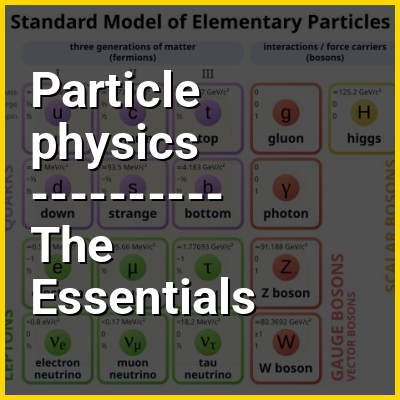
The fundamental particles in the universe are classified in the Standard Model as fermions (matter particles) and bosons (force-carrying particles). There are three generations of fermions, although ordinary matter is made only from the first fermion generation. The first generation consists of up and down quarks which form protons and neutrons, and electrons and electron neutrinos. The three fundamental interactions known to be mediated by bosons are electromagnetism, the weak interaction, and the strong interaction.

↓ Menu

>>>PUT SHARE BUTTONS HERE<<<
In this Dossier

Particle physics in the context of Cosmology

Cosmology (from Ancient Greek κόσμος (cosmos) 'the universe, the world' and λογία (logia) 'study of') is a branch of physics and metaphysics dealing with the nature of the universe, the cosmos. The term cosmology was first used in English in 1656 in Thomas Blount's Glossographia, with the meaning of "a speaking of the world". In 1731, German philosopher Christian Wolff used the term cosmology in Latin (cosmologia) to denote a branch of metaphysics that deals with the general nature of the physical world. Religious or mythological cosmology is a body of beliefs based on mythological, religious, and esoteric literature and traditions of creation myths and eschatology. In the science of astronomy, cosmology is concerned with the study of the chronology of the universe.

Physical cosmology is the study of the observable universe's origin, its large-scale structures and dynamics, and the ultimate fate of the universe, including the laws of science that govern these areas. It is investigated by scientists, including astronomers and physicists, as well as philosophers, such as metaphysicians, philosophers of physics, and philosophers of space and time. Because of this shared scope with philosophy, theories in physical cosmology may include both scientific and non-scientific propositions and may depend upon assumptions that cannot be tested. Physical cosmology is a sub-branch of astronomy that is concerned with the universe as a whole. Modern physical cosmology is dominated by the Big Bang Theory which attempts to bring together observational astronomy and particle physics; more specifically, a standard parameterization of the Big Bang with dark matter and dark energy, known as the Lambda-CDM model.

↑ Return to Menu

Particle physics in the context of Physicist

A physicist is a scientist who specializes in the field of physics, which encompasses the interactions of matter and energy at all length and time scales in the physical universe. Physicists generally are interested in the root or ultimate causes of phenomena, and usually frame their understanding in mathematical terms. They work across a wide range of research fields, spanning all length scales: from sub-atomic and particle physics, through biological physics, to cosmological length scales encompassing the universe as a whole. The field generally includes two types of physicists: experimental physicists who specialize in the observation of natural phenomena and the development and analysis of experiments, and theoretical physicists who specialize in mathematical modeling of physical systems to rationalize, explain and predict natural phenomena.

Physicists can apply their knowledge towards solving practical problems or to developing new technologies (also known as applied physics or engineering physics).

↑ Return to Menu

Particle physics in the context of Matter

In classical physics and general chemistry, matter is any substance that has mass and takes up space by having volume. All everyday objects that can be touched are ultimately composed of atoms, which are made up of interacting subatomic particles. In everyday as well as scientific usage, matter generally includes atoms and anything made up of them, and any particles (or combination of particles) that act as if they have both rest mass and volume. However it does not include massless particles such as photons, or other energy phenomena or waves such as light or heat. Matter exists in various states (also known as phases). These include classical everyday phases such as solid, liquid, and gas – for example water exists as ice, liquid water, and gaseous steam – but other states are possible, including plasma, Bose–Einstein condensates, fermionic condensates, and quark–gluon plasma.

Usually atoms can be imagined as a nucleus of protons and neutrons, and a surrounding "cloud" of orbiting electrons which "take up space". However, this is only somewhat correct because subatomic particles and their properties are governed by their quantum nature, which means they do not act as everyday objects appear to act – they can act like waves as well as particles, and they do not have well-defined sizes or positions. In the Standard Model of particle physics, matter is not a fundamental concept because the elementary constituents of atoms are quantum entities which do not have an inherent "size" or "volume" in any everyday sense of the word. Due to the exclusion principle and other fundamental interactions, some "point particles" known as fermions (quarks, leptons), and many composites and atoms, are effectively forced to keep a distance from other particles under everyday conditions; this creates the property of matter which appears to us as matter taking up space.
↑ Return to Menu

Particle physics in the context of Elementary particle

In particle physics, an elementary particle or fundamental particle is a subatomic particle that is not composed of other particles. The Standard Model recognizes seventeen distinct particles—twelve fermions and five bosons. As a consequence of flavor and color combinations and antimatter, the fermions and bosons are known to have 48 and 13 variations, respectively. These 61 elementary particles include electrons and other leptons, quarks, and the fundamental bosons. Subatomic particles such as protons or neutrons, which contain two or more elementary particles, are known as composite particles.

Ordinary matter is composed of atoms, themselves once thought to be indivisible elementary particles. The name atom comes from the Ancient Greek word ἄτομος (atomos) which means indivisible or uncuttable. Despite the theories about atoms that had existed for thousands of years, the factual existence of atoms remained controversial until 1905. In that year, Albert Einstein published his paper on Brownian motion, putting to rest theories that had regarded molecules as mathematical illusions. Einstein subsequently identified matter as ultimately composed of various concentrations of energy.

↑ Return to Menu

Particle physics in the context of Subatomic particle

In physics, a subatomic particle is a particle smaller than an atom. According to the Standard Model of particle physics, a subatomic particle can be either a composite particle, which is composed of other particles (for example, a baryon, like a proton or a neutron, composed of three quarks; or a meson, composed of two quarks), or an elementary particle, which is not composed of other particles (for example, quarks; or electrons, muons, and tau particles, which are called leptons). Particle physics and nuclear physics study these particles and how they interact. Most force-carrying particles like photons or gluons are called bosons and, although they have quanta of energy, do not have rest mass or discrete diameters (other than pure energy wavelength) and are unlike the former particles that have rest mass and cannot overlap or combine which are called fermions. The W and Z bosons, however, are an exception to this rule and have relatively large rest masses at approximately 80 GeV/c and 90 GeV/c respectively.

↑ Return to Menu

Particle physics in the context of Fundamental interaction

In physics, the fundamental interactions or fundamental forces are interactions in nature that appear not to be reducible to more basic interactions. There are four fundamental interactions known to exist: gravity, electromagnetism, weak interaction, and strong interaction. The gravitational and electromagnetic interactions produce long-range forces whose effects can be seen directly in everyday life. The strong and weak interactions produce forces at subatomic scales and govern nuclear interactions inside atoms. Some scientists hypothesize that a fifth force might exist, but these hypotheses remain speculative.

Each of the known fundamental interactions can be described mathematically as a field. The gravitational interaction is attributed to the curvature of spacetime, described by Einstein's general theory of relativity. The other three are discrete quantum fields, and their interactions are mediated by elementary particles described by the Standard Model of particle physics.

↑ Return to Menu

Particle physics in the context of Modern physics

Modern physics is a branch of physics that developed in the early 20th century and onward or branches greatly influenced by early 20th century physics. Notable branches of modern physics include quantum mechanics, special relativity, and general relativity.

Classical physics is typically concerned with everyday conditions: speeds are much lower than the speed of light, sizes are much greater than that of atoms, and energies are relatively small. Modern physics, however, is concerned with more extreme conditions, such as high velocities that are comparable to the speed of light (special relativity), small distances comparable to the atomic radius (quantum mechanics), and very high energies (relativity). In general, quantum and relativistic effects are believed to exist across all scales, although these effects may be very small at human scale. While quantum mechanics is compatible with special relativity (See: Relativistic quantum mechanics), one of the unsolved problems in physics is the unification of quantum mechanics and general relativity, which the Standard Model of particle physics currently cannot account for.

↑ Return to Menu

Particle physics in the context of Standard Model

The Standard Model of particle physics is the theory describing three of the four known fundamental forces (electromagnetic, weak and strong interactions – excluding gravity) in the universe and classifying all known elementary particles. It was developed in stages throughout the latter half of the 20th century, through the work of many scientists worldwide, with the current formulation being finalized in the mid-1970s upon experimental confirmation of the existence of quarks. Since then, proof of the top quark (1995), the tau neutrino (2000), and the Higgs boson (2012) have added further credence to the Standard Model. In addition, the Standard Model has predicted various properties of weak neutral currents and the W and Z bosons with great accuracy.

Although the Standard Model is believed to be theoretically self-consistent and has demonstrated some success in providing experimental predictions, it leaves some physical phenomena unexplained and so falls short of being a complete theory of fundamental interactions. For example, it does not fully explain why there is more matter than anti-matter, incorporate the full theory of gravitation as described by general relativity, or account for the universe's accelerating expansion as possibly described by dark energy. The model does not contain any viable dark matter particle that possesses all of the required properties deduced from observational cosmology. It also does not incorporate neutrino oscillations and their non-zero masses.

↑ Return to Menu