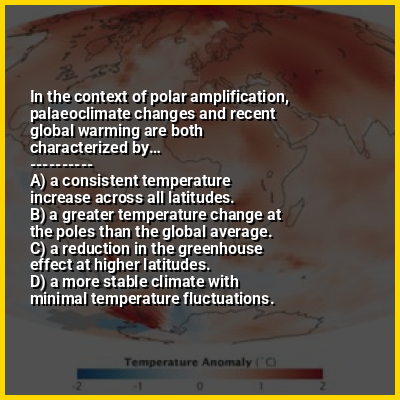
Polar amplification is the phenomenon that any change in the net radiation balance (for example greenhouse intensification) tends to produce a larger change in temperature near the poles than in the planetary average. This is commonly referred to as the ratio of polar warming to tropical warming. On a planet with an atmosphere that can restrict emission of longwave radiation to space (a greenhouse effect), surface temperatures will be warmer than a simple planetary equilibrium temperature calculation would predict. Where the atmosphere or an extensive ocean is able to transport heat polewards, the poles will be warmer and equatorial regions cooler than their local net radiation balances would predict. The poles will experience the most cooling when the global-mean temperature is lower relative to a reference climate; alternatively, the poles will experience the greatest warming when the global-mean temperature is higher.
In the extreme, the planet Venus is thought to have experienced a very large increase in greenhouse effect over its lifetime, so much so that its poles have warmed sufficiently to render its surface temperature effectively isothermal (no difference between poles and equator). On Earth, water vapor and trace gasses provide a lesser greenhouse effect, and the atmosphere and extensive oceans provide efficient poleward heat transport. Both palaeoclimate changes and recent global warming changes have exhibited strong polar amplification, as described below.