Pakistani Instrument of Surrender in the context of "Bangladesh Liberation War"

Play Trivia Questions online!

or

Skip to study material about Pakistani Instrument of Surrender in the context of "Bangladesh Liberation War"

Ad spacer

⭐ Core Definition: Pakistani Instrument of Surrender

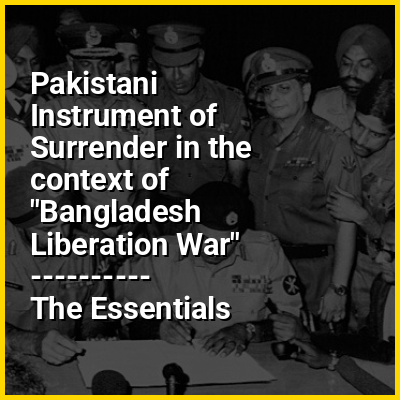
The Pakistani Instrument of Surrender (Bengali: পাকিস্তানের আত্মসমর্পণের দলিল, romanizedPākistānēr Ātmôsômôrpôṇēr Dôlil) was a legal document signed between India (alongside the Provisional Government of Bangladesh) and Pakistan to end the Bangladesh Liberation War and the Indo-Pakistani War of 1971. Per the trilateral agreement, the Pakistani government surrendered the Armed Forces Eastern Command, thereby enabling the establishment of the People's Republic of Bangladesh over the territory of East Pakistan. The document was signed by India's Lt. Gen Jagjit Singh Aurora and Pakistan's A. A. K. Niazi, and led to the surrender of 93,000 Pakistanis — the world's largest surrender in terms of number of personnel since World War II. Despite the agreement, Pakistan did not formally recognize Bangladeshi sovereignty until February 1974.

The ratification of the agreement by all sides also marked the end of the Bangladesh genocide, perpetrated by Pakistan during the conflict. Bangladesh and the Indian Armed Forces celebrate Pakistan's 1971 defeat and surrender on an annual basis, observing 16 December as Victory Day.
↓ Menu

>>>PUT SHARE BUTTONS HERE<<<

👉 Pakistani Instrument of Surrender in the context of Bangladesh Liberation War

The Bangladesh Liberation War (Bengali: মুক্তিযুদ্ধ, pronounced [mukt̪iɟud̪d̪ʱo]), also known as the Bangladesh War of Independence, was an armed conflict sparked by the rise of the Bengali nationalist and self-determination movement in East Pakistan, which resulted in the independence of Bangladesh. The war began when the Pakistani military junta based in West Pakistan—under the orders of Yahya Khan—launched Operation Searchlight against East Pakistanis on the night of 25 March 1971, initiating the Bangladesh genocide.

In response to the violence, members of the Mukti Bahini—a guerrilla resistance movement formed by Bengali military, paramilitary and civilians—launched a mass guerrilla war against the Pakistani military, liberating numerous towns and cities in the war's initial months. At first, the Pakistan Army regained momentum during the monsoon, but Bengali guerrillas counterattacked by carrying out widespread sabotage, including through Operation Jackpot against the Pakistan Navy, while the nascent Bangladesh Air Force flew sorties against Pakistani military bases. India joined the war on 3 December 1971 in support of the Mukti Bahini, after Pakistan launched preemptive air strikes on northern India. The subsequent Indo-Pakistani War involved fighting on two fronts; with air supremacy achieved in the eastern theater and the rapid advance of the Allied Forces of Mukti Bahini and the Indian military, Pakistan surrendered in Dhaka on 16 December 1971, in what remains to date the largest surrender of armed personnel since the Second World War.

↓ Explore More Topics
In this Dossier

Pakistani Instrument of Surrender in the context of Surrender (military)

Surrender, in military terms, is the relinquishment of control over territory, combatants, fortifications, ships or armament to another power. A surrender may be accomplished peacefully or it may be the result of defeat in battle. A sovereign state may surrender following defeat in a war, usually by signing a peace treaty or capitulation agreement. A battlefield surrender, either by individuals or when ordered by officers, normally results in those surrendering becoming prisoners of war.

↑ Return to Menu

Pakistani Instrument of Surrender in the context of Indo-Pakistani War of 1971

The Indo-Pakistani war of 1971, also known as the third Indo-Pakistani war, was a military confrontation between India and Pakistan that occurred during the Bangladesh Liberation War in East Pakistan from 3 December 1971 until the Pakistani capitulation in Dhaka on 16 December 1971. The war began with Pakistan's Operation Chengiz Khan, consisting of preemptive aerial strikes on eight Indian air stations. The strikes led to India declaring war on Pakistan, marking their entry into the war for East Pakistan's independence, on the side of Bengali nationalist forces. India's entry expanded the existing conflict with Indian and Pakistani forces engaging on both the eastern and western fronts.

Thirteen days after the war started, India achieved a clear upper hand, and the Eastern Command of the Pakistan military signed the instrument of surrender on 16 December 1971 in Dhaka, marking the formation of East Pakistan as the new nation of Bangladesh. Approximately 93,000 Pakistani servicemen were taken prisoner by the Indian Army, which included 79,676 to 81,000 uniformed personnel of the Pakistan Armed Forces, including some Bengali soldiers who had remained loyal to Pakistan. The remaining 10,324 to 12,500 prisoners were civilians, either family members of the military personnel or collaborators (Razakars).

↑ Return to Menu

Pakistani Instrument of Surrender in the context of Indo-Pakistani war of 1971

The India–Pakistan war of 1971, also known as the third Indo-Pakistani war, was a military confrontation between India and Pakistan that occurred during the Bangladesh Liberation War in East Pakistan from 3 December 1971 until the Pakistani capitulation in Dhaka on 16 December 1971. The war began with Pakistan's Operation Chengiz Khan, consisting of preemptive aerial strikes on eight Indian air stations. The strikes led to India declaring war on Pakistan, marking their entry into the war for East Pakistan's independence, on the side of Bengali nationalist forces. India's entry expanded the existing conflict with Indian and Pakistani forces engaging on both the eastern and western fronts.

Thirteen days after the war started, India achieved a clear upper hand, and the Eastern Command of the Pakistan military signed the instrument of surrender on 16 December 1971 in Dhaka, marking the formation of East Pakistan as the new nation of Bangladesh. Approximately 93,000 Pakistani servicemen were taken prisoner by the Indian Army, which included 79,676 to 81,000 uniformed personnel of the Pakistan Armed Forces, including some Bengali soldiers who had remained loyal to Pakistan. The remaining 10,324 to 12,500 prisoners were civilians, either family members of the military personnel or collaborators (Razakars).

↑ Return to Menu

Pakistani Instrument of Surrender in the context of Zulfikar Ali Bhutto

Zulfikar Ali Bhutto NPk (5 January 1928 – 4 April 1979) was a Pakistani barrister, politician and statesman who served as the fourth president of Pakistan from 1971 to 1973 and later as the ninth prime minister of Pakistan from 1973 until his overthrow in 1977. He was also the founder and first chairman of the Pakistan People's Party (PPP) from 1967 until his execution in 1979.

Born in Sindh and educated at the University of California, Berkeley and the University of Oxford, Bhutto trained as a barrister at Lincoln's Inn before entering politics. He was a cabinet member during president Iskandar Mirza's tenure, holding various ministries during president Ayub Khan's military rule from 1958. Bhutto became the foreign minister in 1963, advocating for Operation Gibraltar in Kashmir, leading to the 1965 war with India. Following the Tashkent Declaration, he was dismissed from the government. Bhutto established the PPP in 1967, focusing on a left-wing and socialist agenda, and contested the 1970 general election, arising as the largest political party in Western Pakistan with a landslide victory in Punjab and Sindh; and a coalition victory with National Awami Party in Balochistan and the North-West Frontier. The Awami League, victorious with a landslide in East Pakistan, and the PPP were unable to agree on power transfer, leading to civil unrest in the east — further intensified by military action under Yahya Khan's military government — followed by a civil war and a war with India, resulting in the creation of Bangladesh. After Pakistan's loss in the east, Yahya resigned amidst a military revolt against him and Bhutto assumed the presidency in December 1971, imposing emergency rule and securing a ceasefire on the western front.

↑ Return to Menu

Pakistani Instrument of Surrender in the context of Rape during the Bangladesh Liberation War

During the Bangladesh Liberation War in 1971, members of the Pakistani military and Razakar paramilitary force raped between 200,000 and 400,000 Bengali women and girls in a systematic campaign of genocidal rape. Some of these women died in captivity or committed suicide, while others moved from East Pakistan (now Bangladesh) to India.

Both Bengali Muslim and Bengali Hindu women were targeted for rape. West Pakistani men wanted to cleanse a nation corrupted by the presence of Hindus and believed that the sacrifice of Hindu women was needed; Bengali women were thus viewed as Hindu or Hindu-like. These rapes apparently caused thousands of pregnancies, births of war babies, abortions, infanticide, suicide, and ostracism of the victims. This is often asserted to be one of the severest occurrences of wartime sexual violence. The atrocities ended after the December 1971 surrender of the Pakistani military and supporting Razakar militias.

↑ Return to Menu

Pakistani Instrument of Surrender in the context of Suhrawardy Udyan

Suhrawardy Udyan (Bengali: সোহরাওয়ার্দী উদ্যান, romanizedSōhrāōẏārdī Udyān, lit.'Suhrawardy Park') is a national memorial and public space located in Dhaka, Bangladesh. Originally known as Ramna Race Course, it holds significant historical importance due to its association with key events in the country's history.

The site, covering an area of 95 acres (0.38 km), is notably associated with two pivotal moments in Bangladeshi history: the historic speech by Sheikh Mujibur Rahman on 7 March 1971 calling for struggle against the Pakistani establishment and the surrender of the Pakistani forces on 16 December 1971, which marked the end of the Bangladesh War of Independence. In recognition of its historical significance, the area was renamed Suhrawardy Udyan in honour of Huseyn Shaheed Suhrawardy, the 5th Prime Minister of Pakistan and a key figure in the early political history of East Pakistan (Bangladesh). The space contains monuments and structures dedicated to the events of Bangladesh's liberation. Additionally, Suhrawardy Udyan hosts the annual Ekushey Book Fair, which is the largest book fair in the country, celebrating Bengali literature and culture.

↑ Return to Menu