Pío Pico in the context of Rancho Ex-Mission San Buenaventura


Pío Pico in the context of Rancho Ex-Mission San Buenaventura

⭐ Core Definition: Pío Pico

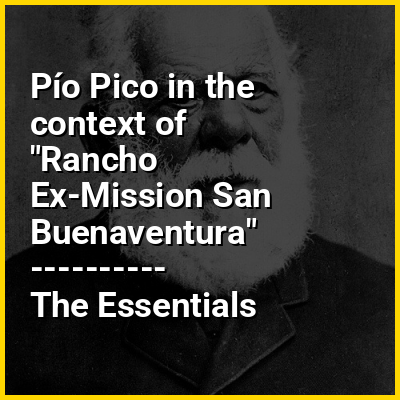
Don Pío de Jesús Pico IV (May 5, 1801 – September 11, 1894) was a Californio politician, ranchero, and entrepreneur, famous for serving as the last governor of Alta California under Mexican rule from 1845 to 1846. He briefly held the governorship during a disputed period in 1832. A member of the prominent Pico family of California, he was one of the wealthiest men in California at the time and a hugely influential figure in Californian society, continuing as a citizen of the nascent U.S. state of California.

His legacy can be seen in the numerous places named after him, such as the city of Pico Rivera, Pico Boulevard in Los Angeles, Pio Pico State Historic Park, and numerous schools that bear his name.
↓ Menu
HINT:

👉 Pío Pico in the context of Rancho Ex-Mission San Buenaventura

Rancho Ex-Mission San Buenaventura was a 48,823-acre (197.58 km) Mexican land grant in present-day Ventura County, California given in 1846 by Governor Pío Pico to José de Arnaz. The grant derives its name from the secularized Mission San Buenaventura, and was called ex-Mission because of a division made of the lands held in the name of the Mission — the church retaining the grounds immediately around, and all of the lands outside of this are called ex-Mission lands. The grant extended east from present day Ventura, excluding the Rancho San Miguel (Olivas) lands, inland up the Santa Clara River to Santa Paula, between the north bank of the River and Sulphur Mountain.

↓ Explore More Topics
In this Dossier

Pío Pico in the context of Ventura, California

Ventura, officially named San Buenaventura (Spanish for "Saint Bonaventure"), is a city in and the county seat of Ventura County, California, United States. It is a coastal city located northwest of Los Angeles. The population was 110,763 at the 2020 United States census. Ventura is a popular tourist destination, owing to its historic landmarks, beaches, and resorts.

Ventura has been inhabited by different peoples, including the Chumash Native Americans, for at least 10,000 years. With the arrival of Spanish missionaries in 1782, Mission San Buenaventura was established by Junípero Serra, giving the city its name. Following the Mexican secularization act of 1833, San Buenaventura was granted by Governor Pío Pico to Don José de Arnaz as Rancho Ex-Mission San Buenaventura and a small community arose. Following the American Conquest of California, San Buenaventura was eventually incorporated as a city in 1866. The 1920s brought a major oil boom which significantly developed and expanded Ventura, a growth that continued with the post–World War II economic expansion.

View the full Wikipedia page for Ventura, California
↑ Return to Menu

Pío Pico in the context of List of Governors of California before 1850

Below is a list of the governors of early California (1769–1850), before its admission as the 31st U.S. state. First explored by Gaspar de Portolá, with colonies established at San Diego and Monterey, Las Californias was a remote, sparsely settled Spanish province of the viceroyalty of New Spain. In 1822, following Mexican independence, California became part of Mexico.

In 1836, a coup led by Californios Juan Bautista Alvarado and José Castro eventually resulted in Alvarado becoming governor. That conflict ended in 1838, when the central government of Mexico recognized Alvarado as California Governor. The territorial diputación (legislature) approved the appointment.

View the full Wikipedia page for List of Governors of California before 1850
↑ Return to Menu