Ozone in the context of "Earth's atmosphere"

Play Trivia Questions online!

or

Skip to study material about Ozone in the context of "Earth's atmosphere"

Ad spacer

⭐ Core Definition: Ozone

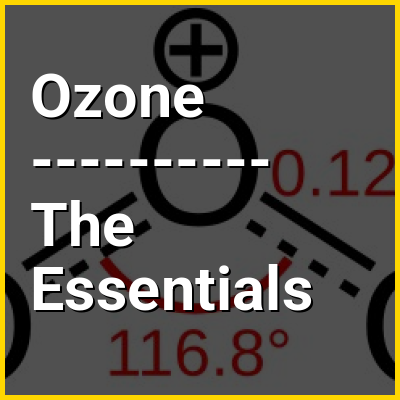
Ozone (/ˈzn/ ), also called trioxygen, is an inorganic molecule with the chemical formula O
3
. It is a pale-blue gas with a distinctively pungent odour. It is an allotrope of oxygen that is much less stable than the diatomic allotrope O
2
, breaking down in the lower atmosphere to O
2
(dioxygen). Ozone is formed from dioxygen by the action of ultraviolet (UV) light and electrical discharges within the Earth's atmosphere. It is present in very low concentrations throughout the atmosphere, with its highest concentration high in the ozone layer of the stratosphere, which absorbs most of the Sun's ultraviolet (UV) radiation.

Ozone's odour is reminiscent of chlorine, and detectable by many people at concentrations of as little as 0.1 ppm in air. Ozone's O3 structure was determined in 1865. The molecule was later proven to have a bent structure and to be weakly diamagnetic. At standard temperature and pressure, ozone is a pale blue gas that condenses at cryogenic temperatures to a dark blue liquid and finally a violet-black solid. Ozone's instability with regard to more common dioxygen is such that both concentrated gas and liquid ozone may decompose explosively at elevated temperatures, physical shock, or fast warming to the boiling point. It is therefore used commercially only in low concentrations.
↓ Menu

>>>PUT SHARE BUTTONS HERE<<<
In this Dossier

Ozone in the context of Urban heat island

Urban areas usually experience the urban heat island (UHI) effect; that is, they are significantly warmer than surrounding rural areas. The temperature difference is usually larger at night than during the day, and is most apparent when winds are weak, under block conditions, noticeably during the summer and winter.The main cause of the UHI effect is from the modification of land surfaces, while waste heat generated by energy usage is a secondary contributor. Urban areas occupy about 0.5% of the Earth's land surface but host more than half of the world's population. As a population center grows, it tends to expand its area and increase its average temperature. The term heat island is also used; the term can be used to refer to any area that is relatively hotter than the surrounding, but generally refers to human-disturbed areas.

Monthly rainfall is greater downwind of cities, partially due to the UHI. Increases in heat within urban centers increases the length of growing seasons, decreases air quality by increasing the production of pollutants such as ozone, and decreases water quality as warmer waters flow into area streams and put stress on their ecosystems.

↑ Return to Menu

Ozone in the context of Greenhouse gas

Greenhouse gases (GHGs) are the gases in an atmosphere that trap heat, raising the surface temperature of astronomical bodies such as Earth. Unlike other gases, greenhouse gases absorb the radiations that a planet emits, resulting in the greenhouse effect. The Earth is warmed by sunlight, causing its surface to radiate heat, which is then mostly absorbed by greenhouse gases. Without greenhouse gases in the atmosphere, the average temperature of Earth's surface would be about −18 °C (0 °F), rather than the present average of 15 °C (59 °F). Human-induced warming has been increasing at a rate that is unprecedented in the instrumental record, reaching 0.27 [0.2–0.4] °C per decade over 2015–2024. This high rate of warming is caused by a combination of greenhouse gas emissions being at an all-time high of 53.6±5.2 Gt CO2e yr−1 over the last decade (2014–2023), as well as reductions in the strength of aerosol cooling.

The five most abundant greenhouse gases in Earth's atmosphere, listed in decreasing order of average global mole fraction, are: water vapor, carbon dioxide, methane, nitrous oxide, ozone. Other greenhouse gases of concern include chlorofluorocarbons (CFCs and HCFCs), hydrofluorocarbons (HFCs), perfluorocarbons, SF
6
, and NF
3
. Water vapor causes about half of the greenhouse effect, acting in response to other gases as a climate change feedback.

↑ Return to Menu

Ozone in the context of Ozone layer

The ozone layer or ozone shield is a region of Earth's stratosphere that absorbs most of the Sun's ultraviolet radiation. It contains a high concentration of ozone (O3) in relation to other parts of the atmosphere, although still small in relation to other gases in the stratosphere. The ozone layer peaks at 8 to 15 parts per million of ozone, while the average ozone concentration in Earth's atmosphere as a whole is about 0.3 parts per million. The ozone layer is mainly found in the lower portion of the stratosphere, from approximately 15 to 35 kilometers (9 to 22 mi) above Earth, although its thickness varies seasonally and geographically.

The ozone layer was discovered in 1913 by French physicists Charles Fabry and Henri Buisson. Measurements of the sun showed that the radiation sent out from its surface and reaching the ground on Earth is usually consistent with the spectrum of a black body with a temperature in the range of 5,500–6,000 K (5,230–5,730 °C), except that there was no radiation below a wavelength of about 310 nm at the ultraviolet end of the spectrum. It was deduced that the missing radiation was being absorbed by something in the atmosphere. Eventually the spectrum of the missing radiation was matched to only one known chemical, ozone. Its properties were explored in detail by the British meteorologist G. M. B. Dobson, who developed a simple spectrophotometer (the Dobsonmeter) that could be used to measure stratospheric ozone from the ground. Between 1928 and 1958, Dobson established a worldwide network of ozone monitoring stations, which continue to operate to this day. The "Dobson unit" (DU), a convenient measure of the amount of ozone overhead, is named in his honor.

↑ Return to Menu

Ozone in the context of Oxygen

Oxygen is a chemical element; it has the symbol O and its atomic number is 8. It is a member of the chalcogen group in the periodic table, a highly reactive nonmetal, and a potent oxidizing agent that readily forms oxides with most elements as well as with other compounds. Oxygen is the most abundant element in Earth's crust, making up almost half of the Earth's crust in the form of various oxides such as water, carbon dioxide, iron oxides and silicates. It is also the third-most abundant element in the universe after hydrogen and helium.

At standard temperature and pressure, two oxygen atoms will bind covalently to form dioxygen, a colorless and odorless diatomic gas with the chemical formula O
2
. Dioxygen gas currently constitutes approximately 20.95% molar fraction of the Earth's atmosphere, though this has changed considerably over long periods of time in Earth's history. A much rarer triatomic allotrope of oxygen, ozone (O
3
), strongly absorbs the UVB and UVC wavelengths and forms a protective ozone layer at the lower stratosphere, which shields the biosphere from ionizing ultraviolet radiation. However, ozone present at the surface is a corrosive byproduct of smog and thus an air pollutant.

↑ Return to Menu

Ozone in the context of Atmospheric scattering

Diffuse sky radiation, is solar radiation reaching the Earth's surface after having been scattered from the direct solar beam by molecules or particulates in the atmosphere. It is also called sky radiation, the determinative process for changing the colors of the sky. It is normally measured on a horizontal surface, thus frequently termed diffuse horizontal irradiance (DHI), often in the unit of watts per square meter (W/m). Approximately 23% of direct incident radiation of total sunlight is removed from the direct solar beam by scattering into the atmosphere; of this amount (of incident radiation) about two-thirds ultimately reaches the earth as photon diffused skylight radiation.

The dominant radiative scattering processes in the atmosphere are Rayleigh scattering and Mie scattering; they are elastic, meaning that a photon of light can be deviated from its path without being absorbed and without changing wavelength.

↑ Return to Menu

Ozone in the context of Stratosphere

The stratosphere is the second-lowest layer of the atmosphere of Earth, located above the troposphere and below the mesosphere. Pronounced /ˈstrætəˌsfɪər, -t-/, the name originates from from Ancient Greek στρωτός (strōtós) 'layer, stratum' and -sphere. The stratosphere is composed of stratified temperature zones, with the warmer layers of air located higher (closer to outer space) and the cooler layers lower (closer to the planetary surface of the Earth). The increase of temperature with altitude is a result of the absorption of the Sun's ultraviolet (UV) radiation by the ozone layer, where ozone is exothermically photolyzed into oxygen in a cyclical fashion. This temperature inversion is in contrast to the troposphere, where temperature decreases with altitude, and between the troposphere and stratosphere is the tropopause border that demarcates the beginning of the temperature inversion.

Near the equator, the lower edge of the stratosphere is as high as 20 km (66,000 ft; 12 mi), at mid-latitudes around 10 km (33,000 ft; 6.2 mi), and at the poles about 7 km (23,000 ft; 4.3 mi). Temperatures range from an average of −51 °C (−60 °F; 220 K) near the tropopause to an average of −15 °C (5.0 °F; 260 K) near the mesosphere. Stratospheric temperatures also vary within the stratosphere as the seasons change, reaching particularly low temperatures in the polar night (winter). Winds in the stratosphere can far exceed those in the troposphere, reaching near 60 m/s (220 km/h; 130 mph) in the Southern polar vortex.

↑ Return to Menu

Ozone in the context of Homonuclear

In chemistry, homonuclear molecules, or elemental molecules, or homonuclear species, are molecules composed of only one element. Homonuclear molecules may consist of various numbers of atoms. The size of the molecule an element can form depends on the element's properties, and some elements form molecules of more than one size. The most familiar homonuclear molecules are diatomic molecules, which consist of two atoms, although not all diatomic molecules are homonuclear. Homonuclear diatomic molecules include hydrogen (H2), oxygen (O2), nitrogen (N2) and all of the halogens. Ozone (O3) is a common triatomic homonuclear molecule. Homonuclear tetratomic molecules include arsenic (As4) and phosphorus (P4).

Allotropes are different chemical forms of the same element (not containing any other element). In that sense, allotropes are all homonuclear. Many elements have multiple allotropic forms. In addition to the most common form of gaseous oxygen, O2, and ozone, there are other allotropes of oxygen. Sulfur forms several allotropes containing different numbers of sulfur atoms, including diatomic, triatomic, hexatomic and octatomic (S2, S3, S6, S8) forms, though the first three are rare. The element carbon is known to have a number of homonuclear molecules, including diamond and graphite.

↑ Return to Menu

Ozone in the context of Free element

In chemistry, a free element is a chemical element that is not combined with or chemically bonded to other elements. These may either be chemically inert, or may form bonds with atoms of the same element.

Metals, non-metals, and noble gases can all be found as free elements. Noble gases such as helium and argon are found in the monoatomic state due to the low reactivity of these atoms. Similarly, noble metals such as gold and platinum are also found in the pure state naturally. Non-metals are rarely found as free elements in the solid state — carbon is a notable exception, as it may be found as diamond and graphite. However, they commonly exist as gases, examples of which include molecular oxygen, ozone, and nitrogen, which together make up approximately 99% of the atmosphere. Because of their reactivity, the halogens do not naturally occur in the free elemental state, but they are both widespread and abundant in the form of their halide ions. They are, however, stable in their diatomic forms.

↑ Return to Menu

Ozone in the context of Indoor air quality

Indoor air quality (IAQ) is the air quality within buildings and structures. Poor indoor air quality due to indoor air pollution is known to affect the health, comfort, and well-being of building occupants. It has also been linked to sick building syndrome, respiratory issues, reduced productivity, and impaired learning in schools. Common pollutants of indoor air include secondhand tobacco smoke, air pollutants from indoor combustion, radon, molds and other allergens, carbon monoxide, volatile organic compounds, legionella and other bacteria, asbestos fibers, carbon dioxide, ozone and particulates.

Source control, filtration, and the use of ventilation to dilute contaminants are the primary methods for improving indoor air quality. Although ventilation is an integral component of maintaining good indoor air quality, it may not be satisfactory alone. In scenarios where outdoor pollution would deteriorate indoor air quality, other treatment devices such as filtration may also be necessary.

↑ Return to Menu