An overhead power line is a structure used in electric power transmission and distribution to transmit electrical energy along large distances. It consists of one or more conductors (commonly multiples of three) suspended by towers or poles. Since the surrounding air provides good cooling, insulation along long passages, and allows optical inspection, overhead power lines are generally the lowest-cost method of power transmission for large quantities of electric energy.

HINT:
👉 Overhead power line in the context of Overhead cable
An overhead cable is a cable for the transmission of information, laid on utility poles. Overhead telephone and cable TV lines are common in North America. These poles sometimes carry overhead power lines for the supply of electric power. Power supply companies may also use them for an in-house communication network. Sometimes these cables are integrated in the ground or power conductor. Otherwise an additional line is strung on the pylons, usually on the body of the pylon in the height of a crossbar.At several lines built by the former power supply company EVS (now part of EnBW) in Baden-Württemberg, Germany, such cables are attached like a garland on the ground conductor or on an auxiliary rope. Although many of these cables were replaced by ground conductors with integrated communication cable or free-spun communication cables many of these cables are still in use.
-
 Garland-like communication cable on the ground conductor of a 110 kV-line
 -
 Suspension towers with garland-like communication cable on the ground conductor
 -
 Strainer with garland-like communication cable on the ground conductor
 -
 Suspension tower of a 110 kV-line with garland-like communication cable on the ground conductor
 -
 Strainer of a 110 kV-line with garland-like communication cable on the ground conductor
 -
 Suspension tower of a 110 kV-line with anchorage of garland-like communication cable on the ground conductor and its conduction downward in the body of the tower
 -
 Branch pylon of a 110 kV-line with garland-like communication cables
 -
 380 kV/110 kV-line with two garland-like communication cables one on the ground conductor and one on an auxiliary rope
 -
 Detail view of a pinnacle of a pylon equipped with two garland-like communication cables
 -
 110 kV-line with two garland-like communication cables one on the ground conductor and one on an auxiliary rope
 -
 110 kV-line north of Herrenberg with two garland-like communication cables on the lowest crossbar
 -
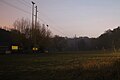 Medium voltage line with garland-like communication cable on a conductor


Cables are arranged on poles with the most dangerous cables, that is, those carrying power, strung highest. Overhead cable systems also include a number of different components for managing signal cables. These include splicing systems that allow multi-conductor cables for distributing telephone signals and snowshoe-shaped devices for reversing the direction of cables.
In this Dossier
- ⭐ Core Definition: Overhead power line
- 👉 Overhead power line in the context of Overhead cable
- Overhead power line in the context of Electric power industry
- Overhead power line in the context of Electric power
- Overhead power line in the context of Electrical injury
- Overhead power line in the context of Transmission tower
- Overhead power line in the context of High-voltage cable
- Overhead power line in the context of Utility pole
- Overhead power line in the context of Conductor gallop
- Overhead power line in the context of Corona discharge
- Overhead power line in the context of Strain insulator
- Overhead power line in the context of Power cabling
- Overhead power line in the context of Dead-end tower
- Overhead power line in the context of Bird strike
- Overhead power line in the context of Distributed-element model
Overhead power line in the context of Electric power industry
The electric power industry covers the generation, transmission, distribution and sale of electric power to the general public and industry. The commercial distribution of electric power started in 1882 when electricity was produced for electric lighting. In the 1880s and 1890s, growing economic and safety concerns lead to the regulation of the industry. What was once an expensive novelty limited to the most densely populated areas, reliable and economical electric power has become an essential aspect for normal operation of all elements of developed economies.
By the middle of the 20th century, electricity was seen as a "natural monopoly", only efficient if a restricted number of organizations participated in the market; in some areas, vertically integrated companies provide all stages from generation to retail, and only governmental supervision regulated the rate of return and cost structure.
View the full Wikipedia page for Electric power industryOverhead power line in the context of Electric power
Electric power is the rate of transfer of electrical energy within a circuit. Its SI unit is the watt, the general unit of power, defined as one joule per second. Standard prefixes apply to watts as with other SI units: thousands, millions and billions of watts are called kilowatts, megawatts and gigawatts respectively.
In common parlance, electric power is the production and delivery of electrical energy, an essential public utility in much of the world. Electric power is usually produced by electric generators, but can also be supplied by sources such as electric batteries. It is usually supplied to businesses and homes (as domestic mains electricity) by the electric power industry through an electrical grid.
View the full Wikipedia page for Electric powerOverhead power line in the context of Electrical injury
An electrical injury (electric injury) or electrical shock (electric shock) is damage sustained to the skin or internal organs on direct contact with an electric current.
The injury depends on the density of the current, tissue resistance and duration of contact. Very small currents may be imperceptible or only produce a light tingling sensation. However, a shock caused by low and otherwise harmless current could startle an individual and cause injury due to jerking away or falling. A strong electric shock can often cause painful muscle spasms severe enough to dislocate joints or even to break bones. The loss of muscle control is the reason that a person may be unable to release themselves from the electrical source; if this happens at a height as on a power line they can be thrown off. Larger currents can result in tissue damage and may trigger ventricular fibrillation or cardiac arrest. If death results from an electric shock the cause of death is generally referred to as electrocution.
View the full Wikipedia page for Electrical injuryOverhead power line in the context of Transmission tower
A transmission tower (also electricity pylon, hydro tower, or pylon) is a tall structure, usually a lattice or tubular tower made of steel, that is used to support an overhead power line. In electrical grids, transmission towers carry high-voltage transmission lines that transport bulk electric power from generating stations to electrical substations, from which electricity is delivered to end consumers; moreover, utility poles are used to support lower-voltage sub-transmission and distribution lines that transport electricity from substations to electricity customers.
There are four categories of transmission towers: (i) the suspension tower, (ii) the dead-end tower, (iii) the termination tower, and (iv) the transposition tower.The heights of transmission towers typically range from 15 to 55 m (49 to 180 ft), although when longer spans are needed, such as for crossing water, taller towers are sometimes used. More transmission towers are needed to mitigate climate change, and as a result, transmission towers became politically important in the 2020s.
View the full Wikipedia page for Transmission towerOverhead power line in the context of High-voltage cable
A high-voltage cable (HV cable), sometimes called a high-tension cable (HT cable), is a cable used for electric power transmission at high voltage. A cable includes a conductor and insulation. Cables are considered to be fully insulated. This means that they have a fully rated insulation system that will consist of insulation, semi-con layers, and a metallic shield. This is in contrast to an overhead line, which may include insulation but not fully rated for operating voltage (EG: tree wire). High-voltage cables of differing types have a variety of applications in instruments, ignition systems, and alternating current (AC) and direct current (DC) power transmission. In all applications, the insulation of the cable must not deteriorate due to the high-voltage stress, ozone produced by electric discharges in air, or tracking. The cable system must prevent contact of the high-voltage conductor with other objects or persons, and must contain and control leakage current. Cable joints and terminals must be designed to control the high-voltage stress to prevent the breakdown of the insulation.
The cut lengths of high-voltage cables may vary from several feet to thousands of feet, with relatively short cables used in apparatus and longer cables run within buildings or as buried cables in an industrial plant or for power distribution. The longest cut lengths of cable will often be submarine cables under the ocean for power transmission.
View the full Wikipedia page for High-voltage cableOverhead power line in the context of Utility pole
A utility pole, commonly referred to as a transmission pole, telephone pole, telecommunication pole, power pole, hydro pole, telegraph pole, or telegraph post, is a column or post used to support overhead power lines and various other public utilities, such as electrical cable, fiber optic cable, and related equipment such as transformers and street lights while depending on its application. They are used for two different types of power lines: sub transmission lines, which carry higher voltage power between substations, and distribution lines, which distribute lower voltage power to customers.
Electrical wires and cables are routed overhead on utility poles as an inexpensive way to keep them insulated from the ground and out of the way of people and vehicles. Utility poles are usually made out of wood, aluminum alloy, metal, concrete, or composites like fiberglass. A Stobie pole is a multi-purpose pole made of two steel joists held apart by a slab of concrete in the middle, generally found in South Australia.
View the full Wikipedia page for Utility poleOverhead power line in the context of Conductor gallop
Conductor gallop is the high-amplitude, low-frequency oscillation of overhead power lines due to wind. The movement of the wires occurs most commonly in the vertical plane, although horizontal or rotational motion is also possible. The natural frequency mode tends to be around 1 Hz, leading the often graceful periodic motion to also be known as conductor dancing. The oscillations can exhibit amplitudes in excess of a metre, and the displacement is sometimes sufficient for the phase conductors to infringe operating clearances (coming too close to other objects), and causing flashover. The forceful motion also adds significantly to the loading stress on insulators and electricity pylons, raising the risk of mechanical failure of either.
The mechanisms that initiate gallop are not always clear, though it is thought to be often caused by asymmetric conductor aerodynamics due to ice build up on one side of a wire. The crescent of encrusted ice approximates an aerofoil, altering the normally round profile of the wire and increasing the tendency to oscillate.
View the full Wikipedia page for Conductor gallopOverhead power line in the context of Corona discharge
A corona discharge is an electrical discharge caused by the ionization of a fluid such as air surrounding a conductor carrying a high voltage. The discharge appears in cases where the voltage exceeds a critical value, but an electric arc cannot form. Instead, the discharge appears as a colored glow around an object.
The corona discharge represents a local region where the air (or other fluid) has undergone electrical breakdown and become conductive, allowing charge to continuously leak off the conductor into the air. A corona discharge occurs at locations where the strength of the electric field (potential gradient) around a conductor exceeds the dielectric strength of the air. It is often seen as a bluish glow in the air adjacent to pointed metal conductors carrying high voltages, and emits light by the same mechanism as in a gas discharge lamp and in glow discharge, namely, via a combination of bremsstrahlung radiation and changes in electronic state that produce discrete spectral lines. Corona discharges can also happen in thunderstorms or other electrically-active weather, where objects like ship masts or airplane wings have a charge significantly different from the air around them (see St. Elmo's fire).
View the full Wikipedia page for Corona dischargeOverhead power line in the context of Strain insulator
A strain insulator is an electrical insulator that is designed to work in mechanical tension (strain), to withstand the pull of a suspended electrical wire or cable. They are used in overhead electrical wiring, to support radio antennas and overhead power lines. A strain insulator may be inserted between two lengths of wire to isolate them electrically from each other while maintaining a mechanical connection, or where a wire attaches to a pole or tower, to transmit the pull of the wire to the support while insulating it electrically. Strain insulators were first used in telegraph systems in the mid 19th century.
View the full Wikipedia page for Strain insulatorOverhead power line in the context of Power cabling
A power cable is an electrical cable used specifically for transmission of electrical power. It is an assembly of one or more electrical conductors, usually held together in a single bundle with an insulating sheath, although some power cables are simply rigged as exposed live wires. Power cables may be detachable portable cords (typically coupled with adaptors), or installed as permanent wirings within buildings and structures, buried in the ground, laid underwater or run overhead. Power cables that are bundled inside thermoplastic sheathing and that are intended to be run inside a building are known as NM-B (nonmetallic sheathed building cable).
Small flexible power cables are used for electrical devices such as computers and peripherals, mobile devices, home appliances, light fixtures, power tools and machinery, as well as household lighting, heating, air conditioning and rooftop photovoltaic and home energy storage systems. Larger power cables are used for transmission of grid electricity to supply industrial, commercial and residential demands, as well as a significant portion of mass transit and freight transport (particularly rail transport).
View the full Wikipedia page for Power cablingOverhead power line in the context of Dead-end tower
A dead-end tower (also tension tower, anchor tower, anchor pylon) is a fully self-supporting structure used in construction of overhead power lines. A dead-end transmission tower uses horizontal strain insulators at the end of conductors. Dead-end towers may be used at a substation as a transition to a "slack span" entering the equipment, when the circuit changes to a buried cable, when a transmission line changes direction by more than a few degrees, or at intervals along a straight run to limit the extent of a catastrophic collapse.
Since dead-end towers require more material and are heavier and costlier than suspension towers, it is uneconomic to build a line with only self-supporting structures.
View the full Wikipedia page for Dead-end towerOverhead power line in the context of Bird strike
A bird strike (sometimes called birdstrike, bird ingestion (for an engine), bird hit, or bird aircraft strike hazard (BASH)) is a collision between a flying animal (usually a bird, occasionally bat) and a moving vehicle (typically an aircraft, occasionally high-speed train or automobile). The term is also used for bird deaths resulting from collisions with highrise buildings, towers (see bird–skyscraper collisions and towerkill) and tall structures such as overhead power lines and wind turbines.
A significant threat to aviation safety, bird strikes have caused a number of accidents with human casualties. There are over 13,000 bird strikes annually in the US alone. However, the number of major accidents involving civil aircraft is quite low and it has been estimated that there is only about one accident resulting in human death in one billion (10) flying hours. The majority of bird strikes (65%) cause little damage to the aircraft; however, the collision is usually fatal to the bird(s) involved.
View the full Wikipedia page for Bird strikeOverhead power line in the context of Distributed-element model
In electrical engineering, the distributed-element model or transmission-line model of electrical circuits assumes that the attributes of the circuit (resistance, capacitance, and inductance) are distributed continuously throughout the material of the circuit. This is in contrast to the more common lumped-element model, which assumes that these values are lumped into electrical components that are joined by perfectly conducting wires. In the distributed-element model, each circuit element is infinitesimally small, and the wires connecting elements are not assumed to be perfect conductors; that is, they have impedance. Unlike the lumped-element model, it assumes nonuniform current along each branch and nonuniform voltage along each wire.
The distributed model is used where the wavelength becomes comparable to the physical dimensions of the circuit, making the lumped model inaccurate. This occurs at high frequencies, where the wavelength is very short, or on low-frequency, but very long, transmission lines such as overhead power lines.
View the full Wikipedia page for Distributed-element model