In probability theory, an outcome is a possible result of an experiment or trial. Each possible outcome of a particular experiment is unique, and different outcomes are mutually exclusive (only one outcome will occur on each trial of the experiment). All of the possible outcomes of an experiment form the elements of a sample space.
___Event_(probability)_q.jpg)
HINT:
In this Dossier
- ⭐ Core Definition: Outcome (probability)
- Outcome (probability) in the context of Propensity probability
- Outcome (probability) in the context of Event (probability theory)
- Outcome (probability) in the context of Random variable
- Outcome (probability) in the context of Jointly exhaustive
- Outcome (probability) in the context of Relative frequency
- Outcome (probability) in the context of Experiment (probability theory)
- Outcome (probability) in the context of Sample space
- Outcome (probability) in the context of Random variables
- Outcome (probability) in the context of Generative model
- Outcome (probability) in the context of Binomial distribution
- Outcome (probability) in the context of Elementary event
- Outcome (probability) in the context of Complementary event
- Outcome (probability) in the context of Bernoulli trial
- Outcome (probability) in the context of P-value
- Outcome (probability) in the context of Organizational effectiveness
Outcome (probability) in the context of Propensity probability
The propensity theory of probability is a probability interpretation in which the probability is thought of as a physical propensity, disposition, or tendency of a given type of situation to yield an outcome of a certain kind, or to yield a long-run relative frequency of such an outcome.
Propensities are not relative frequencies, but purported causes of the observed stable relative frequencies. Propensities are invoked to explain why repeating a certain kind of experiment will generate a given outcome type at a persistent rate. Stable long-run frequencies are a manifestation of invariant single-case probabilities. Frequentists are unable to take this approach, since relative frequencies do not exist for single tosses of a coin, but only for large ensembles or collectives. These single-case probabilities are known as propensities or chances.
View the full Wikipedia page for Propensity probabilityOutcome (probability) in the context of Event (probability theory)
Typically, when the sample space is finite, any subset of the sample space is an event (that is, all elements of the power set of the sample space are defined as events). However, this approach does not work well in cases where the sample space is uncountably infinite. So, when defining a probability space it is possible, and often necessary, to exclude certain subsets of the sample space from being events (see § Events in probability spaces, below).
View the full Wikipedia page for Event (probability theory)Outcome (probability) in the context of Random variable
A random variable (also called random quantity, aleatory variable, or stochastic variable) is a mathematical formalization of a quantity or object which depends on random events. The term 'random variable' in its mathematical definition refers to neither randomness nor variability but instead is a mathematical function in which
- the domain is the set of possible outcomes in a sample space (e.g. the set which are the possible upper sides of a flipped coin heads or tails as the result from tossing a coin); and
- the range is a measurable space (e.g. corresponding to the domain above, the range might be the set if say heads mapped to -1 and mapped to 1). Typically, the range of a random variable is a subset of the real numbers.


Informally, randomness typically represents some fundamental element of chance, such as in the roll of a die; it may also represent uncertainty, such as measurement error. However, the interpretation of probability is philosophically complicated, and even in specific cases is not always straightforward. The purely mathematical analysis of random variables is independent of such interpretational difficulties, and can be based upon a rigorous axiomatic setup.
View the full Wikipedia page for Random variableOutcome (probability) in the context of Jointly exhaustive
In probability theory and logic, a set of events is jointly or collectively exhaustive if at least one of the events must occur. For example, when rolling a six-sided die, the events 1, 2, 3, 4, 5, and 6 are collectively exhaustive, because they encompass the entire range of possible outcomes.
Another way to describe collectively exhaustive events is that their union must cover all the events within the entire sample space. For example, events A and B are said to be collectively exhaustive if
View the full Wikipedia page for Jointly exhaustiveOutcome (probability) in the context of Relative frequency
In probability theory and statistics, the empirical probability, relative frequency, or experimental probability of an event is the ratio of the number of outcomes in which a specified event occurs to the total number of trials, i.e. by means not of a theoretical sample space but of an actual experiment. More generally, empirical probability estimates probabilities from experience and observation.
Given an event A in a sample space, the relative frequency of A is the ratio m being the number of outcomes in which the event A occurs, and n being the total number of outcomes of the experiment.
View the full Wikipedia page for Relative frequency
Outcome (probability) in the context of Experiment (probability theory)
In probability theory, an experiment or trial (see below) is the mathematical model of any procedure that can be infinitely repeated and has a well-defined set of possible outcomes, known as the sample space. An experiment is said to be random if it has more than one possible outcome, and deterministic if it has only one. A random experiment that has exactly two (mutually exclusive) possible outcomes is known as a Bernoulli trial.
When an experiment is conducted, one (and only one) outcome results— although this outcome may be included in any number of events, all of which would be said to have occurred on that trial. After conducting many trials of the same experiment and pooling the results, an experimenter can begin to assess the empirical probabilities of the various outcomes and events that can occur in the experiment and apply the methods of statistical analysis.
View the full Wikipedia page for Experiment (probability theory)Outcome (probability) in the context of Sample space
In probability theory, the sample space (also called sample description space, possibility space, or outcome space) of an experiment or random trial is the set of all possible outcomes or results of that experiment. A sample space is usually denoted using set notation, and the possible ordered outcomes, or sample points, are listed as elements in the set. It is common to refer to a sample space by the labels S, Ω, or U (for "universal set"). The elements of a sample space may be numbers, words, letters, or symbols. They can also be finite, countably infinite, or uncountably infinite.
A subset of the sample space is an event, denoted by . If the outcome of an experiment is included in , then event has occurred.
View the full Wikipedia page for Sample space
Outcome (probability) in the context of Random variables
A random variable (also called random quantity, aleatory variable, or stochastic variable) is a mathematical formalization of a quantity or object which depends on random events. The term 'random variable' in its mathematical definition refers to neither randomness nor variability but instead is a mathematical function in which
- the domain is the set of possible outcomes in a sample space (e.g. the set which are the possible upper sides of a flipped coin heads or tails as the result from tossing a coin); and
- the range is a measurable space (e.g. corresponding to the domain above, the range might be the set if say heads mapped to −1 and mapped to 1). Typically, the range of a random variable is a subset of the real numbers.
Informally, randomness typically represents some fundamental element of chance, such as in the roll of a die; it may also represent uncertainty, such as measurement error. However, the interpretation of probability is philosophically complicated, and even in specific cases is not always straightforward. The purely mathematical analysis of random variables is independent of such interpretational difficulties, and can be based upon a rigorous axiomatic setup.
View the full Wikipedia page for Random variablesOutcome (probability) in the context of Generative model
In statistical classification, two main approaches are called the generative approach and the discriminative approach. These compute classifiers by different approaches, differing in the degree of statistical modelling. Terminology is inconsistent, but three major types can be distinguished:
- A generative model is a statistical model of the joint probability distribution on a given observable variable X and target variable Y; A generative model can be used to "generate" random instances (outcomes) of an observation x.
- A discriminative model is a model of the conditional probability of the target Y, given an observation x. It can be used to "discriminate" the value of the target variable Y, given an observation x.
- Classifiers computed without using a probability model are also referred to loosely as "discriminative".

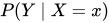
The distinction between these last two classes is not consistently made; Jebara (2004) refers to these three classes as generative learning, conditional learning, and discriminative learning, but Ng & Jordan (2002) only distinguish two classes, calling them generative classifiers (joint distribution) and discriminative classifiers (conditional distribution or no distribution), not distinguishing between the latter two classes. Analogously, a classifier based on a generative model is a generative classifier, while a classifier based on a discriminative model is a discriminative classifier, though this term also refers to classifiers that are not based on a model.
View the full Wikipedia page for Generative modelOutcome (probability) in the context of Binomial distribution
In probability theory and statistics, the binomial distribution with parameters n and p is the discrete probability distribution of the number of successes in a sequence of n independent experiments, each asking a yes–no question, and each with its own Boolean-valued outcome: success (with probability p) or failure (with probability q = 1 − p). A single success/failure experiment is also called a Bernoulli trial or Bernoulli experiment, and a sequence of outcomes is called a Bernoulli process. For a single trial, that is, when n = 1, the binomial distribution is a Bernoulli distribution. The binomial distribution is the basis for the binomial test of statistical significance.
The binomial distribution is frequently used to model the number of successes in a sample of size n drawn with replacement from a population of size N. If the sampling is carried out without replacement, the draws are not independent and so the resulting distribution is a hypergeometric distribution, not a binomial one. However, for N much larger than n, the binomial distribution remains a good approximation, and is widely used.
View the full Wikipedia page for Binomial distributionOutcome (probability) in the context of Elementary event
In probability theory, an elementary event, also called an atomic event or sample point, is an event which contains only a single outcome in the sample space. Using set theory terminology, an elementary event is a singleton. Elementary events and their corresponding outcomes are often written interchangeably for simplicity, as such an event corresponding to precisely one outcome.
The following are examples of elementary events:
View the full Wikipedia page for Elementary eventOutcome (probability) in the context of Complementary event
In probability theory, the complement of any event A is the event [not A], i.e. the event that A does not occur. The event A and its complement [not A] are mutually exclusive and exhaustive. Generally, there is only one event B such that A and B are both mutually exclusive and exhaustive; that event is the complement of A. The complement of an event A is usually denoted as A′, A, A or A. Given an event, the event and its complementary event define a Bernoulli trial: did the event occur or not?

For example, if a typical coin is tossed and one assumes that it cannot land on its edge, then it can either land showing "heads" or "tails." Because these two outcomes are mutually exclusive (i.e. the coin cannot simultaneously show both heads and tails) and collectively exhaustive (i.e. there are no other possible outcomes not represented between these two), they are therefore each other's complements. This means that [heads] is logically equivalent to [not tails], and [tails] is equivalent to [not heads].
View the full Wikipedia page for Complementary eventOutcome (probability) in the context of Bernoulli trial
In the theory of probability and statistics, a Bernoulli trial (or binomial trial) is a random experiment with exactly two possible outcomes, "success" and "failure", in which the probability of success is the same every time the experiment is conducted. It is named after Jacob Bernoulli, a 17th-century Swiss mathematician, who analyzed them in his Ars Conjectandi (1713).
The mathematical formalization and advanced formulation of the Bernoulli trial is known as the Bernoulli process.
View the full Wikipedia page for Bernoulli trialOutcome (probability) in the context of P-value
In null-hypothesis significance testing, the p-value is the probability of obtaining test results at least as extreme as the result actually observed, under the assumption that the null hypothesis is correct. A very small p-value means that such an extreme observed outcome would be very unlikely under the null hypothesis. Even though reporting p-values of statistical tests is common practice in academic publications of many quantitative fields, misinterpretation and misuse of p-values is widespread and has been a major topic in mathematics and metascience.
In 2016, the American Statistical Association (ASA) made a formal statement that "p-values do not measure the probability that the studied hypothesis is true, or the probability that the data were produced by random chance alone" and that "a p-value, or statistical significance, does not measure the size of an effect or the importance of a result" or "evidence regarding a model or hypothesis". That said, a 2019 task force by ASA has issued a statement on statistical significance and replicability, concluding with: "p-values and significance tests, when properly applied and interpreted, increase the rigor of the conclusions drawn from data".
View the full Wikipedia page for P-valueOutcome (probability) in the context of Organizational effectiveness
Organizational effectiveness is a concept used to assess how well an organization achieves its intended outcomes. It is utilized to improve organizational activities. The specifics that define organizational effectiveness are context dependent vary depending on the methods used to measure organizational performance. Multiple factors are considered when determining organizational effectiveness: these include talent management, leadership development, organization design and structure, systems for measuring performance, change management strategies, and smart technology integration.
View the full Wikipedia page for Organizational effectiveness