Ottoman conquest of Lesbos in the context of "Castle of Mytilene"

Play Trivia Questions online!

or

Skip to study material about Ottoman conquest of Lesbos in the context of "Castle of Mytilene"

Ad spacer

⭐ Core Definition: Ottoman conquest of Lesbos

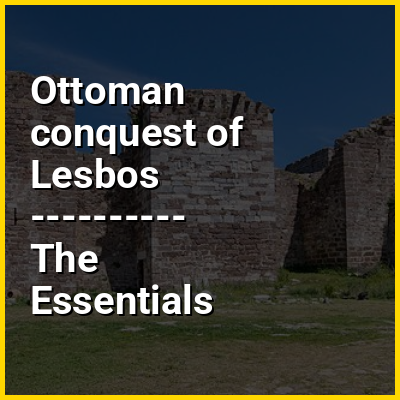
The Ottoman conquest of Lesbos took place in September 1462. The Ottoman Empire, under Sultan Mehmed II, laid siege to the island's capital, Mytilene. After its surrender, the other forts of the island surrendered as well. The event put an end to the semi-independent Genoese lordship that the Gattilusio family had established in the northeastern Aegean since the mid-14th century, and heralded the beginning of the First Ottoman–Venetian War in the following year.

In the mid-14th century, the Gattilusio family had established an autonomous lordship under Byzantine suzerainty on Lesbos. By 1453, the Gattilusio domains had come to include most of the islands in the northeastern Aegean. In the aftermath of the fall of the Byzantine Empire in 1453, however, Mehmed II began reducing the Gattilusio holdings. By the end of 1456, only Lesbos remained in Gattilusio hands, in exchange for an annual tribute to the Sultan. In 1458 Niccolò Gattilusio seized control of the island from his brother, and began preparing for an eventual Ottoman attack. Despite his appeals, however, no help was forthcoming from other Western powers. Mehmed II began his campaign against Lesbos in August 1462, and the Ottomans landed on the island on 1 September. After a few days of skirmishing, the Ottomans brought up their artillery and began bombarding the Castle of Mytilene. By the eighth day, the Ottomans had captured the harbour fortifications, and two days later, they seized the lower town of Melanoudion. At this point, panic set in among the defenders, and their will to continue resisting collapsed.
↓ Menu

>>>PUT SHARE BUTTONS HERE<<<
In this Dossier

Ottoman conquest of Lesbos in the context of Lesbos

Lesbos or Lesvos (Greek: Λέσβος, romanizedLésvos [ˈlezvos]) is a Greek island located in the northeastern Aegean Sea. It has an area of 1,633 km (631 sq mi), with approximately 400 kilometres (249 miles) of coastline, making it the third largest island in Greece and the eighth largest in the Mediterranean. It is separated from Asia Minor by the narrow Mytilini Strait. On the southeastern coast is the island's capital and largest city, Mytilene (Μυτιλήνη), whose name is also used for the island as a whole. Lesbos is a separate regional unit with the seat in Mytilene, which is also the capital of the larger North Aegean region. The region includes the islands of Lesbos, Chios, Ikaria, Lemnos, and Samos. The total population of the island was 83,755 in 2021. A third of the island's inhabitants live in the capital, while the remainder are concentrated in small towns and villages. The largest are Plomari, Agia Paraskevi, Polichnitos, Agiassos, Eresos, Gera, and Molyvos (the ancient Mythimna).

According to later Greek writers, Mytilene was founded in the 11th century BC by the family Penthilidae, who arrived from Thessaly and ruled the city-state until a popular revolt (590–580 BC) led by Pittacus of Mytilene ended their rule. In fact, the archaeological and linguistic records may indicate a late Iron Age arrival of Greek settlers, although references in Late Bronze Age Hittite archives indicate a likely Greek presence then. According to Homer's Iliad, Lesbos was part of the kingdom of Priam, which ruled from Troy. In the Middle Ages, it was under Byzantine and then Genoese rule. Lesbos was conquered by the Ottoman Empire in 1462. The Ottomans then ruled the island until the First Balkan War in 1912, when it became part of the Kingdom of Greece.

↑ Return to Menu