Otto Kandler in the context of "Photophosphorylation"

Play Trivia Questions online!

or

Skip to study material about Otto Kandler in the context of "Photophosphorylation"

Ad spacer

⭐ Core Definition: Otto Kandler

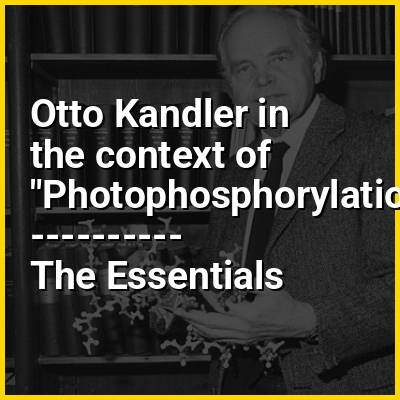
Otto Kandler (23 October 1920 in Deggendorf – 29 August 2017 in Munich, Bavaria) was a German botanist and microbiologist. Until his retirement in 1986 he was professor of botany at the Ludwig Maximilian University of Munich.

His most important research topics were photosynthesis, plant carbohydrate metabolism, analysis of the structure of bacterial cell walls (murein/peptidoglycan), the systematics of Lactobacillus, and the chemotaxonomy of plants and microorganisms.He presented the first experimental evidence for the existence of photophosphorylation in vivo. His discovery of the basic differences between the cell walls of bacteria and archaea (up to 1990 called "archaebacteria") convinced him that archaea represent an autonomous group of organisms distinct from bacteria. This was the basis for his cooperation with Carl Woese and made him the founder of research on the Archaea in Germany. In 1990, together with Woese, he proposed the three domains of life: Bacteria, Archaea, Eucarya. Finally, on the basis of his lifelong interest in the early evolution and diversification of life on this planet, Kandler presented his pre-cell theory, suggesting that the three domains of life did not emerge from an ancestral cell, e.g. the last universal common ancestor (LUCA), but from a population of pre-cells.
↓ Menu

>>>PUT SHARE BUTTONS HERE<<<
In this Dossier

Otto Kandler in the context of Three domains of life

The three-domain system is a taxonomic classification system that groups all cellular life into three domains, namely Archaea, Bacteria and Eukarya, introduced by Carl Woese, Otto Kandler and Mark Wheelis in 1990. The key difference from earlier classifications such as the two-empire system and the five-kingdom classification is the splitting of Archaea (previously named "archaebacteria") from Bacteria as completely different organisms.

The three domain hypothesis is considered obsolete by some who believe that eukaryotes do not form a separate domain of life, but arose from a fusion between an Archaea species and a Bacteria species. (see Two-domain system)

↑ Return to Menu

Otto Kandler in the context of Domain (biology)

In biological taxonomy, a domain (/dəˈmn/ or /dˈmn/) (Latin: regio or dominium), also dominion, superkingdom, realm, or empire, is the highest taxonomic rank of all organisms taken together. It was introduced in the three-domain system of taxonomy devised by Carl Woese, Otto Kandler and Mark Wheelis in 1990.

According to the domain system, the tree of life consists of either three domains, Archaea, Bacteria, and Eukarya, or two domains, Archaea and Bacteria, with Eukarya included in Archaea. In the three-domain model, the first two are prokaryotes, single-celled microorganisms without a membrane-bound nucleus. All organisms that have a cell nucleus and other membrane-bound organelles are included in Eukarya and called eukaryotes.

↑ Return to Menu

Otto Kandler in the context of Mark Wheelis

Mark L. Wheelis is an American microbiologist. Wheelis is currently a professor in the College of Biological Sciences, University of California, Davis. Carl Woese and Otto Kandler with Wheelis wrote the important paper Towards a natural system of organisms: proposal for the domains Archaea, Bacteria, and Eucarya that proposed a change from the Two-empire system of Prokaryotes and Eukaryotes to the Three-domain system of the domains Eukaryota, Bacteria and Archaea.

Wheelis's research interests include the history of biological warfare. He co-authored (with Larry Gonick) The Cartoon Guide to Genetics (1983). Wheelis provided the scientific knowledge and text, while Gonick contributed the illustrations and humor.

↑ Return to Menu