Oogamy is a type of sexual reproduction where the gametes differ greatly in both size and form. In oogamy in animals the large female gamete (also known as the ovum) is immotile, while the small male gamete (also known as a sperm) is mobile. Most sexually reproducing species – animals, land plants and some algae, are oogamous. It is generally accepted that isogamy is the ancestral state, from which oogamy evolved at least twenty times via anisogamy. Once oogamy evolves, males and females typically differ in various aspects. Internal fertilization may have originated from oogamy, although some studies suggest certain species may have evolved before the transition from external to internal fertilization. In streptophytes, oogamy occurred before the split from green algae.
>>>PUT SHARE BUTTONS HERE<<<
👉 Oogamous in the context of Egg cell
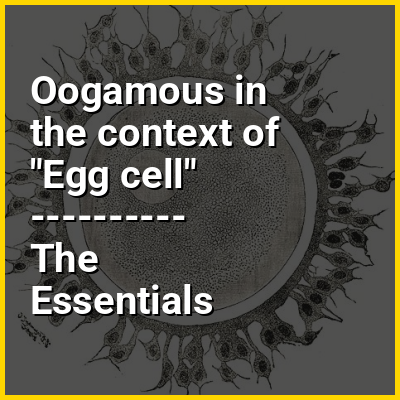
The egg cell or ovum (pl.: ova) is the female reproductive cell, or gamete, in most anisogamous organisms (organisms that reproduce sexually with a larger, female gamete and a smaller, male one). The term is used when the female gamete is not capable of movement (non-motile). If the male gamete (sperm) is capable of movement, the type of sexual reproduction is also classified as oogamous. A nonmotile female gamete formed in the oogonium of some algae, fungi, oomycetes, or bryophytes is an oosphere. When fertilized, the oosphere becomes the oospore.
When egg and sperm fuse together during fertilisation, a diploid cell (the zygote) is formed, which rapidly grows into a new organism.
In this Dossier