Omo River in the context of "Omotic languages"

Play Trivia Questions online!

or

Skip to study material about Omo River in the context of "Omotic languages"

Ad spacer

⭐ Core Definition: Omo River

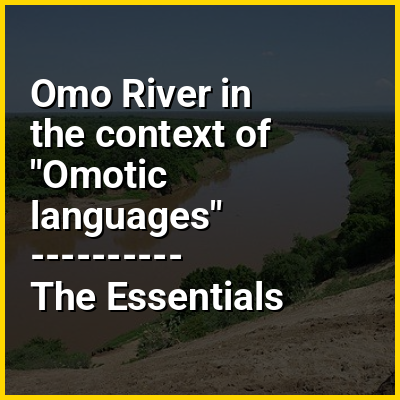
The Omo River (Amharic: ኦሞ ወንዝ, romanizedOmo Wenz; also called Omo-Bottego) in southern Ethiopia is the largest Ethiopian river outside the Nile Basin. Its course is entirely contained within the boundaries of Ethiopia, and it empties into Lake Turkana on the border with Kenya. The river is the principal stream of an endorheic drainage basin, the Turkana Basin.

The river basin is famous for its large number of early hominid fossils and archeological findings such as early stone tools, leading to its inclusion on the UNESCO World Heritage List in 1980.

↓ Menu

>>>PUT SHARE BUTTONS HERE<<<

👉 Omo River in the context of Omotic languages

The Omotic languages are a traditionally recognized but disputed grouping of languages spoken mainly in southwestern Ethiopia, around the Omo River region, and in parts of southeastern Sudan (Blue Nile State). This classification conventionally includes the Damotic (North Omotic), Mao, Dizoid, and Aroid (South Omotic) languages.

Some of these languages are written in the Geʽez script, while others use the Latin alphabet. They are generally agglutinative and exhibit complex tonal systems, as in the Bench language. The group comprises about 7.9 million speakers.

↓ Explore More Topics
In this Dossier

Omo River in the context of Karo language (Ethiopia)

Karo (also Cherre, Kere, Kerre, Kara) is a South Omotic language spoken in the Debub (South) Omo Zone of the Southern Nations, Nationalities, and People's Region in Ethiopia. Karo is described as being closely related to its neighbor, Hamer-Banna, with a lexical similarity of 81%, and is considered a dialect of Hamer by Blench (2006), but as a separate language belonging to the Hamer-Karo subfamily in Glottolog. The Karo people, who live close to the lower Omo River, use colorful bodywork, complex headdresses and body scars to express beauty and importance within the community. 2,400 speakers are using the Karo language.

↑ Return to Menu

Omo River in the context of Banna people

The Banna people, also Banya, are an Omotic ethnic group in Ethiopia that inhabit the Lower Omo Valley, primarily between the Weyto and Omo rivers. They live in an area between the towns of Gazer and Dimeka, with the traditional area of the Banna being divided into two ritual regions: Ailama (around Gazer) and Anno (spanning from Benata to Dimeka). According to the 2007 census, they number at around 47,000 individuals. They engage primarily in agriculture and supplement this by pastoralism, hunting, and gathering. They are mainly traditionalists, however, a significant share are Christians, and they have their own king.

Most Banna are speakers of the Banna variety of the Hamar-Banna language (a member of the putative Southern branch of the Omotic languages), although some also speak the related Aari language in and around Mokocha and Chali. Some Banna claim only slight difficulty when communicating with speakers of the Hamar and Bashada varieties of the same language, and despite their linguistic proximity there is a clear virtual border to the Banna between themselves and the neighboring Hamar in specific.
↑ Return to Menu