Old Nubian (also called Middle Nubian or Old Nobiin) is an extinct Nubian language, attested in writing from the 8th to the 15th century AD. It is ancestral to modern-day Nobiin and closely related to Dongolawi and Kenzi. It was used throughout the kingdom of Makuria, including the eparchy of Nobatia. The language is preserved in more than a hundred pages of documents and inscriptions, both of a religious nature (homilies, prayers, hagiographies, psalms, lectionaries), and related to the state and private life (legal documents, letters), written using adaptation of the Coptic alphabet.
>>>PUT SHARE BUTTONS HERE<<<
👉 Old Nubian in the context of Faras
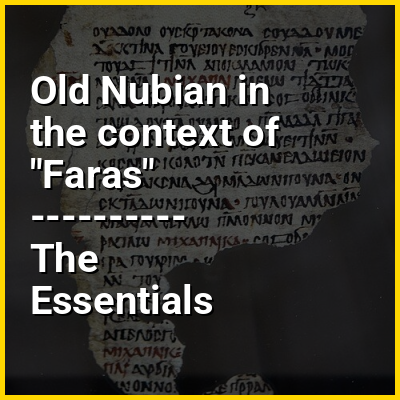
Faras (formerly Ancient Greek: Παχώρας, Pakhôras; Latin: Pachoras; Old Nubian: Ⲡⲁⲭⲱⲣⲁⲥ, Pakhoras) was a major city in Lower Nubia. The site of the city, on the border between modern Egypt and Sudan at Wadi Halfa Salient, was flooded by Lake Nasser in the 1960s and is now permanently underwater. Before this flooding, extensive archaeological work was conducted by a Polish archaeological team led by professor Kazimierz Michałowski.
In this Dossier
Old Nubian in the context of Makuria
Makuria (Old Nubian: ⲇⲱⲧⲁⲩⲟ, Dotawo; Greek: Μακουρία, romanized: Makouria; Arabic: المقرة, romanized: al-Muqurra) was a medieval Nubian kingdom in what is today northern Sudan and southern Egypt. Its capital was Dongola (Old Nubian: Tungul) in the fertile Dongola Reach, and the kingdom is sometimes known by the name of its capital.
Coming into being after the collapse of the Kingdom of Kush in the 4th century, it originally covered the Nile Valley from the 3rd cataract to somewhere south of Abu Hamed at Mograt Island. The capital of Dongola was founded around 500 and soon after, in the mid-6th century, Makuria converted to Christianity. Probably in the early 7th century Makuria annexed its northern neighbour Nobatia, now sharing a border with Byzantine Egypt.
Old Nubian in the context of Old Dongola
Old Dongola (Old Nubian: ⲧⲩⲛⲅⲩⲗ, Tungul; Arabic: دنقلا العجوز, Dunqulā al-ʿAjūz) is a deserted Nubian town in what is now Northern State, Sudan, located on the east bank of the Nile opposite the Wadi Howar. An important city in medieval Nubia, and the departure point for caravans west to Darfur and Kordofan, from the fourth to the fourteenth century Old Dongola was the capital of the Makurian state. A Polish archaeological team has been excavating the town since 1964.
The urban center of the population moved downstream 80 km (50 miles) to the opposite side of the Nile during the nineteenth century, becoming the modern Dongola.
Old Nubian in the context of Meroitic alphabet
The Meroitic script consists of two alphasyllabic scripts developed to write the Meroitic language at the beginning of the Meroitic Period (3rd century BC) of the Kingdom of Kush. The two scripts are Meroitic Cursive, derived from Demotic Egyptian, and Meroitic Hieroglyphs, derived from Egyptian hieroglyphs. Meroitic Cursive is the most widely attested script, constituting ~90% of all inscriptions, and antedates, by a century or more, the earliest surviving Meroitic hieroglyphic inscription. Greek historian Diodorus Siculus (ca. 50 BC) described the two scripts in his Bibliotheca historica, Book III (Africa), Chapter 4. The last known Meroitic inscription is the Meroitic Cursive inscription of the Blemmye king, Kharamadoye, from a column in the Temple of Kalabsha (REM 0094), which has recently been re-dated to AD 410/ 450 of the 5th century. Before the Meroitic Period, Egyptian hieroglyphs were used to write Kushite names and lexical items.
Though the Kingdom of Kush ended with the fall of the royal capital of Meroë, use of the language and Cursive script continued for a time after that event. During the 6th century Christianization of Nubia, the Kushite language and Cursive script were replaced by Byzantine Greek, Coptic, and Old Nubian. The Old Nubian script, derived from the Uncial Greek script, added three Meroitic Cursive letters: ⟨ne⟩, ⟨w(a)⟩, and possibly ⟨kh(a)⟩, for Old Nubian [ɲ], [w – u], and [ŋ] respectively. This addition of Meroitic Cursive letters suggests that the development of the Old Nubian script began at least two centuries before its first full attestation in the late 8th century and/or that knowledge of the Kushite language and script was retained until the 8th century.
Old Nubian in the context of Agilkia Island
Agilkia Island (also called Agilika; Arabic: أجيليكا, from Old Nubian: ⲁ̅ⲅⲗ̅, romanised: agil, "mouth") is an island in the reservoir of the Old Aswan Dam along the Nile River in southern Egypt; it is the present site of the relocated ancient Egyptian temple complex of Philae. Partially to completely flooded by the old dam's construction in 1902, the Philae complex was dismantled and relocated to Agilkia island, as part of a wider UNESCO project related to the 1960s construction of the Aswan High Dam and the eventual flooding of many sites posed by its large reservoir upstream. To allow Agilkia island to accommodate the relocated temple, the island was leveled to match the old contours of Philae island as best as possible, which required the removal of the top of the island.
Agilkia, like the island, was the name chosen for the planned landing site on a comet by the Rosetta spacecraft mission's Philae lander. Upon initial touchdown, however, the lander took a large bounce followed by a smaller one before finally coming to rest perhaps a kilometre away from Agilkia, at a site named Abydos, after the ancient Egyptian city.
Old Nubian in the context of Qasr Ibrim
Qasr Ibrim (Arabic: قصر ابريم; Meroitic: Pedeme; Old Nubian: Silimi; Coptic: ⲡⲣⲓⲙ Prim; Latin: Primis) is an archaeological site in Lower Nubia, located in the modern country of Egypt. The site has a long history of occupation, ranging from as early as the eighth century BC to AD 1813, and was an economic, political, and religious center. Originally it was a major city perched on a cliff above the Nile, but the flooding of Lake Nasser after the construction of the Aswan High Dam – with the related International Campaign to Save the Monuments of Nubia – transformed it into an island and flooded its outskirts. Qasr Ibrim is the only major archaeological site in Lower Nubia to have survived the Aswan Dam floods. Both prior to and after the floods, it has remained a major site for archaeological investigations.