Nuu-chah-nulth language in the context of "Maquinna"

Play Trivia Questions online!

or

Skip to study material about Nuu-chah-nulth language in the context of "Maquinna"

Ad spacer

⭐ Core Definition: Nuu-chah-nulth language

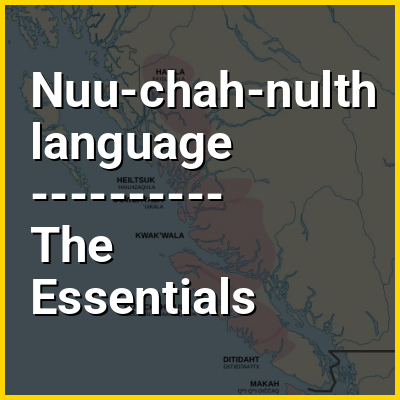
Nuu-chah-nulth (nuučaan̓uɫ), a.k.a. Nootka (/ˈntkə/), is a Wakashan language in the Pacific Northwest of North America on the west coast of Vancouver Island, from Barkley Sound to Quatsino Sound in British Columbia by the Nuu-chah-nulth peoples. Nuu-chah-nulth is a Southern Wakashan language related to Nitinaht and Makah.

It is the first language of the indigenous peoples of the Pacific Northwest Coast to have documentary written materials describing it. In the 1780s, Captains Vancouver, Quadra, and other European explorers and traders frequented Nootka Sound and the other Nuu-chah-nulth communities, making reports of their voyages. From 1803 to 1805 John R. Jewitt, an English blacksmith, was held captive by chief Maquinna at Nootka Sound. He made an effort to learn the language, and in 1815 published a memoir with a brief glossary of its terms.
↓ Menu

>>>PUT SHARE BUTTONS HERE<<<

👉 Nuu-chah-nulth language in the context of Maquinna

Maquinna (also transliterated Muquinna, Macuina, Maquilla from m̓ukʷina in Nuu-chah-nulth) was the chief of the Nuu-chah-nulth people of Nootka Sound, during the heyday of the maritime fur trade in the 1780s and 1790s on the Pacific Northwest Coast. The name means "possessor of pebbles". His people are today known as the Mowachaht and reside today with their kin, the Muchalaht, at Gold River, British Columbia, Canada.

↓ Explore More Topics
In this Dossier

Nuu-chah-nulth language in the context of Unicase

A unicase or unicameral alphabet is a writing script that has no separate cases for its letters. Semitic abjads such as Hebrew and Arabic, Brahmic scripts such as Devanagari, Tamil and Thai, Chinese characters, Hangul and the Iberian and Georgian scripts are unicase writing systems, while scripts like Latin, Greek, Cyrillic and Armenian are bicameral, as they have two cases for each letter, e.g. B and b, Б and б, Β and β, or Բ and բ. Individual characters can also be called unicameral if they are used as letters with a generally bicameral alphabet but have only one form for both cases; for example, the ʻokina as used in Polynesian languages and the glottal stop as used in Nuu-chah-nulth are unicameral.

Most modern writing systems originated as unicase orthographies. The Latin script originally had only majuscule forms directly derived from the Greek alphabet, which were originally viable for being chiseled into stone. At the same time, everyday writing was carried out in a cursive variant of the block capitals, which during the Middle Ages evolved into new letterforms for use in running text that were more legible and faster to write with an ink pen, such as Carolingian minuscule. Originally, use of the two forms was mutually exclusive, but it became a common compromise to use both in tandem, which ultimately had additional benefits in areas such as legibility. The later minuscule became the "lowercase" forms, while the original majuscule became the "uppercase" forms.

↑ Return to Menu

Nuu-chah-nulth language in the context of Nuu-chah-nulth

The Nuu-chah-nulth (/nˈɑːnʊlθ/ noo-CHAH-nuulth; Nuu-chah-nulth: Nuučaan̓ułʔatḥ [nuːt͡ʃaːnˀuɬʔatħ]), also formerly referred to as the Nootka, Nutka, Aht, Nuuchahnulth or Tahkaht, are one of the Indigenous peoples of the Pacific Northwest Coast in Canada. The term Nuu-chah-nulth is used to describe fifteen related tribes whose traditional home is on the west coast of Vancouver Island.

In precontact and early post-contact times, the number of tribes was much greater, but the smallpox epidemics and other consequences of contact with Europeans resulted in the disappearance of some groups and the absorption of others into neighbouring groups. The Nuu-chah-nulth are related to the Kwakwaka'wakw, the Haisla, and the Ditidaht First Nation. The Nuu-chah-nulth language belongs to the Wakashan family.

↑ Return to Menu

Nuu-chah-nulth language in the context of Nitinaht language

Ditidaht [dee-tee-dot] (also Nitinaht, Nitinat, Southern Nootkan) or diitiidʔaaʔtx̣ is a South Wakashan (Nootkan) language spoken on the southern part of Vancouver Island. Nitinaht is related to the other South Wakashan languages, Makah and the neighboring Nuu-chah-nulth.

↑ Return to Menu

Nuu-chah-nulth language in the context of Makah language

The Makah language is the indigenous language spoken by the Makah. Makah has not been spoken as a first language since 2002, when its last fluent native speaker died. However, it survives as a second language, and the Makah tribe is attempting to revive the language, including through preschool classes. The endonym for the Makah is qʷi·qʷi·diččaq.

The Makah reside in the northwestern corner of the Olympic Peninsula of Washington on the south side of the Strait of Juan de Fuca. It is closely related to Nuu-chah-nulth and Ditidaht, which are languages of the First Nations of the west coast of Vancouver Island on the north side of the strait, in the Canadian province of British Columbia. Makah is the only member of the Wakashan language family in the United States, with the other members spoken in British Columbia, from Vancouver Island to the Central Coast region.

↑ Return to Menu