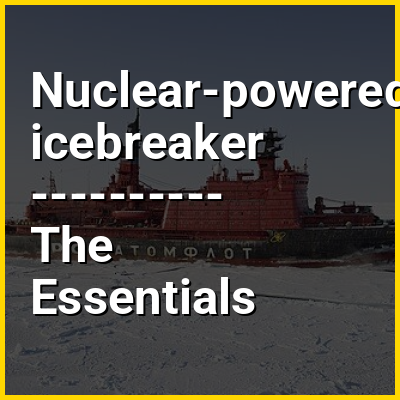
A nuclear-powered icebreaker is an icebreaker with an onboard nuclear power plant that produces power for the vessel's propulsion system. Although more expensive to operate, nuclear-powered icebreakers provide a number of advantages over their diesel-powered counterparts, especially along the Northern Sea Route where diesel-powered icebreaker operations are challenging due to the heavy power demand associated with icebreaking, limited refueling infrastructure along the Siberian coast, and the endurance required. As of 2025, Russia is the only country that builds and operates nuclear-powered icebreakers, having built a number of such vessels to aid shipping along the Northern Sea Route and Russian arctic outposts since the Soviet era.
HINT:
👉 Nuclear-powered icebreaker in the context of Arktika-class icebreaker
The Arktika class is a Russian (formerly Soviet) class of nuclear-powered icebreakers. Also known by their Russian designations Project 10520 (first two ships) and Project 10521 (from third ship onwards), they were the world's largest and most powerful icebreakers until the 2016 launch of the first Project 22220 icebreaker, also named Arktika.
Ships of the Arktika class are owned by the federal government, but were operated by the Murmansk Shipping Company (MSCO) until 2008, when they were transferred to the fully state-owned corporation Atomflot. Of the ten civilian nuclear-powered vessels built by Russia or the Soviet Union, six were of this type.
In this Dossier
- ⭐ Core Definition: Nuclear-powered icebreaker
- 👉 Nuclear-powered icebreaker in the context of Arktika-class icebreaker
- Nuclear-powered icebreaker in the context of Marine propulsion
- Nuclear-powered icebreaker in the context of 50 Let Pobedy
- Nuclear-powered icebreaker in the context of Yamal (icebreaker)
Nuclear-powered icebreaker in the context of Marine propulsion
Marine propulsion is the mechanism or system used to generate thrust to move a watercraft through water. While paddles and sails are still used on some smaller boats, most modern ships are propelled by mechanical systems consisting of an electric motor or internal combustion engine driving a propeller, or less frequently, in pump-jets, an impeller. Marine engineering is the discipline concerned with the engineering design process of marine propulsion systems.
Human-powered paddles and oars, and later, sails were the first forms of marine propulsion. Rowed galleys, some equipped with sail, played an important early role in early human seafaring and warfare. The first advanced mechanical means of marine propulsion was the marine steam engine, introduced in the early 19th century. During the 20th century it was replaced by two-stroke or four-stroke diesel engines, outboard motors, and gas turbine engines on faster ships. Marine nuclear reactors, which appeared in the 1950s, produce steam to propel warships and icebreakers; commercial application, attempted late that decade, failed to catch on. Electric motors using battery packs have been used for propulsion on submarines and electric boats and have been proposed for energy-efficient propulsion.
View the full Wikipedia page for Marine propulsionNuclear-powered icebreaker in the context of 50 Let Pobedy
50 Let Pobedy (Russian: 50 лет Победы; "50 Years of Victory", referring to the anniversary of victory of the Soviet Union in World War II) is a Russian Arktika-class nuclear-powered icebreaker. The ship was laid down in the Soviet Union in 1989, and construction was halted by the Russian government in 1994 following the dissolution of the Soviet Union. Construction was restarted in 2003 and completed in 2007.
View the full Wikipedia page for 50 Let PobedyNuclear-powered icebreaker in the context of Yamal (icebreaker)
Yamal (Russian: Ямал) is a Russian Arktika-class nuclear-powered icebreaker operated by Atomflot (formerly by the Murmansk Shipping Company). She is named after the Yamal Peninsula in Northwest Siberia; the name means End of the Land in Nenets.
Laid down in Leningrad in 1986, and commissioned in October 1992, after the breakup of the Soviet Union, she filled her designed role of keeping shipping lanes open and also carried passengers on Arctic excursions. In July 1994 Yamal took an excursion to the North Pole, with the NSF (National Science Foundation – US), to celebrate the official maiden voyage. While at the exact North Pole (verified by GPS & Inmarsat satellite coordinates) the crew and passengers celebrated with a barbeque – the ambient temperature was −23 °C (−9 °F) (wind gusts were measured at −40 °C (−40 °F)). Because of the ship 90/90 coordinates the ship captain (Smirnov) organized a swimming party with Will Rountree (US) being recorded as the first person to ever swim there (21 July 1994) – water temperature was below freezing, ranging from 0 to −1.8 °C (32 to 29 °F). In 2007 Lewis Gordon Pugh swam a kilometer at the North Pole, having sailed there aboard Yamal.
View the full Wikipedia page for Yamal (icebreaker)