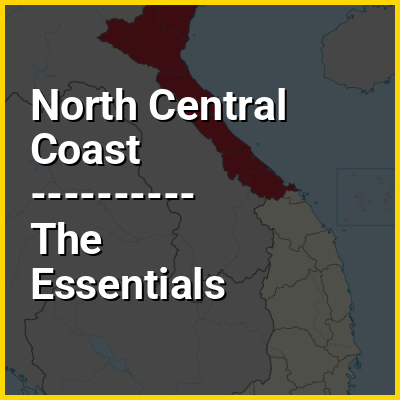
Bắc Trung Bộ (literally North Central Region, and often translated as North Central Coast) is one of the geographic regions of Vietnam. It consists of six provinces in northern part of Central Vietnam: Thanh Hóa, Nghệ An, Hà Tĩnh, Quảng Bình, Quảng Trị, Huế. The last two provinces were the northernmost provinces of State of Vietnam and South Vietnam until Reunification of Vietnam in 1976. In the Nguyễn dynasty, this area (except Thừa Thiên) was known as Hữu Trực Kỳ (the area located in the left of Thừa Thiên).
HINT:
👉 North Central Coast in the context of Chứt people
The Chut (Vietnamese: Người Chứt, Rục language: Cheut /rocky mountain) are a small ethnic group located in the Minh Hóa and Tuyên Hóa districts of Quảng Bình Province, in Vietnam's North Central Coast.
Chut is not a distinct group but a collective name for five different Vietic-speaking groups in Quảng Bình, namely the Arem, the Rục, the Maliêng/Mã Liêng, the Mày, and the Sách. In 1973, Vietnamese researchers decided to group these peoples into a new crafted ethnic group called Chứt. In accordance with the Resolution of the General Statistics Office of Vietnam, #121/TCTK/PPCD of March 2, 1979 List of ethnic groups in Vietnam, the Chut ethnonym was recognized at the state level as the common name for five groups (Arem, Mã Liêng, Mày, Rục, and Sách).
In this Dossier
- ⭐ Core Definition: North Central Coast
- 👉 North Central Coast in the context of Chứt people
- North Central Coast in the context of Regions of Vietnam
- North Central Coast in the context of Huế
- North Central Coast in the context of Cồn Cỏ special administrative region
- North Central Coast in the context of Gianh River
- North Central Coast in the context of Son River (Vietnam)
- North Central Coast in the context of Quảng Trị province
- North Central Coast in the context of Quảng Bình province
North Central Coast in the context of Regions of Vietnam
The Vietnamese government often groups the various provinces and municipalities into three regions: Northern Vietnam, Central Vietnam, and Southern Vietnam. These regions can be further subdivided into eight subregions: Northeast Vietnam, Northwest Vietnam, the Red River Delta, the North Central Coast, the South Central Coast, the Central Highlands, Southeast Vietnam, and the Mekong River Delta. These regions are not always used, and alternative classifications are possible. Other classifications used can be: Northern, Central, Southern, and Mekong.
View the full Wikipedia page for Regions of VietnamNorth Central Coast in the context of Huế
Huế, formerly Thừa Thiên Huế province, is the southernmost coastal city in the North Central Coast region, approximately in the center of the country, and an educational, medical, scientific, and cultural hub of Vietnam. It borders Quảng Trị to the north, Đà Nẵng to the south, Salavan and Sekong of Laos to the west and the South China Sea to the east. As one of the country's six direct-controlled municipalities, it falls under the administration of the central government.
Huế has 128 km of coastline, 22,000 ha of lagoons and over 200,000 ha of forest. The city is located in the middle of the North Central and South Central regions (including the South Central Coast and Central Highlands), and is transitional in many aspects: geology, climate, administrative division and local culture.
View the full Wikipedia page for HuếNorth Central Coast in the context of Cồn Cỏ special administrative region
Cồn Cỏ ( ; also known as Tigris Insula in the maritime terminology) is a special administrative region of Quảng Trị province in the North Central Coast region of Vietnam.
View the full Wikipedia page for Cồn Cỏ special administrative regionNorth Central Coast in the context of Gianh River
The Gianh River (vernacular Vietnamese: sông Gianh, also known as Gianh giang; Sino-Vietnamese: Linh Giang 靈江) is a river in the Quảng Bình province of Vietnam's North Central Coast (Bắc Trung Bộ). The river is 268 kilometres (167 mi) in length.
The Gianh–Son River served as the boundary between Đàng Ngoài and Đàng Trong, ruled by rival families, during the partition of Vietnam in the 17th and 18th centuries following the Trịnh–Nguyễn War. The 17th parallel, used as the border between North Vietnam and South Vietnam from 1954 to 1975, was located just south of the Gianh River, at the Bến Hải River in Quảng Trị province.
View the full Wikipedia page for Gianh RiverNorth Central Coast in the context of Son River (Vietnam)
Son River or Troc River (Vietnamese: Sông Son or sông Tróc) (lit. Lipstick River, because its water is red in flooding season) is a tributary of Gianh River in Quảng Bình Province, North Central Coast region, Vietnam. This river runs in the territory of Quảng Bình Province. The upstream of this river with the length of 7729 m runs underground in limestone mountains of Phong Nha-Kẻ Bàng National Park. Son River makes confluence with Gianh River near Ba Đồn town of Quảng Trạch District before emptying into South China Sea.
View the full Wikipedia page for Son River (Vietnam)North Central Coast in the context of Quảng Trị province
Quảng Trị (Vietnamese pronunciation: [kʷâŋ ʈ͡ʂîˀ]) is a coastal province near the southernmost part of the North Central Coast region, the Central of Vietnam. It borders Huế to the south, Savannakhet of Laos to the west and the South China Sea to the east, with 75 kilometres (47 mi) of coast. On June 12, 2025, Quảng Bình province was merged into Quảng Trị.
View the full Wikipedia page for Quảng Trị provinceNorth Central Coast in the context of Quảng Bình province
Quảng Bình was formerly a southern coastal province in the North Central Coast region, the Central of Vietnam. It borders Hà Tĩnh to the north, Quảng Trị to the south, Khammouane of Laos to the west and the Gulf of Tonkin (South China Sea) to the east.
On June 12, 2025, Quảng Bình was merged into Quảng Trị.
View the full Wikipedia page for Quảng Bình province