Central Vietnam in the context of "Regions of Vietnam"

Play Trivia Questions online!

or

Skip to study material about Central Vietnam in the context of "Regions of Vietnam"

Ad spacer

⭐ Core Definition: Central Vietnam

Central Vietnam (Vietnamese: Trung Bộ or miền Trung), also known as Middle Vietnam or The Middle, formerly known as Trung Việt by the State of Vietnam, Trung Phần by the Republic of Vietnam, Trung Kỳ or Annam under French colonial rule, is one of the three geographical regions within Vietnam.

The name Trung Bộ was used by the emperor Bảo Đại when he established administrative level higher than Province in 1945, instead of the Trung Kỳ which recalled the French occupation. This name was officially used by government of the Democratic Republic of Vietnam and is popularly used today.

↓ Menu

>>>PUT SHARE BUTTONS HERE<<<

👉 Central Vietnam in the context of Regions of Vietnam

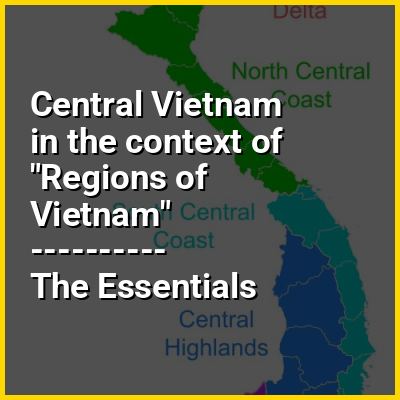
The Vietnamese government often groups the various provinces and municipalities into three regions: Northern Vietnam, Central Vietnam, and Southern Vietnam. These regions can be further subdivided into eight subregions: Northeast Vietnam, Northwest Vietnam, the Red River Delta, the North Central Coast, the South Central Coast, the Central Highlands, Southeast Vietnam, and the Mekong River Delta. These regions are not always used, and alternative classifications are possible. Other classifications used can be: Northern, Central, Southern, and Mekong.

↓ Explore More Topics
In this Dossier

Central Vietnam in the context of Annam (French protectorate)

Annam (chữ Hán: 安南; alternate spelling: Anam), or Trung Kỳ (中圻), was a French protectorate encompassing what is now Central Vietnam from 1883 to 1949. Like the French protectorate of Tonkin, it was nominally ruled by the Vietnamese Nguyễn dynasty. Before the protectorate's establishment, the name Annam was used in the West to refer to Vietnam as a whole; Vietnamese people were referred to as Annamites. The protectorate of Annam became a part of French Indochina in 1887. The region had a dual system of French and Vietnamese administration. The government of the Nguyễn Dynasty still nominally ruled Annam and Tonkin as the Empire of Đại Nam, with the emperor residing in Huế. On 23 May 1948, the protectorate was partly merged in the Provisional Central Government of Vietnam, which was replaced the next year by the newly established State of Vietnam. The French legally maintained the protectorate until they formally signed over sovereignty to the Bảo Đại and the government of the State of Vietnam in 1950 after the Élysée Accords took over in June 1949. The region was divided between communist North Vietnam and anti-communist South Vietnam under the terms of the Geneva Accord of 1954.

↑ Return to Menu

Central Vietnam in the context of Vietnam under Chinese rule

Vietnam under Chinese rule or Bắc thuộc (北屬 lit. "belonging to the north") (111 BCE–939 CE, 1407–1428 CE) refers to four historical periods during which several portions of modern-day northern and central Vietnam were governed by successive Chinese dynasties. Vietnamese historiography traditionally dates the beginning of this period to 111 BCE, when the Han dynasty annexed Nanyue (Vietnamese: Nam Việt). Chinese control continued in various forms until 939 CE, when the Ngô dynasty was established, marking the end of what is usually referred to as the main phase of Chinese rule. A later period of occupation by the Ming dynasty from 1407 to 1428 is often treated as a distinct episode. Notably, parts of Vietnam were under Chinese rule for longer than several territories that now form the modern provinces of China, underlining the longevity and depth of Chinese influence in the region over many centuries.

The historiography of this period has become a subject of scholarly debate, particularly concerning how national and cultural identities have been retroactively applied. Historians such as Catherine Churchman, Jaymin Kim, and Keith W. Taylor argue that many narratives about Bắc thuộc are shaped by modern constructs, often influenced by nationalist or anti-colonial sentiment. These scholars emphasise that the idea of an unbroken narrative of resistance or subjugation simplifies a more complex historical relationship, which included periods of accommodation, syncretism and local autonomy. Recent research critiques the use of this history as a tool for contemporary nationalist and irredentist projects in Vietnam, China and elsewhere.
↑ Return to Menu

Central Vietnam in the context of Champa

Champa (Cham: ꨌꩌꨛꨩ, چمڤا; Khmer: ចាម្ប៉ា; Vietnamese: Chiêm Thành 占城 or Chiêm Bà 占婆; modern Vietnamese Chăm Pa) was a collection of independent Cham polities that extended across the coast of what is present-day central and southern Vietnam from approximately the 2nd century AD until 1832.

According to earliest historical references found in ancient sources, the first Cham polities were established around the 2nd to 3rd centuries AD, in the wake of Khu Liên's rebellion against the rule of China's Eastern Han dynasty, and lasted until when the final remaining principality of Champa was annexed by Emperor Minh Mạng of the Vietnamese Nguyễn dynasty as part of the expansionist Nam tiến policy. The kingdom was known variously as Nagaracampa (Sanskrit: नगरचम्प), Champa (ꨌꩌꨛꨩ) in modern Cham, and Châmpa (ចាម្ប៉ា) in the Khmer inscriptions, Chiêm Thành in Vietnamese, Campa in Malay, Zhànchéng (Mandarin: 占城) in Chinese records, and al-Ṣanf (Arabic: صَنْف) in Middle Eastern Muslim records.

↑ Return to Menu

Central Vietnam in the context of Southern Vietnam

Southern Vietnam (Vietnamese: Nam Bộ) is one of the three geographical regions of Vietnam, the other two being Northern and Central Vietnam. It includes 2 administrative subregions, which in turn are divided into 19 First Tier units, of which 17 are provinces and 2 are municipalities.

Known as Nam Bộ today in Vietnamese, it was historically called Gia Định (1779–1832), Nam Kỳ (1832–1945, during Nguyễn's Lục tỉnh and French Cochinchina), Nam Bộ (1945 to the present, encompassing the Empire of Vietnam and the Democratic Republic of Vietnam), and Nam Phần, sometimes Nam Việt (1948–1975, during the State of Vietnam and the Republic of Vietnam). Cochinchina is a historical exonym for this region during the colonial period, which referred to the entire domain of Đàng Trong in the feudal period. A more accurate term for the southern region is Lower Cochinchina, or Basse-Cochinchine in French.

↑ Return to Menu

Central Vietnam in the context of Central Highlands (Vietnam)

The Central Highlands (Vietnamese: Cao nguyên Trung phần), South Central Highlands (Vietnamese: Cao nguyên Nam Trung Bộ), Western Highlands (Vietnamese: Tây Nguyên) or Midland Highlands (Vietnamese: Cao nguyên Trung bộ) was a former region located in the south central part of Vietnam. It did contain parts of the provinces of Đắk Lắk, Gia Lai, Quảng Ngãi, and Lâm Đồng. On June 12 2025 the region merged with South Central Coast

↑ Return to Menu

Central Vietnam in the context of Xisha Islands

The Paracel Islands, also known as the Xisha Islands (simplified Chinese: 西沙群岛; traditional Chinese: 西沙群島; pinyin: xīshā qúndǎo; lit. 'West Sand Archipelago') and the Hoàng Sa Archipelago (Vietnamese: Quần đảo Hoàng Sa; Chữ Hán: 羣島黃沙, lit.'Yellow Sand Archipelago'), is a disputed archipelago in the South China Sea and currently controlled by the People's Republic of China.

The word paracel is of Portuguese origin, meaning placer (a submerged bank or reef), and appears on 16th-century Portuguese maps. The archipelago includes about 130 small coral islands and reefs, most grouped into the northeastern Amphitrite Group or the western Crescent Group. They are distributed over a maritime area of around 15,000 square kilometers (5,800 sq mi), with a land area of approximately 7.75 square kilometers (2.99 sq mi). The archipelago is located about 220 miles (350 km) southeast of Hainan Island, equidistant from the coastlines of the People's Republic of China (PRC) and Vietnam, and approximately one-third of the way between central Vietnam and the northern Philippines. A feature of the Paracel Islands is Dragon Hole, the second deepest blue hole (underwater sinkhole) in the world. Sea turtles and seabirds are native to the islands, which have a hot and humid climate, abundant rainfall and may experience annual typhoons. The archipelago is surrounded by productive fishing grounds and a seabed potentially containing unexplored oil and gas reserves.

↑ Return to Menu

Central Vietnam in the context of Chams

The Chams (Cham: ꨌꩌ, چام, cam), or Champa people (Cham: ꨂꨣꩃ ꨌꩌꨛꨩ, اوراڠ چمڤا, Urang Campa; Vietnamese: Người Chăm or Người Chàm; Khmer: ជនជាតិចាម, Chônchéatĕ Cham), are an Austronesian ethnic group in Southeast Asia and are the original inhabitants of central Vietnam and coastal Cambodia before the arrival of the Cambodians and Vietnamese, during the expansion of the Khmer Empire (802–1431) and the Vietnamese conquest of Champa (11th–19th century).

From the 2nd century, the Chams founded Champa, a collection of independent Hindu-Buddhist principalities in what is now central and southern Vietnam. By the 17th century, Champa became an Islamic sultanate. Today, the Cham people are largely Muslim, with a minority following Hinduism, both formed the indigenous Muslim and Hindu population in both Cambodia and Vietnam. Despite their adherence to Islam, the Cham people still retain their ancestral practice of matriarchy in family and inheritance.

↑ Return to Menu