Niobium in the context of "Tantalus"

Play Trivia Questions online!

or

Skip to study material about Niobium in the context of "Tantalus"


⭐ Core Definition: Niobium

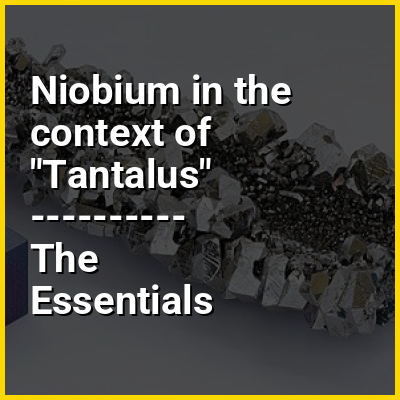
Niobium is a chemical element; it has symbol Nb (formerly columbium, Cb) and atomic number 41. It is a light grey, crystalline, and ductile transition metal. Pure niobium has a Mohs hardness rating similar to pure titanium, and it has similar ductility to iron. Niobium oxidizes in Earth's atmosphere very slowly, hence its application in jewelry as a hypoallergenic alternative to nickel. Niobium is often found in the minerals pyrochlore and columbite. Its name comes from Greek mythology: Niobe, daughter of Tantalus, the namesake of tantalum. The name reflects the great similarity between the two elements in their physical and chemical properties, which makes them difficult to distinguish.

English chemist Charles Hatchett reported a new element similar to tantalum in 1801 and named it columbium. In 1809, English chemist William Hyde Wollaston wrongly concluded that tantalum and columbium were identical. German chemist Heinrich Rose determined in 1846 that tantalum ores contain a second element, which he named niobium. In 1864 and 1865, a series of scientific findings clarified that niobium and columbium were the same element (as distinguished from tantalum), and for a century both names were used interchangeably. Niobium was officially adopted as the name of the element in 1949, but the name columbium remains in current use in metallurgy in the United States.
↓ Menu

In this Dossier

Niobium in the context of Native metal

A native metal is any metal that is found pure in its metallic form in nature. Metals that can be found as native deposits singly or in alloys include antimony, arsenic, bismuth, cadmium, chromium, cobalt, indium, iron, manganese, molybdenum, nickel, niobium, rhenium, tantalum, tellurium, tin, titanium, tungsten, vanadium, and zinc, as well as the gold group (gold, copper, lead, aluminium, mercury, silver) and the platinum group (platinum, iridium, osmium, palladium, rhodium, ruthenium). Among the alloys found in native state have been brass, bronze, pewter, German silver, osmiridium, electrum, white gold, silver-mercury amalgam, and gold-mercury amalgam.

Only gold, silver, copper and the platinum group occur native in large amounts. Over geological time scales, very few metals can resist natural weathering processes like oxidation, so mainly the less reactive metals such as gold and platinum are found as native metals. The others usually occur as isolated pockets where a natural chemical process reduces a common compound or ore of the metal, leaving the pure metal behind as small flakes or inclusions.

↑ Return to Menu

Niobium in the context of Refractory metals

Refractory metals are a class of metals that are extraordinarily resistant to heat and wear. The expression is mostly used in the context of materials science, metallurgy and engineering. The definitions of which elements belong to this group differ. The most common definition includes five elements: two of the fifth period (niobium and molybdenum) and three of the sixth period (tantalum, tungsten, and rhenium). They all share some properties, including a melting point above 2000 °C and high hardness at room temperature. They are chemically inert and have a relatively high density. Their high melting points make powder metallurgy the method of choice for fabricating components from these metals. Some of their applications include tools to work metals at high temperatures, wire filaments, casting molds, and chemical reaction vessels in corrosive environments. Partly due to their high melting points, refractory metals are stable against creep deformation to very high temperatures.

↑ Return to Menu

Niobium in the context of Carbon steel

Carbon steel (US) or Non-alloy steel (Europe) is a steel with carbon content from about 0.05 up to 2.1 percent by weight. The definition of carbon steel from the American Iron and Steel Institute (AISI) states:

As the carbon content percentage rises, steel has the ability to become harder and stronger through heat treating; however, it becomes less ductile. Regardless of the heat treatment, a higher carbon content reduces weldability. In carbon steels, the higher carbon content lowers the melting point.

↑ Return to Menu

Niobium in the context of Hafnium

Hafnium is a chemical element; it has symbol Hf and atomic number 72. A lustrous, silvery gray, tetravalent transition metal, hafnium chemically resembles zirconium and is found in many zirconium minerals. Its existence was predicted by Dmitri Mendeleev in 1869, though it was not identified until 1922 by Dirk Coster and George de Hevesy. Hafnium is named after Hafnia, the Latin name for Copenhagen, where it was discovered. The element is obtained only by separation from zirconium, with most of the world's hafnium production coming from processes that also produce zirconium. These processes make use of heavy mineral sands ore deposits, which include the minerals zircon, rutile, and ilmenite, among others.

Hafnium is most often used in alloys with nickel, and was used in larger quantities to produce the control rods used in nuclear reactors. Hafnium's large neutron capture cross section makes it a good material for neutron absorption in control rods in nuclear power plants, but at the same time requires that it be removed from the neutron-transparent corrosion-resistant zirconium alloys used in nuclear reactors. It is ductile, and is also used in filaments and electrodes. Some semiconductor fabrication processes use its oxide for integrated circuits at 45 nanometres (1.8×10 in) and smaller, and superalloys used for special applications can contain hafnium in combination with niobium, titanium, or tungsten.

↑ Return to Menu

Niobium in the context of Tantalum

Tantalum is a chemical element; it has symbol Ta and atomic number 73. It is named after Tantalus, a figure in Greek mythology. Tantalum is a very hard, ductile, lustrous, blue-gray transition metal that is highly corrosion-resistant. It is part of the refractory metals group, which are widely used as components of strong high-melting-point alloys. It is a group 5 element, along with vanadium and niobium, and it always occurs in geologic sources together with the chemically similar niobium, mainly in the mineral groups tantalite, columbite, and coltan.

The chemical inertness and very high melting point of tantalum make it valuable for laboratory and industrial equipment such as reaction vessels and vacuum furnaces. It is used in tantalum capacitors for electronic equipment such as computers. It is being investigated for use as a material for high-quality superconducting resonators in quantum processors.

↑ Return to Menu

Niobium in the context of Rutile

Rutile is an oxide mineral composed of titanium dioxide (TiO2), the most common natural form of TiO2. Rarer polymorphs of TiO2 are known, including anatase, akaogiite, and brookite.

Rutile has one of the highest refractive indices at visible wavelengths of any known crystal and also exhibits a particularly large birefringence and high dispersion. Owing to these properties, it is useful for the manufacture of certain optical elements, especially polarization optics, for longer visible and infrared wavelengths up to about 4.5 micrometres. Natural rutile may contain up to 10% iron and significant amounts of niobium and tantalum.

↑ Return to Menu

Niobium in the context of Low carbon steel

Carbon steel (US) or non-alloy steel (Europe) is a steel with carbon content from about 0.05 up to 2.1 percent by weight. The definition of carbon steel from the American Iron and Steel Institute (AISI) states:

As the carbon content percentage rises, steel has the ability to become harder and stronger through heat treating; however, it becomes less ductile. Regardless of the heat treatment, a higher carbon content reduces weldability. In carbon steels, the higher carbon content lowers the melting point.

↑ Return to Menu