Ningxia Hui Autonomous Region in the context of "Yinchuan"

Play Trivia Questions online!

or

Skip to study material about Ningxia Hui Autonomous Region in the context of "Yinchuan"

Ad spacer

⭐ Core Definition: Ningxia Hui Autonomous Region

Ningxia, officially the Ningxia Hui Autonomous Region, is an autonomous region in Northwestern China. Formerly a province, Ningxia was incorporated into Gansu in 1954 but was later separated from Gansu in 1958 and reconstituted as an autonomous region for the Hui people, one of the 56 officially recognised nationalities of China. Twenty percent of China's Hui population lives in Ningxia.

Ningxia is bounded by Shaanxi to the east, Gansu to the south and west and Inner Mongolia Autonomous Region to the north and has an area of around 66,400 square kilometres (25,600 sq mi). This sparsely settled, mostly desert region lies partially on the Loess Plateau and in the vast plain of the Yellow River and features the Great Wall of China along its northeastern boundary. Over about 2000 years, an extensive system of canals (with a total length of approximately 1397 kilometers) has been built from Qin dynasty. Extensive land reclamation and irrigation projects have made increased cultivation possible. The arid region of Xihaigu, which covers large parts of the province, suffers from severe water shortage, which the canals were intended to alleviate.
↓ Menu

>>>PUT SHARE BUTTONS HERE<<<

👉 Ningxia Hui Autonomous Region in the context of Yinchuan

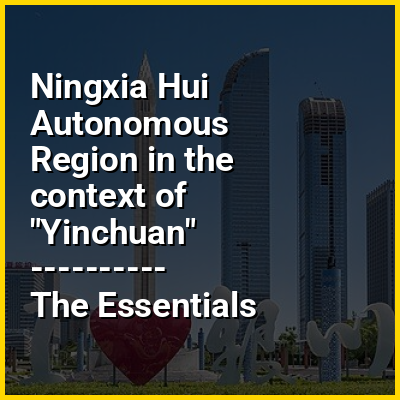
Yinchuan (Chinese: 银川; pinyin: Yínchuān; lit. "Silver River") is a prefecture‑level city and the capital of the Ningxia Hui Autonomous Region in northwest China. It served as the imperial capital of the Tangut‑led Western Xia (1038–1227).

Yinchuan hosts the biennial China–Arab States Expo.As of the 2020 Chinese census, Yinchuan’s administrative area had 2,859,074 inhabitants; the built‑up area had 2,564,918 residents, comprising the three urban districts and the urbanized parts of Helan and Yongning counties. At the end of 2024, the resident population of the city was 2,914,700, an increase of 66,600 over the end of the previous year. Among them, the urban population is 2,429,400.

↓ Explore More Topics
In this Dossier

Ningxia Hui Autonomous Region in the context of Mount Liupan

The Liupan Mountains (Chinese: 六盘山; pinyin: Lìupán Shān) are a mountain range in northwestern China, located mostly in southern Ningxia Hui Autonomous Region. The range marks the southwestern boundary of the Ordos Basin.

Its southern section is known as Mount Long (Chinese: 陇山; pinyin: Lǒng Shān), which strides southeast through eastern Gansu and western Shaanxi province before joining into the Qinling Mountains, giving rise to regional names like "Longxi" (陇西, lit. "west of Mount Long"), "Longdong" (陇东, "east of Mount Long", referring to the Jing River valley basin region around eastern Pingliang, southern Qingyang and northern Xianyang) and "Longnan" (陇南, "south of Mount Long"). It is the western boundary of the Guanzhong Plain, and is also the source of the Qian River (千河), a left tributary of the Wei River that flows through the prefectural city of Baoji.

↑ Return to Menu

Ningxia Hui Autonomous Region in the context of Shizuishan

Shizuishan, formerly Shizuizi, is a prefecture-level city in the Ningxia Hui Autonomous Region of the People's Republic of China. It is the northernmost prefecture in Ningxia and the second most populous, after the regional capital Yinchuan, bordered by Inner Mongolia to all directions except the south. Shizuishan sits on the western bank of the Yellow River on the western side of the Ordos Loop. It was formerly a center for caravans traveling the northern routes to and from Beijing across the Ordos Desert.

↑ Return to Menu