Nilpena Ediacara National Park in the context of "Ediacara Hills"

Play Trivia Questions online!

or

Skip to study material about Nilpena Ediacara National Park in the context of "Ediacara Hills"

Ad spacer

⭐ Core Definition: Nilpena Ediacara National Park

Nilpena Ediacara National Park, which includes the former Ediacara Conservation Park, is a national park located in the northern Flinders Ranges, in the state of South Australia. It is significant for its abundance of Ediacaran fossils, so named because of their discovery in the Ediacara Hills. It is located about around 551 km (342 mi) north of the city of Adelaide, around 30 kilometres (19 miles) south-west of the town of Leigh Creek in the state's Far North, and lies on the traditional lands of the Adnyamathanha people.

The Flinders Ranges Ediacara Foundation was established in 2018 with a charter to protect the unique fossils. The park, which includes the Ediacara Hills and covers 60,617 hectares (149,790 acres), was proclaimed in June 2021, and opened in April 2023. The park and the fossils are of major significance to the bid for UNESCO World Heritage Listing for the Flinders Ranges.
↓ Menu

>>>PUT SHARE BUTTONS HERE<<<

👉 Nilpena Ediacara National Park in the context of Ediacara Hills

Ediacara Hills (/ˌdiˈækərə/ EE-dee-AK-ər-ə), also known as Ediacaran Hills, are a range of low hills in the northern part of the Flinders Ranges of South Australia, around 650 kilometres (400 mi) north of the state capital of Adelaide. They are within the Nilpena Ediacara National Park.

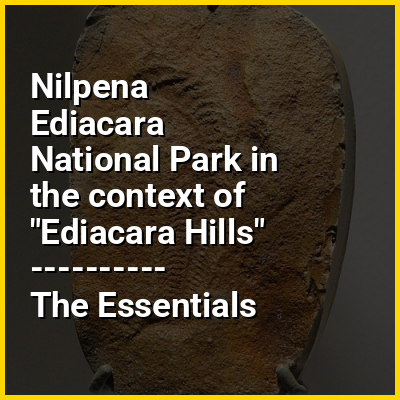
The hills are known for being the location where the significant trace fossils of the Ediacaran biota were discovered. These fossil beds contain some of the oldest known multicellular lifeforms, the importance of which has led to the naming of the Ediacaran geological period.

↓ Explore More Topics
In this Dossier

Nilpena Ediacara National Park in the context of Ediacaran

The Ediacaran ( /ˌdiˈækərən, ˌɛdi-/ EE-dee-AK-ər-ən, ED-ee-) is a geological period of the Neoproterozoic Era that spans 96 million years from the end of the Cryogenian Period at 635 Mya to the beginning of the Cambrian Period at 538.8 Mya. It is the last period of the Proterozoic Eon as well as the last of the so-called "Precambrian supereon", before the beginning of the subsequent Cambrian Period marks the start of the Phanerozoic Eon, where recognizable fossil evidence of life becomes common.

The Ediacaran Period is named after the Ediacara Hills of South Australia, where trace fossils of a diverse community of previously unrecognized lifeforms (later named the Ediacaran biota) were first discovered by geologist Reg Sprigg in 1946. Its status as an official geological period was ratified in 2004 by the International Union of Geological Sciences (IUGS), making it the first new geological period declared in 120 years. Although the period took namesake from the Ediacara Hills in the Nilpena Ediacara National Park, the type section is actually located in the bed of the Enorama Creek within the Brachina Gorge in the Ikara-Flinders Ranges National Park, at 31°19′53.8″S 138°38′0.1″E / 31.331611°S 138.633361°E / -31.331611; 138.633361, approximately 55 km (34 mi) southeast of the Ediacara Hills fossil site.

↑ Return to Menu