Monte Carlo Casino in the context of "Charles III, Prince of Monaco"

Play Trivia Questions online!

or

Skip to study material about Monte Carlo Casino in the context of "Charles III, Prince of Monaco"

Ad spacer

⭐ Core Definition: Monte Carlo Casino

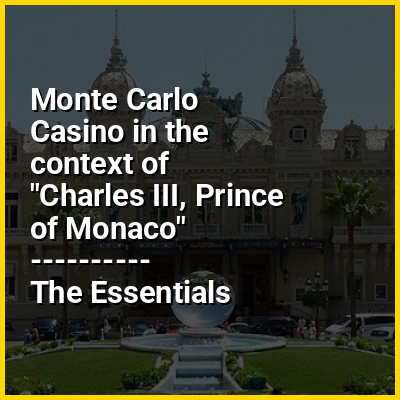
The Monte Carlo Casino, officially named Casino de Monte-Carlo, is a gambling and entertainment complex located in Monaco. It includes a casino, the Opéra de Monte-Carlo, and the office of Les Ballets de Monte-Carlo.

The Casino de Monte-Carlo is owned and operated by the Société des Bains de Mer (SBM), a public company in which the government of Monaco and the ruling princely family have a majority interest. The company also owns the principal hotels, sports clubs, foodservice establishments, and nightclubs throughout the Principality.
↓ Menu

>>>PUT SHARE BUTTONS HERE<<<

👉 Monte Carlo Casino in the context of Charles III, Prince of Monaco

Charles III (Charles Honoré Grimaldi; 8 December 1818 – 10 September 1889) was Prince of Monaco and Duke of Valentinois from 20 June 1856 to his death. He was the founder of the famous casino in Monte Carlo, as his name in Monegasque and Italian was Carlo III. He was born in Paris, the only son of Florestan, Prince of Monaco, and Caroline Gibert de Lametz.

↓ Explore More Topics
In this Dossier

Monte Carlo Casino in the context of Opéra de Monte-Carlo

The Opéra de Monte-Carlo is an opera house which is part of the Monte Carlo Casino located in the Principality of Monaco.

With the lack of cultural diversions available in Monaco in the 1870s, Prince Charles III, along with the Société des bains de mer, decided to include a concert hall as part of the casino. The main public entrance to the hall was from the casino, while Charles III's private entrance was on the western side. It opened in 1879 and became known as the Salle Garnier, after the architect Charles Garnier, who designed it.

↑ Return to Menu

Monte Carlo Casino in the context of Monte Carlo method

Monte Carlo methods, (sometimes called Monte Carlo experiments or Monte Carlo simulations) are a broad class of computational algorithms that rely on repeated random sampling to obtain numerical results. The underlying concept is to use randomness to solve problems that might be deterministic in principle. The name comes from the Monte Carlo Casino in Monaco, where the primary developer of the method, mathematician Stanisław Ulam, was inspired by his uncle's gambling habits.

Monte Carlo methods are mainly used in three distinct problem classes: optimization, numerical integration, and generating draws from a probability distribution. They can also be used to model phenomena with significant uncertainty in inputs, such as calculating the risk of a nuclear power plant failure. Monte Carlo methods are often implemented using computer simulations, and they can provide approximate solutions to problems that are otherwise intractable or too complex to analyze mathematically.

↑ Return to Menu

Monte Carlo Casino in the context of Société des bains de mer de Monaco

The Société des Bains de Mer (SBM; English: Society of Sea Baths), officially the Société Anonyme des Bains de Mer et du Cercle des Étrangers à Monaco (French: [sɔsjete de bɛ̃ d(ə) mɛʁ e dy sɛʁkl(ə) dez‿etʁɑ̃ʒez‿a mɔnako]; English: Society of Sea Baths and of the Circle of Foreigners in Monaco), is a publicly traded company registered in the Principality of Monaco. SBM owns and manages the Monte Carlo Casino, the Opéra de Monte-Carlo and the Hôtel de Paris in Monte Carlo.

↑ Return to Menu