Mohicans in the context of "Mohawk hairstyle"

Play Trivia Questions online!

or

Skip to study material about Mohicans in the context of "Mohawk hairstyle"


⭐ Core Definition: Mohicans

The Mohicans or Mahicans (/mˈhkənz/ or /məˈhkənz/) are an Eastern Algonquian Native American tribe that historically spoke an Algonquian language. As part of the Eastern Algonquian family of tribes, they are related to the neighboring Lenape, whose indigenous territory was to the south as far as the Atlantic coast. The Mohicans lived in the upper tidal Hudson River Valley, including the confluence of the Mohawk River (where present-day Albany, New York, developed) and into western New England centered on the upper Housatonic River watershed. After 1680, due to conflicts with the powerful Mohawk to the west during the Beaver Wars, many were driven southeastward across the present-day Massachusetts western border and the Taconic Mountains to Berkshire County around Stockbridge, Massachusetts.

They combined with Lenape Native Americans (a branch known as the Munsee) in Stockbridge, MA, and later the people moved west away from pressure of European invasion. They settled in what became Shawano County, Wisconsin. Most eastern Native American populations were forced to reservations in Indian Territory during the 1830s, and other reservations in the American West later. Decades later the United States government organized the Stockbridge-Munsee Community with registered members of the Munsee people and a 22,000-acre (89 km) reservation, which was originally the land of the Menominee Nation.
↓ Menu

👉 Mohicans in the context of Mohawk hairstyle

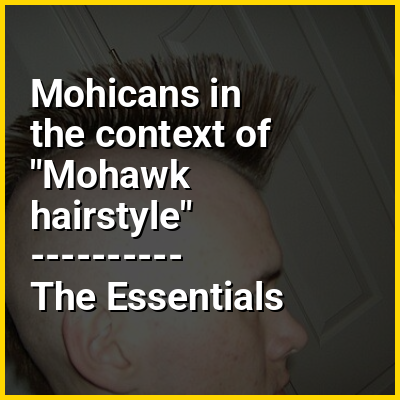
The mohawk (also referred to as a mohican in British English) is a hairstyle in which, in the most common variety, both sides of the head are shaven, leaving a strip of noticeably longer hair in the center. Mohawk hairstyles have existed for thousands of years. As of the 21st century, they are most commonly associated with punks, or broader non-conformity.

The mohawk is also sometimes referred to as an iro in reference to the Iroquois, who include the Mohawk people from whom the hairstyle is supposedly derived, though historically the hair was plucked out, rather than shaved. Additionally, hairstyles bearing these names more closely resemble those worn by the Pawnee, rather than the Mohawk, Mohicans, Mohegan, or other groups whose names are phonetically similar.

↓ Explore More Topics
In this Dossier

Mohicans in the context of Beaver Wars

The Beaver Wars (Mohawk: Tsianì kayonkwere, pronounced [d͡ʒanî gajũgwere]), also known as the Iroquois Wars or the French and Iroquois Wars (French: Guerres franco-iroquoises), were a series of conflicts fought intermittently during the 17th century in North America throughout the Saint Lawrence River valley in Canada and the Great Lakes region which pitted the Iroquois (Haudenosaunee) against the Wendat, northern Algonquians and their French allies. As a result of this conflict, the Iroquois destroyed several confederacies and tribes through warfare: the Wendat or Hurons, Erie, Neutral, Wenro, Petun, Susquehannock, Mohican and northern Algonquins whom they defeated and dispersed, some fleeing to neighbouring peoples and others assimilated, routed, or killed.

The Iroquois sought to expand their territory to monopolize the fur trade with European markets. They originally were a confederacy of the Mohawk, Oneida, Onondaga, Cayuga, and Seneca tribes inhabiting the lands in what is now Upstate New York along the shores of Lake Ontario east to Lake Champlain and Lake George on the Hudson River, and the lower-estuary of the Saint Lawrence River. The Iroquois Confederation led by the Mohawks mobilized against the largely Algonquian-speaking tribes and Iroquoian-speaking Wendat (Huron) and related tribes of the Great Lakes region. The Iroquois were supplied with arms by their Dutch and English trading partners; the Algonquians and Wendat were backed by the French, their chief trading partner.

↑ Return to Menu

Mohicans in the context of Mohawk language

Mohawk (/ˈmhɔːk/ ) or Kanienʼkéha ('[language] of the Flint Place') is an Iroquoian language currently spoken by around 3,500 people of the Mohawk nation, located primarily in current or former Haudenosaunee territories, predominantly in Canada (southern Ontario and Quebec), and to a lesser extent in the United States (western and northern New York). The word "Mohawk" is an exonym. In the Mohawk language, the people say that they are from Kanien:ke ('Mohawk Country' or 'Flint Stone Place') and that they are Kanienʼkehá꞉ka ('People of the Flint Stone Place' or 'People of the Flint Nation').

The Mohawks were extremely wealthy traders, as other nations in their confederacy needed their flint for tool-making. Their Algonquian-speaking neighbors (and competitors), the People of Muh-heck Heek Ing ('food-area place'), a people called by the Dutch "Mohicans" or "Mahicans", called the People of Ka-nee-en Ka "Maw Unk Lin" or 'Bear People'. The Dutch heard and wrote that as "Mohawks" and so the People of Kan-ee-en Ka are often referred to as Mohawks. The Dutch also referred to the Mohawk as Egils or Maquas. The French adapted those terms as Aigniers or Maquis, or called them by the generic Iroquois.

↑ Return to Menu