Modern South Arabian languages in the context of "Afroasiatic language"

Play Trivia Questions online!

or

Skip to study material about Modern South Arabian languages in the context of "Afroasiatic language"

Ad spacer

⭐ Core Definition: Modern South Arabian languages

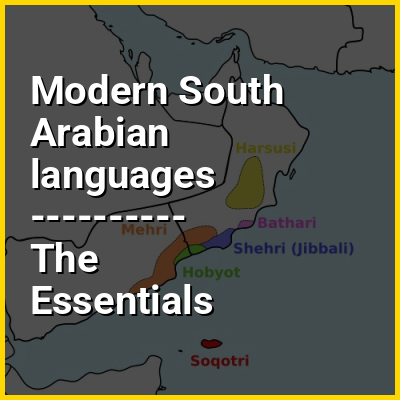
The Modern South Arabian languages, also known as Eastern South Semitic languages, are a group of endangered languages spoken by small populations inhabiting the Arabian Peninsula, in Yemen (including Socotra) and Oman. Together with the Ethiosemitic and Sayhadic languages, the Western branch, they form the South Semitic sub-branch of the Afroasiatic language family's Semitic branch.

Mehri and Hobyot are spoken in both Yemen and Oman. Soqotri is only spoken in the Yemeni archipelago of Socotra, and the Harsusi, Bathari, and Shehri languages are only spoken in Oman.
↓ Menu

>>>PUT SHARE BUTTONS HERE<<<
In this Dossier

Modern South Arabian languages in the context of Semitic languages

The Semitic languages are a branch of the Afroasiatic language family. They include Arabic, Amharic, Tigrinya, Aramaic, Hebrew, Maltese, Modern South Arabian languages and numerous other ancient and modern languages. They are spoken by more than 460 million people across much of West Asia, North Africa, the Horn of Africa, Malta, and in large immigrant and expatriate communities in North America, Europe, and Australasia. The terminology was first used in the 1780s by members of the Göttingen school of history, who derived the name from Shem (שם), one of the three sons of Noah in the Book of Genesis.

Arabic is by far the most widely spoken of the Semitic languages with 411 million native speakers of all varieties, and it is the most spoken native language in Africa and West Asia. Other Semitic languages include Amharic (35 million native speakers), Tigrinya (9.9 million speakers), Hebrew (5 million native speakers), Tigre (1 million speakers), and Maltese (570,000 speakers). Arabic, Amharic, Hebrew, Tigrinya, and Maltese are considered national languages with an official status.

↑ Return to Menu

Modern South Arabian languages in the context of Central Semitic languages

The Central Semitic languages comprise one of the three groups of West Semitic languages, alongside Modern South Arabian languages and Ethiopian Semitic languages. They are therefore of the Semitic phylum of the Afroasiatic language family. The group is spoken across much of the Arabic peninsula and north into the Levant region.

Central Semitic can itself be further divided into two groups: Arabic and Northwest Semitic. Northwest Semitic languages largely fall into the Canaanite languages (such as Ammonite, Phoenician and Hebrew) and Aramaic.

↑ Return to Menu

Modern South Arabian languages in the context of South Arabia

South Arabia (Arabic: جنوب الجزيرة العربية), or Greater Yemen, is a historical region that consists of the southern region of the Arabian Peninsula in West Asia, mainly centered in what is now the Republic of Yemen, yet it historically included Najran, Jazan, and Asir, which are presently in Saudi Arabia, and Dhofar of present-day Oman.

South Arabia is inhabited by people possessing distinctive linguistic and ethnic affinities, as well as traditions and culture, transcending recent political boundaries. There are two indigenous language groups: the now extinct Old South Arabian languages and the unrelated Modern South Arabian languages, both members of the Semitic family.

↑ Return to Menu

Modern South Arabian languages in the context of Hobyót language

Hobyót (Arabic: لغة هوبيوت , also known as Hewbyót, Habyot, or Hobi), natively known as Weyheybyot, is one of the six Modern South Arabian languages (MSAL), a group of South Semitic languages spoken in the southern Arabian Peninsula. A severely-endangered Semitic language on the verge of extinction, it is spoken in a small area near the Yemen-Oman border. The speaking population is estimated to be about 1000 in Oman and 40 in Yemen, though the true number may be less.

Its usage is less associated with a specific community or tribe of people, and more related to the geographical area in which it is spoken (the mountainous Dhufar/Yemen border). Much of the information regarding Hobyot's existence originated through the study of the more dominant, neighboring Modern South Arabian languages like Mehri and Jibbali. A clear linguistic description of Hobyot is difficult, as many speakers mix Mehri into their speech around outsiders.

↑ Return to Menu

Modern South Arabian languages in the context of Soqotri language

Soqotri (autonym: ماتڸ دسقطري, romanized: mɛ́taḷ di-saḳɔ́ṭri; Arabic: اللغة السقطرية, romanizedal-luḡah al-suquṭriyyah) is a South Semitic language spoken by the Soqotri people on the island of Socotra and the two nearby islands of Abd al Kuri and Samhah, in the Socotra archipelago, in the Guardafui Channel. Soqotri is one of six languages that form a group called Modern South Arabian languages (MSAL). These additional languages include Mehri, Shehri, Bathari, Harsusi, and Hobyot. All are spoken in different regions of South Arabia.

↑ Return to Menu