Military history of Korea in the context of War Memorial of Korea


Military history of Korea in the context of War Memorial of Korea

⭐ Core Definition: Military history of Korea

Korea's military history spans thousands of years, beginning with the ancient nation of Gojoseon and continuing into the present day with the countries of North Korea and South Korea, and is notable for its many successful triumphs over invaders.

Throughout its history, Korea has boasted numerous exceptional leaders who gained outstanding victories against numerically superior enemies. Famed leaders credited with defending Korea against foreign invasions include: Ŭlchi Mundŏk of Goguryeo, who defeated Sui China during the Goguryeo–Sui War; Yŏn Kaesomun of Goguryeo, who defeated Emperor Taizong of Tang China during the Goguryeo–Tang War; Kang Kam-ch'an of Goryeo, who defeated the Khitan Empire during the Goryeo-Khitan War; Ch'oe Yŏng and Yi Sŏnggye of Goryeo, who defeated the Red Turbans during the Red Turban Invasions; and Yi Sun-shin of Joseon, who defeated the Japanese at sea during the Imjin War.

↓ Menu
HINT:

👉 Military history of Korea in the context of War Memorial of Korea

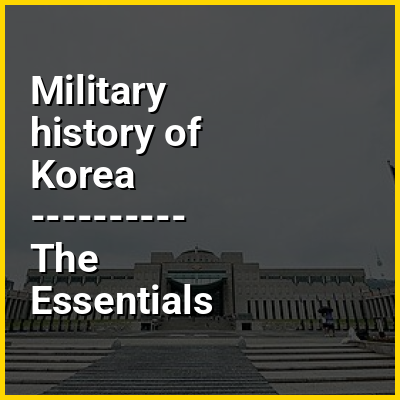
The War Memorial of Korea (Korean전쟁기념관) is a museum located in Yongsan-dong, Yongsan-gu, Seoul, South Korea. It opened in 1994 on the former site of the army headquarters to exhibit and memorialize the military history of Korea. It was built for the purpose of preventing war through lessons from the Korean War and for the hoped for peaceful reunification of North and South Korea. The memorial building has six indoor exhibition rooms and an outdoor exhibition centre displaying war memorabilia and military equipment from China, South Korea and the United States.

↓ Explore More Topics
In this Dossier

Military history of Korea in the context of Invention of gunpowder

Gunpowder is the first explosive to have been created in the world. Popularly listed as one of the "Four Great Inventions" of China, it was invented during the late Tang dynasty (9th century) while the earliest recorded chemical formula for gunpowder dates to the Song dynasty (11th century). Knowledge of gunpowder spread rapidly throughout Eurasia, possibly as a result of the Mongol conquests during the 13th century, with written formulas for it appearing in the Middle East between 1240 and 1280 in a treatise by Hasan al-Rammah, and in Europe by 1267 in the Opus Majus by Roger Bacon. It was employed in warfare to some effect from at least the 10th century in weapons such as fire arrows, bombs, and the fire lance before the appearance of the gun in the 13th century. While the fire lance was eventually supplanted by the gun, other gunpowder weapons such as rockets and fire arrows continued to see use in China, Korea, India, and this eventually led to its use in the Middle East, Europe, and Africa. Bombs too never ceased to develop and continued to progress into the modern day as grenades, mines, and other explosive implements. Gunpowder has also been used for non-military purposes such as fireworks for entertainment, or in explosives for mining and tunneling.

The evolution of guns led to the development of large artillery pieces, popularly known as bombards, during the 15th century, pioneered by states such as the Duchy of Burgundy. Firearms came to dominate early modern warfare in Europe by the 17th century. The gradual improvement of cannons firing heavier rounds for a greater impact against fortifications led to the invention of the star fort and the bastion in the Western world, where traditional city walls and castles were no longer suitable for defense. The use of gunpowder technology also spread throughout the Islamic world and to India, Korea, and Japan. The so-called Gunpowder Empires of the early modern period consisted of the Mughal Empire, Safavid Empire, and Ottoman Empire.

View the full Wikipedia page for Invention of gunpowder
↑ Return to Menu

Military history of Korea in the context of Ŭlchi Mundŏk

Ŭlchi Mundŏk (Korean을지문덕; Hanja乙支文德) was a military leader of early 7th century Goguryeo, one of the Three Kingdoms of Korea, who successfully defended Goguryeo against Sui China. He is famous for his victory at Salsu, and is often numbered among the greatest heroes in the military history of Korea.

View the full Wikipedia page for Ŭlchi Mundŏk
↑ Return to Menu