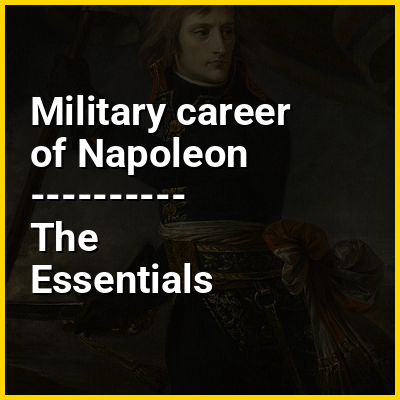
The military career of Napoleon spanned over 20 years. He led French armies in the French Revolutionary Wars and later, as emperor, in the Napoleonic Wars. Despite his comprehensive battle-winning record, Napoleon ended his career in defeat. Nevertheless, European history has since regarded Napoleon as a military genius and one of the finest commanders in history. His battles, campaigns and wars have been studied at military schools worldwide. Such campaigns as the Italian campaign of 1796–1797, the Ulm campaign and the Six Days' Campaign demonstrated his strategic and tactical genius. He fought more than 80 battles, losing only ten, mostly towards the end when the French army was not as dominant. As historian Alexander Mikhailovsky-Danilevsky observed, Napoleon was a "despotic sovereign of the battlefield, in whose presence but few generals ventured to maneuver, striving only to ward off his blows." Napoleon never sought refuge behind ridges, redoubts, etc.; he was a proponent of the offensive principle.
The French dominion collapsed rapidly after the invasion of Russia in 1812. Napoleon was defeated in 1814 and exiled to the island of Elba, before returning to France. He was finally defeated in 1815 at Waterloo. He spent his remaining days in British custody on the remote volcanic tropical island of Saint Helena. In his long military career, Bonaparte celebrated 64 victories and suffered 10 defeats; 6 battles ended with an uncertain outcome.