Midway Atoll in the context of "Papahānaumokuākea Marine National Monument"

Play Trivia Questions online!

or

Skip to study material about Midway Atoll in the context of "Papahānaumokuākea Marine National Monument"


⭐ Core Definition: Midway Atoll

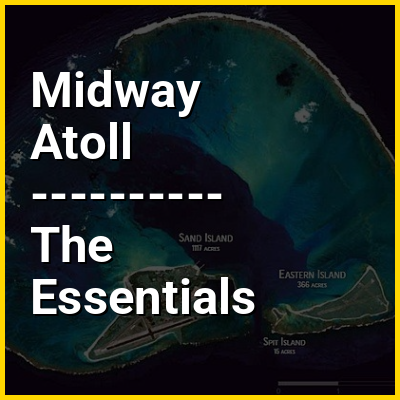
Midway Atoll (colloquial: Midway Islands; Hawaiian: Kuaihelani, lit.'the backbone of heaven'; Pihemanu, 'the loud din of birds') is a 2.4 sq mi (6.2 km) atoll in the North Pacific Ocean. Midway Atoll is an insular area of the United States and is an unorganized and unincorporated territory. The largest island is Sand Island, which has housing and an airstrip. Immediately east of Sand Island, across the narrow Brooks Channel, is Eastern Island, which is uninhabited and no longer has any facilities. Forming a rough, incomplete circle around the two main islands and creating Midway Lagoon is Spit Island, a narrow reef.

Roughly equidistant between North America and Asia, Midway is the only island in the Hawaiian Archipelago that is not part of the state of Hawaii. Unlike the other Hawaiian islands, Midway observes Samoa Time (UTC−11:00, i.e., eleven hours behind Coordinated Universal Time), which is one hour behind the time in the Hawaii–Aleutian Time Zone used in Hawaii. For statistical purposes, Midway is grouped as one of the United States Minor Outlying Islands. The Midway Atoll National Wildlife Refuge, encompassing 590,991.50 acres (239,165.77 ha) of land and water in the surrounding area, is administered by the United States Fish and Wildlife Service (FWS). The refuge and surrounding area are part of the larger Papahānaumokuākea Marine National Monument.
↓ Menu

In this Dossier

Midway Atoll in the context of Hawaii

Hawaii (/hə.ˈw.i/ hə-WY-ee; Hawaiian: Hawaiʻi [hə.ˈvɐj.ʔi, hə.ˈwɐj.ʔi]) is an island state of the United States, in the Pacific Ocean about 2,000 miles (3,200 km) southwest of the U.S. mainland. One of the two non-contiguous U.S. states (along with Alaska), it is the only state not on the North American mainland, the only state that is an archipelago, the only state in the tropics, and one of the two U.S. states, along with Texas, that were internationally recognized sovereign countries before becoming U.S. states.

Hawaii consists of 137 volcanic islands that make up almost the entire Hawaiian archipelago (the exception is Midway Atoll). Spanning 1,500 miles (2,400 km), the state is physiographically and ethnologically part of the Polynesian subregion of Oceania. Hawaii's ocean coastline is consequently the fourth-longest in the U.S., at about 750 miles (1,210 km). The eight main islands, from northwest to southeast, are Niʻihau, Kauaʻi, Oʻahu, Molokaʻi, Lānaʻi, Kahoʻolawe, Maui, and Hawaiʻi, after which the state is named; the last is often called the "Big Island" or "Hawaiʻi Island" to avoid confusion with the state or archipelago. The uninhabited Northwestern Hawaiian Islands make up most of the Papahānaumokuākea Marine National Monument, the largest protected area in the U.S. and the fourth-largest in the world.

↑ Return to Menu

Midway Atoll in the context of United States Minor Outlying Islands

The United States Minor Outlying Islands is a statistical designation applying to the minor outlying islands and groups of islands that comprise eight United States insular areas and territories in the Pacific Ocean (Baker Island, Howland Island, Jarvis Island, Johnston Atoll, Kingman Reef, Midway Atoll, Palmyra Atoll, and Wake Island) and one in the Caribbean Sea (Navassa Island).

It is defined by the International Organization for Standardization's ISO 3166-1 code. The entry code is ISO 3166-2:UM.

↑ Return to Menu

Midway Atoll in the context of Hawaii Territory

The Territory of Hawaii or Hawaii Territory (Hawaiian: Panalāʻau o Hawaiʻi) was an organized incorporated territory of the United States that existed from April 30, 1900, until August 21, 1959, when most of its territory, excluding Palmyra Island, was admitted to the United States as the 50th US state, the State of Hawaii. The Hawaii Admission Act specified that the State of Hawaii would not include Palmyra Island, the Midway Islands, Kingman Reef, and Johnston Atoll, which includes Johnston (or Kalama) Island and Sand Island.

On July 4, 1898, the United States Congress passed the Newlands Resolution authorizing the US annexation of the Republic of Hawaii, and five weeks later, on August 12, Hawaii became a US territory. In April 1900, Congress approved the Hawaiian Organic Act which organized the territory. United States Public Law 103-150 adopted in 1993, (informally known as the Apology Resolution), acknowledged that "the overthrow of the Kingdom of Hawaii occurred with the active participation of agents and citizens of the United States" and also "that the Native Hawaiian people never directly relinquished to the United States their claims to their inherent sovereignty as a people over their national lands, either through the Kingdom of Hawaii or through a plebiscite or referendum".

↑ Return to Menu

Midway Atoll in the context of Kure Atoll

Kure Atoll (/ˈkʊər/; Hawaiian: Hōlanikū, lit.'bringing forth heaven'; Mokupāpapa, 'flat island') or Ocean Island is an atoll in the Pacific Ocean 48 nautical miles (89 km; 55 mi) west-northwest of Midway Atoll in the Northwestern Hawaiian Islands at 28°25′N 178°20′W / 28.417°N 178.333°W / 28.417; -178.333. A coral ring 6 miles (9.7 km) across encloses a lagoon several meters deep. The atoll's largest island is called Green Island, and is a habitat for hundreds of thousands of seabirds in the present day and wildlife staff. A short, unused, and unmaintained runway and a portion of one building, both from a former United States Coast Guard LORAN station, are located on the island. Politically, it is part of Hawaii, though the nearest island is Midway, which is a separate unorganized territory. Kure Atoll, in addition to being the nesting grounds for tens of thousands of seabirds, has recorded several vagrant terrestrial birds, including snow bunting, eyebrowed thrush, brambling, olive-backed pipit, black kite, Steller's sea eagle and Chinese sparrowhawk. It is currently managed as a Wildlife Bird Sanctuary by the State of Hawaii's Department of Land and Natural Resource—Division of Forestry and Wildlife as one of the co-trustees of Papahānaumokuākea Marine National Monument with support from the Kure Atoll Conservancy. Kure is one of the westernmost islands of the Northwestern Hawaiian Islands.

Kure is seasonally inhabited by small crews of two to eight volunteers and biologists who work to restore and manage the native ecosystem.

↑ Return to Menu

Midway Atoll in the context of Northwestern Hawaiian Islands

The Northwestern Hawaiian Islands, also known as the Leeward Hawaiian Islands, are a series of mostly uninhabited islands and atolls located northwest of Kauai and Niʻihau in the Hawaiian island chain. Politically, these islands are part of Honolulu County in the U.S. state of Hawaii, with the exception of Midway Atoll, though they are generally not included on maps and graphic depictions of the State of Hawaii. Midway Atoll is a territory distinct from the State of Hawaii, and is classified as one of the United States Minor Outlying Islands. The United States Census Bureau designates this area, excluding Midway Atoll, as Census Tract 114.98 of Honolulu County. The total land area of these islands is 3.1075 square miles (8.048 km²). With the exception of Nīhoa, all of the islands lie north of the Tropic of Cancer, making them the only islands in Hawaii situated outside the tropics.

Almost all of the islands are uninhabited, the main exception being Midway Atoll, which maintains a permanent rotating population of U.S. Fish and Wildlife Service staff and other workers. Kure Atoll and Tern Island have a seasonal population of a small team of environmental staff. At least some of the islands were visited by Ancient Hawaiians, with Nīhoa showing evidence of permanent habitation.

↑ Return to Menu

Midway Atoll in the context of List of extinct animals of the Hawaiian Islands

This is a list of Hawaiian animal species extinct in the Holocene that covers extinctions from the Holocene epoch, a geologic epoch that began about 11,650 years before present (about 9700 BCE) and continues to the present day.

The Hawaiian Islands include the eight major islands (the Windward Islands) and the small islands and atolls of the Northwestern Hawaiian Islands. They are all part of the U.S. state of Hawaii, except Midway Atoll, which is a separate U.S. territory.

↑ Return to Menu

Midway Atoll in the context of Battle of Midway

The Battle of Midway was a major naval battle in the Pacific Theater of World War II that took place on 4–7 June 1942, six months after Japan's attack on Pearl Harbor and one month after the Battle of the Coral Sea. The Japanese Combined Fleet under the command of Isoroku Yamamoto suffered a decisive defeat by the U.S. Pacific Fleet near Midway Atoll, about 1,300 mi (1,100 nmi; 2,100 km) northwest of Oahu. Yamamoto had intended to capture Midway and lure out and destroy the U.S. Pacific Fleet, especially the aircraft carriers which had escaped damage at Pearl Harbor.

Before the battle, Japan desired to extend its Pacific defense perimeter, especially after the Doolittle air raid of Tokyo in April 1942, and to clear the seas for attacks on Midway, Fiji, Samoa, and Hawaii. A related Japanese attack on the Aleutian Islands began one day earlier, on 3 June. The Japanese strike force at Midway, known as the Kidō Butai, was commanded by Chuichi Nagumo. Yamamoto's plan for the operation, which depended on precise timing and coordination, was undermined by its wide dispersal of forces, which left the rest of the fleet unable to support the Kidō Butai effectively.

↑ Return to Menu