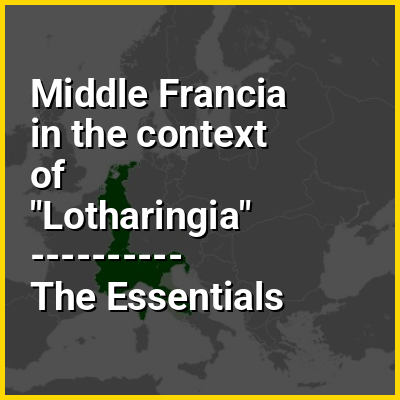
Lotharingia was a historical region and an early medieval polity that existed during the late Carolingian and early Ottonian, from the middle of the 9th to the middle of the 10th century. It was established in 855 by the Treaty of Prüm as a distinct kingdom within the Carolingian Empire, but abolished already in 869-870 when it was divided by the Treaty of Meerssen. It was territorially reunited in 880 by the Treaty of Ribemont, and reestablished as a kingdom from 895 to 900. Since 903 it was organized as a duchy, which existed up to 959, when it was divided into two distinct duchies: Upper Lotharingia (southern half), and Lower Lotharingia (northern half). The regional name Lotharingia means, approximately, "the land of Lothair", and was derived from the name of its first ruler, king Lothair II, who received this territory as his share of the Kingdom of Middle Francia. The region comprised present-day Lorraine (France), Luxembourg, parts of modern Germany west of the Rhine, most of Belgium, and the Netherlands.
Lotharingia resulted from the tripartite division in 855 of the kingdom of Middle Francia, which itself was formed after the threefold division of the Carolingian Empire by the Treaty of Verdun of 843. Conflict between East and West Francia over Lotharingia was based on the fact that these were the old Frankish homelands of Austrasia, so possession of them was a matter of great prestige to their kings as true claimant of Frankish imperial legacy.