Microeconomics in the context of Expenditure function


Microeconomics in the context of Expenditure function

Microeconomics Study page number 1 of 5

Play TriviaQuestions Online!

or

Skip to study material about Microeconomics in the context of "Expenditure function"


⭐ Core Definition: Microeconomics

Microeconomics is a branch of economics that studies the behavior of individuals and firms in making decisions regarding the allocation of scarce resources and the interactions among these individuals and firms. Microeconomics focuses on the study of individual markets, sectors, or industries as opposed to the economy as a whole, which is studied in macroeconomics.

One goal of microeconomics is to analyze the market mechanisms that establish relative prices among goods and services and allocate limited resources among alternative uses. Microeconomics shows conditions under which free markets lead to desirable allocations. It also analyzes market failure, where markets fail to produce efficient results.

↓ Menu
HINT:

In this Dossier

Microeconomics in the context of Industry (economics)

In microeconomics, an industry is a branch of an economy that produces a closely related set of raw materials, goods, or services. For example, one might refer to the wood industry or to the insurance industry.

When evaluating a single group or company, its dominant source of revenue is typically used by industry classifications to classify it within a specific industry. For example the International Standard Industrial Classification (ISIC) – used directly or through derived classifications for the official statistics of most countries worldwide – classifies "statistical units" by the "economic activity in which they mainly engage". Industry is then defined as "set of statistical units that are classified into the same ISIC category". However, a single business need not belong just to one industry, such as when a large business (often referred to as a conglomerate) diversifies across separate industries.

View the full Wikipedia page for Industry (economics)
↑ Return to Menu

Microeconomics in the context of Economic efficiency

In microeconomics, economic efficiency, depending on the context, is usually one of the following two related concepts:

These definitions are not equivalent: a market or other economic system may be allocatively but not productively efficient, or productively but not allocatively efficient. There are also other definitions and measures. All characterizations of economic efficiency are encompassed by the more general engineering concept that a system is efficient or optimal when it maximizes desired outputs (such as utility) given available inputs.

View the full Wikipedia page for Economic efficiency
↑ Return to Menu

Microeconomics in the context of Economics

Economics (/ˌɛkəˈnɒmɪks, ˌkə-/) is a social science that studies the production, distribution, and consumption of goods and services.

Economics focuses on the behaviour and interactions of economic agents and how economies work. Microeconomics analyses what is viewed as basic elements within economies, including individual agents and markets, their interactions, and the outcomes of interactions. Individual agents may include, for example, households, firms, buyers, and sellers. Macroeconomics analyses economies as systems where production, distribution, consumption, savings, and investment expenditure interact; and the factors of production affecting them, such as: labour, capital, land, and enterprise, inflation, economic growth, and public policies that impact these elements. It also seeks to analyse and describe the global economy.

View the full Wikipedia page for Economics
↑ Return to Menu

Microeconomics in the context of Common good

In philosophy, economics, and political science, the common good (also commonwealth, common weal, general welfare, or public benefit) is either what is shared and beneficial for all or most members of a given community, or alternatively, what is achieved by citizenship, collective action, and active participation in the realm of politics and public service. The concept of the common good differs significantly among philosophical doctrines. Early conceptions of the common good were set out by Ancient Greek philosophers, including Aristotle and Plato. One understanding of the common good rooted in Aristotle's philosophy remains in common usage today, referring to what one contemporary scholar calls the "good proper to, and attainable only by, the community, yet individually shared by its members."

The concept of common good developed through the work of political theorists, moral philosophers, and public economists, including Thomas Aquinas, Niccolò Machiavelli, John Locke, Jean-Jacques Rousseau, James Madison, Adam Smith, Karl Marx, John Stuart Mill, John Maynard Keynes, John Rawls, and many other thinkers. In contemporary economic theory, a common good is any good which is rivalrous yet non-excludable, while the common good, by contrast, arises in the subfield of welfare economics and refers to the outcome of a social welfare function. Such a social welfare function, in turn, would be rooted in a moral theory of the good (such as utilitarianism). Social choice theory aims to understand processes by which the common good may or may not be realized in societies through the study of collective decision rules. Public choice theory applies microeconomic methodology to the study of political science in order to explain how private interests affect political activities and outcomes.

View the full Wikipedia page for Common good
↑ Return to Menu

Microeconomics in the context of Economies of scale

In microeconomics, economies of scale are the cost advantages that enterprises obtain due to their scale of operation, and are typically measured by the amount of output produced per unit of cost (production cost). A decrease in cost per unit of output enables an increase in scale that is, increased production with lowered cost. At the basis of economies of scale, there may be technical, statistical, organizational or related factors to the degree of market control.

Economies of scale arise in a variety of organizational and business situations and at various levels, such as a production, plant or an entire enterprise. When average costs start falling as output increases, then economies of scale occur. Some economies of scale, such as capital cost of manufacturing facilities and friction loss of transportation and industrial equipment, have a physical or engineering basis. The economic concept dates back to Adam Smith and the idea of obtaining larger production returns through the use of division of labor. Diseconomies of scale are the opposite.

View the full Wikipedia page for Economies of scale
↑ Return to Menu

Microeconomics in the context of Overconsumption

Overconsumption describes a situation where consumers overuse their available goods and services to where they cannot, or do not want to, replenish or reuse them. In microeconomics, this is the point where the marginal cost of a consumer is greater than their marginal utility. The term overconsumption is quite controversial and does not necessarily have a single unifying definition. When used to refer to natural resources to the point where the environment is negatively affected, it is synonymous with the term overexploitation. However, when used in the broader economic sense, overconsumption can refer to all types of goods and services, including artificial ones, e.g., "the overconsumption of alcohol can lead to alcohol poisoning." Overconsumption is driven by several factors of the current global economy, including forces like consumerism, planned obsolescence, economic materialism, and other unsustainable business models, and can be contrasted with sustainable consumption.

Defining the amount of a natural resource required to be consumed for it to count as "overconsumption" is challenging because defining a sustainable capacity of the system requires accounting for many variables. A system's total capacity occurs at regional and worldwide levels, which means that specific regions may have higher consumption levels of certain resources than others due to greater resources without overconsuming a resource. A long-term pattern of overconsumption in any region or ecological system can cause a reduction in natural resources, often resulting in environmental degradation. However, this is only when applying the word to environmental impacts. When used in an economic sense, this point is defined as when the marginal cost of a consumer is equal to their marginal utility. Gossen's law of diminishing utility states that at this point, the consumer realizes the cost of consuming/purchasing another item/good is not worth the amount of utility (also known as happiness or satisfaction from the good) they had received, and therefore is not conducive to the consumer's wellbeing.

View the full Wikipedia page for Overconsumption
↑ Return to Menu

Microeconomics in the context of Macroeconomics

Macroeconomics is a branch of economics that deals with the performance, structure, behavior, and decision-making of an economy as a whole. This includes regional, national, and global economies. Macroeconomists study topics such as output/GDP (gross domestic product) and national income, unemployment (including unemployment rates), price indices and inflation, consumption, saving, investment, energy, international trade, and international finance.

Macroeconomics and microeconomics are the two most general fields in economics. The focus of macroeconomics is often on a country (or larger entities like the whole world) and how its markets interact to produce large-scale phenomena that economists refer to as aggregate variables. In microeconomics, the focus of analysis is often a single market, such as whether changes in supply or demand are to blame for price increases in the oil and automotive sectors. From introductory classes in "principles of economics" through doctoral studies, the macro/micro divide is institutionalized in the field of economics. Most economists identify as either macro- or micro-economists.

View the full Wikipedia page for Macroeconomics
↑ Return to Menu

Microeconomics in the context of Opportunity cost

In microeconomic theory, the opportunity cost of a choice is the value of the best alternative forgone where, given limited resources, a choice needs to be made between several mutually exclusive alternatives. Assuming the best choice is made, it is the "cost" incurred by not enjoying the benefit that would have been had if the second best available choice had been taken instead. The New Oxford American Dictionary defines it as "the loss of potential gain from other alternatives when one alternative is chosen". As a representation of the relationship between scarcity and choice, the objective of opportunity cost is to ensure efficient use of scarce resources. It incorporates all associated costs of a decision, both explicit and implicit. Thus, opportunity costs are not restricted to monetary or financial costs: the real cost of output forgone, lost time, pleasure, or any other benefit that provides utility should also be considered an opportunity cost.

View the full Wikipedia page for Opportunity cost
↑ Return to Menu

Microeconomics in the context of Consumer choice

The theory of consumer choice is the branch of microeconomics that relates preferences to consumption expenditures and to consumer demand curves. It analyzes how consumers maximize the desirability of their consumption (as measured by their preferences subject to limitations on their expenditures), by maximizing utility subject to a consumer budget constraint.Factors influencing consumers' evaluation of the utility of goods include: income level, cultural factors, product information and physio-psychological factors.

Consumption is separated from production, logically, because two different economic agents are involved. In the first case, consumption is determined by the individual. Their specific tastes or preferences determine the amount of utility they derive from goods and services they consume. In the second case, a producer has different motives to the consumer in that they are focussed on the profit they make. This is explained further by producer theory. The models that make up consumer theory are used to represent prospectively observable demand patterns for an individual buyer on the hypothesis of constrained optimization. Prominent variables used to explain the rate at which the good is purchased (demanded) are the price per unit of that good, prices of related goods, and wealth of the consumer.

View the full Wikipedia page for Consumer choice
↑ Return to Menu

Microeconomics in the context of Expected utility hypothesis

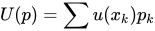
The expected utility hypothesis is a foundational assumption in mathematical economics concerning decision making under uncertainty. It postulates that rational agents maximize utility, meaning the subjective desirability of their actions. Rational choice theory, a cornerstone of microeconomics, builds this postulate to model aggregate social behaviour.

The expected utility hypothesis states an agent chooses between risky prospects by comparing expected utility values (i.e., the weighted sum of adding the respective utility values of payoffs multiplied by their probabilities). The summarised formula for expected utility is where is the probability that outcome indexed by with payoff is realized, and function u expresses the utility of each respective payoff. Graphically the curvature of the u function captures the agent's risk attitude.

View the full Wikipedia page for Expected utility hypothesis
↑ Return to Menu

Microeconomics in the context of Behavioral economics

Behavioral economics is the study of the psychological (e.g. cognitive, behavioral, affective, social) factors involved in the decisions of individuals or institutions, and how these decisions deviate from those implied by traditional economic theory.

Behavioral economics is primarily concerned with the bounds of rationality of economic agents. Behavioral models typically integrate insights from psychology, neuroscience and microeconomic theory.

View the full Wikipedia page for Behavioral economics
↑ Return to Menu

Microeconomics in the context of Economist

An economist is a professional and practitioner in the social science discipline of economics.

The individual may also study, develop, and apply theories and concepts from economics and write about economic policy. Within this field there are many sub-fields, ranging from the broad philosophical theories to the focused study of minutiae within specific markets, macroeconomic analysis, microeconomic analysis or financial statement analysis, involving analytical methods and tools such as econometrics, statistics, economics computational models, financial economics, regulatory impact analysis and mathematical economics.

View the full Wikipedia page for Economist
↑ Return to Menu

Microeconomics in the context of Welfare economics

Welfare economics is a field of economics that applies microeconomic techniques to evaluate the overall well-being (welfare) of a society.

The principles of welfare economics are often used to inform public economics, which focuses on the ways in which government intervention can improve social welfare. Additionally, welfare economics serves as the theoretical foundation for several instruments of public economics, such as cost–benefit analysis. The intersection of welfare economics and behavioral economics has given rise to the subfield of behavioral welfare economics.

View the full Wikipedia page for Welfare economics
↑ Return to Menu

Microeconomics in the context of Energy economics

Energy economics is a broad scientific subject area which includes topics related to supply and use of energy in societies. Considering the cost of energy services and associated value gives economic meaning to the efficiency at which energy can be produced. Energy services can be defined as functions that generate and provide energy to the “desired end services or states”. The efficiency of energy services is dependent on the engineered technology used to produce and supply energy. The goal is to minimise energy input required (e.g. kWh, mJ, see Units of Energy) to produce the energy service, such as lighting (lumens), heating (temperature) and fuel (natural gas). The main sectors considered in energy economics are transportation and building, although it is relevant to a broad scale of human activities, including households and businesses at a microeconomic level and resource management and environmental impacts at a macroeconomic level.

Interdisciplinary scientist Vaclav Smil has asserted that "every economic activity is fundamentally nothing but a conversion of one kind of energy to another, and monies are just a convenient (and often rather unrepresentative) proxy for valuing the energy flows."

View the full Wikipedia page for Energy economics
↑ Return to Menu

Microeconomics in the context of Market failure

In neoclassical economics, market failure is a situation in which the allocation of goods and services by a free market is not Pareto efficient, often leading to a net loss of economic value. The first known use of the term by economists was in 1958, but the concept has been traced back to the Victorian writers John Stuart Mill and Henry Sidgwick.Market failures are often associated with public goods, time-inconsistent preferences, information asymmetries, failures of competition, principal–agent problems, externalities, unequal bargaining power, behavioral irrationality (in behavioral economics), and macro-economic failures (such as unemployment and inflation).

The neoclassical school attributes market failures to the interference of self-regulatory organizations, governments or supra-national institutions in a particular market, although this view is criticized by heterodox economists. Economists, especially microeconomists, are often concerned with the causes of market failure and possible means of correction. Such analysis plays an important role in many types of public policy decisions and studies.

View the full Wikipedia page for Market failure
↑ Return to Menu

Microeconomics in the context of Substitute good

In microeconomics, substitute goods are two goods that can be used for the same purpose by consumers. That is, a consumer perceives both goods as similar or comparable, so that having more of one good causes the consumer to desire less of the other good. Contrary to complementary goods and independent goods, substitute goods may replace each other in use due to changing economic conditions. An example of substitute goods is Coca-Cola and Pepsi; the interchangeable aspect of these goods is due to the similarity of the purpose they serve, i.e. fulfilling customers' desire for a soft drink. These types of substitutes can be referred to as close substitutes.

Substitute goods are commodity which the consumer demanded to be used in place of another good.

View the full Wikipedia page for Substitute good
↑ Return to Menu

Microeconomics in the context of Monopoly price

In microeconomics, a monopoly price is set by a monopoly. A monopoly occurs when a firm lacks any viable competition and is the sole producer of the industry's product. Because a monopoly faces no competition, it has absolute market power and can set a price above the firm's marginal cost.

The monopoly ensures a monopoly price exists when it establishes the quantity of the product. As the sole supplier of the product within the market, its sales establish the entire industry's supply within the market, and the monopoly's production and sales decisions can establish a single price for the industry without any influence from competing firms. The monopoly always considers the demand for its product as it considers what price is appropriate, such that it chooses a production supply and price combination that ensures a maximum economic profit, which is determined by ensuring that the marginal cost (determined by the firm's technical limitations that form its cost structure) is the same as the marginal revenue (MR) (as determined by the impact a change in the price of the product will impact the quantity demanded) at the quantity it decides to sell. The marginal revenue is solely determined by the demand for the product within the industry and is the change in revenue that will occur by lowering the price just enough to ensure a single additional unit is sold. The marginal revenue is positive, but it is lower than its associated price because lowering the price will increase the demand for its product and increase the firm's sales revenue, and lower the price paid by those who are willing to buy the product at the higher price, which ensures a lower sales revenue on the product sales than those willing to pay the higher price.

View the full Wikipedia page for Monopoly price
↑ Return to Menu