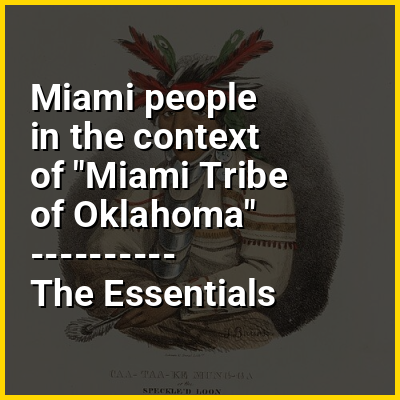
The Miami (Miami–Illinois: Myaamiaki) are a Native American nation originally speaking the Miami–Illinois language, one of the Algonquian languages. Among the peoples known as the Great Lakes tribes, they occupied territory that is now identified as north-central Indiana, southwest Michigan, and western Ohio. The Miami were historically made up of several prominent subgroups, including the Piankeshaw, Wea, Pepikokia, Kilatika, Mengakonkia, and Atchakangouen. In modern times, Miami is used more specifically to refer to the Atchakangouen. By 1846, most of the Miami had been forcefully displaced to Indian Territory (initially to what is now Kansas, and later to what is now part of Oklahoma). The Miami Tribe of Oklahoma are the federally recognized tribe of Miami Indians in the United States. The Miami Nation of Indiana, a nonprofit organization of self-identified descendants of Miamis who were exempted from removal, have unsuccessfully sought separate recognition.
- ⭐ Core Definition: Miami people
- Miami people in the context of Miami-Illinois language
- Miami people in the context of Miami University
- Miami people in the context of Western Confederacy
- Miami people in the context of Wea
Miami people in the context of Miami-Illinois language
Miami–Illinois or Wabash (endonym: myaamia, [mjɑːmia]) is an Indigenous Algonquian language that is spoken in the United States, historically in Illinois, Missouri, Indiana, western Ohio and adjacent areas along the Mississippi River by the Miami and Wea as well as the tribes of the Illinois Confederation, including the Kaskaskia, Peoria, Tamaroa, Cahokia, and possibly Mitchigamea. Although the last native speaker died in 1989, there has been an effort by the Myaamia (Miami) Nation of Oklahoma and the Miami Nation of Indians of the State of Indiana (a nonprofit organization) to revive the language and preserve their native heritage by teaching it to young and old members. As of 2016, it is estimated that around 500 members of the tribe use the language on a regular basis.
View the full Wikipedia page for Miami-Illinois languageMiami people in the context of Miami University
Miami University (informally Miami of Ohio or simply Miami) is a public research university in Oxford, Ohio, United States. Founded in 1809, it is the second-oldest university in Ohio and the tenth-oldest public university in the United States. It is named for its location near the Miami Valley, in turn named after the Myaamia people. The university enrolls over 18,000 students in Oxford and also has regional campuses in nearby Hamilton, Middletown, and West Chester. Miami also operates the international Dolibois European Center in Differdange, Luxembourg.
Miami University provides a liberal arts education with an emphasis on undergraduate studies. It consists of seven colleges and schools, including the College of Arts and Science; Farmer School of Business; College of Creative Arts; College of Education, Health and Society; and College of Engineering and Computing. The campus also includes the Richard and Carole Cocks Art Museum, Karl Limper Geology Museum, and William H. McGuffey House. Miami is a member of the University System of Ohio and is classified among "R2: Doctoral Universities – High research activity".
View the full Wikipedia page for Miami UniversityMiami people in the context of Western Confederacy
The Northwestern Confederacy, or Northwestern Indian Confederacy, was a loose confederacy of Native Americans in the Great Lakes region of the United States created after the American Revolutionary War. Formally, the confederacy referred to itself as the United Indian Nations, at their Confederate Council. It was known infrequently as the Miami Confederacy since many contemporaneous federal officials overestimated the influence and numerical strength of the Miami tribes based on the size of their principal city, Kekionga.
The confederacy, which had its roots in pan-tribal movements dating to the 1740s, formed in an attempt to resist the expansion of the United States and the encroachment of American settlers into the Northwest Territory after Great Britain ceded the region to the U.S. in the 1783 Treaty of Paris. American expansion resulted in the Northwest Indian War (1785–1795), in which the Confederacy won significant victories over the United States, but concluded with a U.S. victory at the Battle of Fallen Timbers. The Confederacy became fractured and agreed to peace with the United States, but the pan-tribal resistance was later rekindled by Tenskwatawa (known as the Prophet) and his brother, Tecumseh, resulting in the formation of Tecumseh's confederacy.
View the full Wikipedia page for Western ConfederacyMiami people in the context of Wea
The Wea (Miami–Illinois: Waayaahtanwa) were a Miami–Illinois-speaking Native American tribe originally located in western Indiana. Historically, they were described as being either closely related to the Miami tribe or a sub-tribe of Miami.
Today, the descendants of the Wea, along with the Kaskaskia, Piankeshaw, and Peoria, are enrolled in the Peoria Tribe of Indians of Oklahoma, a federally recognized tribe in Oklahoma.
View the full Wikipedia page for Wea