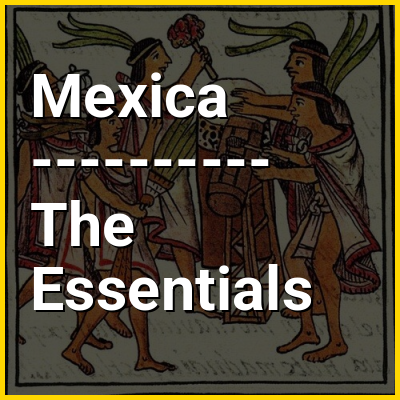
Mexica in the context of "Aztec"

Play Trivia Questions online!

or

Skip to study material about Mexica in the context of "Aztec"

Ad spacer

>>>PUT SHARE BUTTONS HERE<<<

👉 Mexica in the context of Aztec

The Aztecs (/ˈæztɛks/ AZ-teks) were a Mesoamerican civilization that flourished in central Mexico from 1300 to 1521. The Aztec people included different ethnic groups of central Mexico, particularly those groups who spoke the Nahuatl language. Aztec culture was organized into city-states (altepetl), some of which joined to form alliances, political confederations, or empires. The Aztec Empire was a confederation of three city-states established in 1427: Tenochtitlan (the capital city of the Mexica or Tenochca), Tetzcoco, and Tlacopan, previously part of the Tepanec empire, whose dominant power was Azcapotzalco. Although the term Aztecs is often narrowly restricted to the Mexica of Tenochtitlan, it is also broadly used to refer to Nahua polities or peoples of central Mexico in the prehispanic era, as well as the Spanish colonial era (1521–1821).

Most ethnic groups of central Mexico in the post-classic period shared essential cultural traits of Mesoamerica. The culture of central Mexico includes maize cultivation, the social division between nobility (pipiltin) and commoners (macehualtin), a pantheon, and the calendric system. Particular to the Mexica of Tenochtitlan was the patron god Huitzilopochtli, twin pyramids, and the ceramic styles known as Aztec I to IV. The Mexica were late-comers to the Valley of Mexico, and founded the city-state of Tenochtitlan on unpromising islets in Lake Texcoco, later becoming the dominant power of the Aztec Triple Alliance or Aztec Empire which conquered other city-states throughout Mesoamerica. It originated in 1427 as an alliance between the city-states Tenochtitlan, Texcoco, and Tlacopan to defeat the Tepanec state of Azcapotzalco, which had previously dominated the Basin of Mexico. Soon Texcoco and Tlacopan were relegated to junior partnership in the alliance, with Tenochtitlan the dominant power. The empire extended its reach by a combination of trade and military conquest. It was never a true territorial empire controlling territory by large military garrisons in conquered provinces but rather dominated its client city-states primarily by installing friendly rulers in conquered territories, constructing marriage alliances between the ruling dynasties, and extending an imperial ideology to its client city-states. Client city-states paid taxes, not tribute to the Aztec emperor, the Huey Tlatoani, in an economic strategy limiting communication and trade between outlying polities, making them dependent on the imperial center for the acquisition of luxury goods. The political clout of the empire reached far south into Mesoamerica conquering polities as far south as Chiapas and Guatemala and spanning Mesoamerica from the Pacific to the Atlantic oceans.

↓ Explore More Topics
In this Dossier

Mexica in the context of A Study of History

A Study of History is a 12-volume universal history by the British historian Arnold J. Toynbee, published from 1934 to 1961. It received enormous popular attention but according to historian Richard J. Evans, "enjoyed only a brief vogue before disappearing into the obscurity in which it has languished". Toynbee's goal was to trace the development and decay of 19 or 21 world civilizations in the historical record, applying his model to each of these civilizations, detailing the stages through which they all pass: genesis, growth, time of troubles, universal state, and disintegration.

The 19 (or 21) major civilizations, as Toynbee sees them, are: Egyptian, Andean, Sumerian, Babylonic, Hittite, Minoan, Indic, Hindu, Syriac, Hellenic, Western, Orthodox Christian (having two branches: the main or Byzantine body and the Russian branch), Far Eastern (having two branches: the main or Chinese body and the Japanese-Korean branch), Islamic (having two branches which later merged: Arabic and Iranic), Mayan, Mexican and Yucatec. Moreover, there are three "abortive civilizations" (Abortive Far Western Christian, Abortive Far Eastern Christian, Abortive Scandinavian) and five "arrested civilizations" (Polynesian, Eskimo, Nomadic, Ottoman, Spartan), for a total of 27 or 29.

↑ Return to Menu

Mexica in the context of Nahuatl

Nahuatl (English: /ˈnɑːwɑːtəl/ NAH-wah-təl; hispanicized from Nawatl Nahuatl pronunciation: [ˈnaːwat͡ɬ] ), Aztec, or Mexicano is a language or, by some definitions, a group of languages of the Uto-Aztecan language family. Varieties of Nahuatl are spoken by about 1.7 million Nahuas, most of whom live mainly in Central Mexico and have smaller populations in the United States.

Nahuatl has been spoken in central Mexico since at least the seventh century AD. It was the language of the Mexica, who dominated what is now central Mexico during the Late Postclassic period of Mesoamerican history. During the centuries preceding the Spanish conquest of the Aztec Empire, the Aztecs had expanded to incorporate a large part of central Mexico. Their influence caused the variety of Nahuatl spoken by the residents of Tenochtitlan to become a prestige language in Mesoamerica.

↑ Return to Menu

Mexica in the context of Aztec sun stone

19°25′34″N 99°11′15″W / 19.42611°N 99.18750°W / 19.42611; -99.18750

The Aztec sun stone (Spanish: Piedra del Sol) is a late post-classic Mexica sculpture housed in the National Anthropology Museum in Mexico City, and is perhaps the most famous work of Mexica sculpture. It measures 3.6 metres (12 ft) in diameter and 98 centimetres (39 in) thick, and weighs 24,590 kg (54,210 lb). Shortly after the Spanish conquest, the monolithic sculpture was buried in the Zócalo, the main square of Mexico City. It was rediscovered on 17 December 1790 during repairs on the Mexico City Cathedral. Following its rediscovery, the sun stone was mounted on an exterior wall of the cathedral, where it remained until 1885. Early scholars initially thought that the stone was carved in the 1470s, though modern research suggests that it was carved some time between 1502 and 1521.

↑ Return to Menu

Mexica in the context of Nahuas

The Nahuas (/ˈnɑːwɑːz/ NAH-wahz) are a Uto-Nahuan ethnic group and one of the Indigenous people of Mexico, with Nahua minorities also in El Salvador, Guatemala, Honduras, Nicaragua, and Costa Rica. They comprise the largest Indigenous group in Mexico, as well as the largest population out of any North American Indigenous people group who are native speakers of their respective Indigenous language. Amongst the Nahua, this is Nahuatl. When ranked amongst all Indigenous languages across the Americas, Nahuas list third after speakers of Guaraní and Quechua.

The Mexica (Aztecs) are of Nahua ethnicity, as are their historical enemies and allies of the Spaniards: the Tlaxcallans (Tlaxcaltecs). The Toltecs which predated both groups are often thought to have been Nahua as well. However, in the pre-Columbian period Nahuas were subdivided into many groups that did not necessarily share a common identity.

↑ Return to Menu

Mexica in the context of Tlacopan

Tlacopan, also called Tacuba, (Classical Nahuatl: Tlacōpan, [t͡ɬaˈkóːpan̥]) was a Tepanec / Mexica altepetl on the western shore of Lake Texcoco. The site is today the neighborhood of Tacuba, in Mexico City.

↑ Return to Menu

Mexica in the context of Lake Texcoco

Lake Texcoco (Spanish: Lago de Texcoco; Nahuatl languages: Tetzco(h)co) was a natural saline lake within the Anahuac or Valley of Mexico. Lake Texcoco is best known for an island situated on the western side of the lake where the Mexica built the city of Mēxihco Tenōchtitlan, which would later become the capital of the Aztec Empire. After the Spanish conquest, efforts to control flooding led to most of the lake being drained.

The entire lake basin is now almost completely occupied by Mexico City, the capital of the present-day nation of Mexico. Drainage of the lake has led to serious ecological and human consequences. The local climate and water availability have changed considerably, contributing to water scarcity in the area; subsequent groundwater extraction leads to land subsidence under much of the city. Native species endemic to the lake region, such as the axolotl, have become severely endangered or extinct due to ecosystem change.

↑ Return to Menu