Merv in the context of "Mary, Turkmenistan"

Play Trivia Questions online!

or

Skip to study material about Merv in the context of "Mary, Turkmenistan"

Ad spacer

⭐ Core Definition: Merv

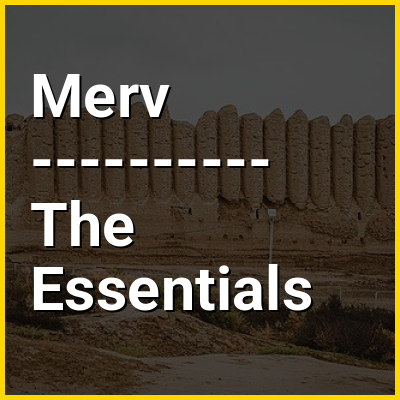
Merv (Turkmen: Merw [ˈmeɾβ]; Persian: مرو [ˈmæɹv]), also known as the Merve Oasis, was a major Iranian city in Central Asia, located on the historical Silk Road, near today's Mary, Turkmenistan. Human settlements on the site of Merv existed from the 3rd millennium BC until the 18th century AD. It changed hands repeatedly throughout history. Under the Achaemenid Empire, it was the center of the satrapy of Margiana. It was subsequently ruled by Hellenistic Kings, Parthians, Sasanians, Arabs, Ghaznavids, Seljuqs, Khwarazmians and Timurids, among others.

Merv served as the capital of several polities throughout its history. In the beginning of the 9th century, Merv was the seat of the caliph al-Ma'mun and the capital of the entire Islamic caliphate. It served later as the seat of the Tahirid governors of Khorasan. In the 11th–12th centuries, Merv was the capital of the Great Seljuk Empire and remained so until its ultimate fall. Around this time, Merv turned into a chief centre of Islamic science and culture, attracting as well as producing renowned poets, musicians, physicians, mathematicians and astronomers. The great Persian polymath Omar Khayyam, among others, spent a number of years working at the observatory in Merv. As Persian geographer and traveller al-Istakhri wrote of Merv: "Of all the countries of Iran, these people were noted for their talents and education." Arab geographer Yaqut al-Hamawi counted as many as 10 giant libraries in Merv, including one within a major mosque that contained 12,000 volumes.
↓ Menu

>>>PUT SHARE BUTTONS HERE<<<
In this Dossier

Merv in the context of Turkmenistan

Turkmenistan is a landlocked country in Central Asia, bordered by Kazakhstan and Uzbekistan to the north, Afghanistan to the southeast, Iran to the south and southwest, and the Caspian Sea to the west. It is one of six independent Turkic states. Ashgabat is the capital and largest city. With over 7 million people, Turkmenistan is the 35th most-populous country in Asia and has the lowest population of the Central Asian republics while being one of the most sparsely populated nations located on the Asian continent.

Turkmenistan has long served as a thoroughfare for several empires and cultures. Merv is one of the oldest oasis-cities in Central Asia, and was once among the biggest cities in the world. It was also one of the great cities of the Islamic world and an important stop on the Silk Road. Annexed by the Russian Empire in 1881, Turkmenistan figured prominently in the anti-Bolshevik movement in Central Asia. In 1925, Turkmenistan became a constituent republic of the Soviet Union, the Turkmen Soviet Socialist Republic (Turkmen SSR); it became independent after the dissolution of the Soviet Union in 1991.

↑ Return to Menu

Merv in the context of Mongol conquest of Persia and Mesopotamia

The Mongol conquest of Persia and Mesopotamia comprised three Mongol campaigns against Islamic states in the Middle East and Central Asia between 1219 and 1258. These campaigns led to the termination of the Khwarazmian Empire, the Nizari Ismaili state, and the Abbasid Caliphate of Baghdad, and the establishment of the Mongol Ilkhanate government in their place in Persia.

Genghis Khan had unified the Mongolic peoples and conquered the Western Xia state in the late 12th and early 13th centuries. After a series of diplomatic provocations on the part of Muhammad II, the ruler of the neighbouring Khwarazmian Empire, the Mongols launched an invasion in 1219. The invaders laid waste to the Transoxianan cities of Bukhara, Samarkand, and Gurganj in turn, before obliterating the region of Khorasan, slaughtering the inhabitants of Herat, Nishapur, and Merv, three of the largest cities in the world. Muhammad died destitute on an island in the Caspian Sea. His son and successor, Jalal al-Din, tried to resist the Mongols, but was defeated and forced into exile. Genghis returned to his campaign against the Jin dynasty in 1223, only retaining governance of the northern Khwarazmian regions.

↑ Return to Menu

Merv in the context of Demographics of Istanbul

Throughout most of its history, Istanbul has ranked among the largest cities in the world. By 500 CE, Constantinople had somewhere between 400,000 and 500,000 people, edging out its predecessor, Rome, for world's largest city. Constantinople jostled with other major historical cities, such as Baghdad, Chang'an, Kaifeng and Merv for the position of world's most populous city until the 12th century. It never returned to being the world's largest, but remained Europe's largest city from 1500 to 1750, when it was surpassed by London.

The Turkish Statistical Institute estimates that the population of Istanbul Metropolitan Municipality was 15,701,602 at the end of 2024, hosting 18 percent of the country's population. Then about 97–98% of the inhabitants of the metropolitan municipality were within city limits, up from 89% in 2007 and 61% in 1980. 64.9% of the residents live on the European side and 35.1% on the Asian side. While the city ranks as the world's 5th-largest city proper, it drops to the 24th place as an urban area and to the 18th place as a metro area because the city limits are roughly equivalent to the agglomeration. Today, it forms one of the largest urban agglomerations in Europe, alongside Moscow. The city's annual population growth of 3.45 percent ranks as the highest among the seventy-eight largest metropolises in the Organisation for Economic Co-operation and Development. The high population growth mirrors an urbanization trend across the country, as the second and third fastest-growing OECD metropolises are the Turkish cities of İzmir and Ankara.

↑ Return to Menu

Merv in the context of Mongol invasion of the Khwarazmian Empire

Between 1219 and 1221, the Mongol forces under Genghis Khan invaded the lands of the Khwarazmian Empire in Central Asia. The campaign, which followed the annexation of the Qara Khitai Khanate, saw widespread devastation and atrocities. The invasion marked the completion of the Mongol conquest of Central Asia, and began the Mongol conquest of Persia.

Both belligerents, although large, had been formed recently: the Khwarazmian dynasty had expanded from their homeland to replace the Seljuk Empire in the late 1100s and early 1200s; nearly simultaneously, Genghis Khan had unified the Mongolic peoples and conquered the Western Xia dynasty. Although relations were initially cordial, Genghis was angered by a series of diplomatic provocations. When a senior Mongol diplomat was executed by Khwarazmshah Muhammed II, the Khan mobilized his forces, estimated to be between 90,000 and 200,000 men, and invaded. The Shah's forces were widely dispersed and probably outnumbered—realizing his disadvantage, he decided to garrison his cities individually to bog the Mongols down. However, through excellent organization and planning, the Mongols were able to isolate and conquer the Transoxianan cities of Bukhara, Samarkand, and Gurganj. Genghis and his youngest son Tolui then laid waste to Khorasan, destroying Herat, Nishapur, and Merv, three of the largest cities in the world. Meanwhile, Muhammed II was forced into flight by the forces of Mongol generals Subutai and Jebe; unable to reach any bastions of support, he died destitute on an island in the Caspian Sea. His son and heir Jalal-al Din managed to mobilize substantial forces, defeating a Mongol general at the Battle of Parwan, but these were crushed by Genghis at the Battle of the Indus a few months later.

↑ Return to Menu

Merv in the context of Dravidian languages

The Dravidian languages are a family of languages spoken by 250 million people, primarily in South India, north-east Sri Lanka, and south-west Pakistan, with pockets elsewhere in South Asia.

The most commonly spoken Dravidian languages are (in descending order) Telugu, Tamil, Kannada, and Malayalam, all of which have long literary traditions.Smaller literary languages are Tulu and Kodava.Together with several smaller languages such as Gondi, these languages cover the southern part of India and the northeast of Sri Lanka, and account for the overwhelming majority of speakers of Dravidian languages.Malto and Kurukh are spoken in isolated pockets in eastern India.Kurukh is also spoken in parts of Nepal, Bhutan and Bangladesh. Brahui is mostly spoken in the Balochistan region of Pakistan, Iranian Balochistan, Afghanistan and around the Marw oasis in Turkmenistan. During the British colonial period, Dravidian speakers were sent as indentured labourers to Southeast Asia, Mauritius, South Africa, Fiji, the Caribbean, and East Africa. There are more-recent Dravidian-speaking diaspora communities in the Middle East, Europe, North America and Oceania.

↑ Return to Menu

Merv in the context of Mashhad

Mashhad (Persian: مشهد [mæʃˈhæd] ), historically also known as Mashad (/məˈʃæd/ mə-SHAD), Meshhed, or Meshed, is the second-most-populous city in Iran, located in the north-east of the country about 900 kilometres (560 miles) from Tehran. In the Central District of Mashhad County, it serves as the capital of Razavi Khorasan province, the county, and the district. It has a population of about 3,400,000 (2016 census), which includes the areas of Mashhad Taman and Torqabeh.

Throughout its history, Mashhad has been governed by different ethnic groups. It was previously a small village, which by the 9th century was known as Sanabad, and was located—along with Tus and other villages—on the ancient Silk Road connecting them with Merv to the east. It would eventually outgrow all its surrounding villages. It gained its current name, meaning "place of martyrdom", in reference to the Imam Reza shrine, where the eighth Shia Imam, Ali al-Rida, is buried. The Abbasid caliph Harun al-Rashid is also buried within the same shrine. The shrine is an important place of pilgrimage, visited by 2,5 millions each year in what is often described as "the holiest city in Iran".

↑ Return to Menu

Merv in the context of Battle of Dandanaqan

The Battle of Dandanaqan (Persian: نبرد دندانقان) was fought in 1040 between the Seljuq Turkmens and the Ghaznavid Empire near the city of Merv (now in Turkmenistan). The battle ended with a decisive Seljuq victory, which subsequently brought down the Ghaznavid domination in Greater Khorasan.

↑ Return to Menu

Merv in the context of Margiana

Margiana (Greek: Μαργιανή Margianḗ, Old Persian: Marguš, Middle Persian: Marv) is a historical region centred on the oasis of Merv and was a minor satrapy within the Achaemenid satrapy of Bactria, and a province within its successors, the Seleucid, Parthian and Sasanian empires.

It was located in the valley of the Murghab River which has its sources in the mountains of Afghanistan, and passes through Murghab District in modern Afghanistan, and then reaches the oasis of Merv in modern Turkmenistan. Margiana bordered Parthia to the south-west, Aria in the south, Bactria in the east and Sogdia in the north.

↑ Return to Menu