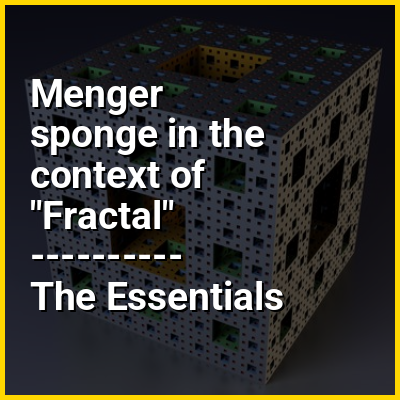
In mathematics, the Menger sponge (also known as the Menger cube, Menger universal curve, Sierpiński cube, or Sierpiński sponge) is a fractal curve. It is a three-dimensional generalization of the one-dimensional Cantor set and two-dimensional Sierpinski carpet. It was first described by Karl Menger in 1926, in his studies of the concept of topological dimension.
>>>PUT SHARE BUTTONS HERE<<<
👉 Menger sponge in the context of Fractal
In mathematics, a fractal is a geometric shape containing detailed structure at arbitrarily small scales, usually having a fractal dimension strictly exceeding the topological dimension. Many fractals appear similar at various scales, as illustrated in successive magnifications of the Mandelbrot set. This exhibition of similar patterns at increasingly smaller scales is called self-similarity, also known as expanding symmetry or unfolding symmetry; if this replication is exactly the same at every scale, as in the Menger sponge, the shape is called affine self-similar. Fractal geometry relates to the mathematical branch of measure theory by their Hausdorff dimension.
One way that fractals are different from finite geometric figures is how they scale. Doubling the edge lengths of a filled polygon multiplies its area by four, which is two (the ratio of the new to the old side length) raised to the power of two (the conventional dimension of the filled polygon). Likewise, if the radius of a filled sphere is doubled, its volume scales by eight, which is two (the ratio of the new to the old radius) to the power of three (the conventional dimension of the filled sphere). However, if a fractal's one-dimensional lengths are all doubled, the spatial content of the fractal scales by a power that is not necessarily an integer and is in general greater than its conventional dimension. This power is called the fractal dimension of the geometric object, to distinguish it from the conventional dimension (which is formally called the topological dimension).
In this Dossier
Menger sponge in the context of Sierpiński carpet
The Sierpiński carpet is a plane fractal first described by Wacław Sierpiński in 1916. The carpet is a generalization of the Cantor set to two dimensions; another such generalization is the Cantor dust.
The technique of subdividing a shape into smaller copies of itself, removing one or more copies, and continuing recursively can be extended to other shapes. For instance, subdividing an equilateral triangle into four equilateral triangles, removing the middle triangle, and recursing leads to the Sierpiński triangle. In three dimensions, a similar construction based on cubes is known as the Menger sponge.