Median in the context of Data set


Median in the context of Data set

Median Study page number 1 of 3

Play TriviaQuestions Online!

or

Skip to study material about Median in the context of "Data set"


⭐ Core Definition: Median

The median of a set of numbers is the value separating the higher half from the lower half of a data sample, a population, or a probability distribution. For a data set, it may be thought of as the “middle" value. The basic feature of the median in describing data compared to the mean (often simply described as the "average") is that it is not skewed by a small proportion of extremely large or small values, and therefore provides a better representation of the center. Median income, for example, may be a better way to describe the center of the income distribution because increases in the largest incomes alone have no effect on the median. For this reason, the median is of central importance in robust statistics.

Median is a 2-quantile; it is the value that partitions a set into two equal parts.

↓ Menu
HINT:

In this Dossier

Median in the context of Africa

Africa is the world's second-largest and second-most populous continent after Asia. At about 30.3 million km (11.7 million square miles) including adjacent islands, it covers 20% of Earth's land area and 6% of its total surface area. With nearly 1.4 billion people as of 2021, it accounts for about 18% of the world's human population. Africa's population is the youngest among all the continents; the median age in 2012 was 19.7, when the worldwide median age was 30.4. Based on 2024 projections, Africa's population will exceed 3.8 billion people by 2100. Africa is the least wealthy inhabited continent per capita and second-least wealthy by total wealth, ahead of Oceania. Scholars have attributed this to different factors including geography, climate, corruption, colonialism, the Cold War, and neocolonialism. Despite this low concentration of wealth, recent economic expansion and a large and young population make Africa an important economic market in the broader global context, and Africa has a large quantity of natural resources.

Africa straddles the equator and the prime meridian. The continent is surrounded by the Mediterranean Sea to the north, the Arabian Plate and the Gulf of Aqaba to the northeast, the Indian Ocean to the southeast and the Atlantic Ocean to the west. France, Italy, Portugal, Spain, and Yemen have parts of their territories located on African geographical soil, mostly in the form of islands.

View the full Wikipedia page for Africa
↑ Return to Menu

Median in the context of Wealth

Wealth is the abundance of valuable financial assets or physical possessions which can be converted into a form that can be used for transactions. This includes the core meaning as held in the originating Old English word weal, which is from an Indo-European word stem. The modern concept of wealth is of significance in all areas of economics, and clearly so for growth economics and development economics, yet the meaning of wealth is context-dependent. A person possessing a substantial net worth is known as wealthy. Net worth is defined as the current value of one's assets less liabilities (excluding the principal in trust accounts).

At the most general level, economists may define wealth as "the total of anything of value" that captures both the subjective nature of the idea and the idea that it is not a fixed or static concept. Various definitions and concepts of wealth have been asserted by various people in different contexts. Defining wealth can be a normative process with various ethical implications, since often wealth maximization is seen as a goal or is thought to be a normative principle of its own. A community, region or country that possesses an abundance of such possessions or resources to the benefit of the common good is known as wealthy.

View the full Wikipedia page for Wealth
↑ Return to Menu

Median in the context of Average wage

The national average salary (or national average wage) is the mean salary for the working population of a nation. It is calculated by summing all the annual salaries of all persons in work (surveyed) and dividing the total by the number of workers (surveyed). It is not the same as the Gross domestic product (GDP) per capita, which is calculated by dividing the GDP by the total population of a country, including the unemployed and those not in the workforce (e.g. retired people, children, students, etc.). It can be useful in understanding economic conditions, and to employers and employees in negotiating salaries. The national median salary is usually significantly less than the national average salary because the distribution of workers by salary is skewed.

View the full Wikipedia page for Average wage
↑ Return to Menu

Median in the context of Median income

The median income is the income amount that divides a population into two groups, half having an income above that amount, and half having an income below that amount. It may differ from the mean (or average) income. Both of these are ways of understanding income distribution. Median income can be calculated by household income, by personal income, or for specific demographic groups. When taxes and mandatory contributions are subtracted from income, the result is called net or disposable income. The measurement of income from individuals and households, which is necessary to produce statistics such as the median, can pose challenges and yield results inconsistent with aggregate national accounts data. For example, an academic study on the Census income data claims that when correcting for underreporting, U.S. median gross household income was 15% higher in 2010 (table 3).

View the full Wikipedia page for Median income
↑ Return to Menu

Median in the context of List of countries by wealth per adult

This is a list of countries of the world by wealth per adult, from UBS's Global Wealth Databook. Wealth includes both financial and non-financial assets.

UBS publishes various statistics relevant for calculating net wealth. These figures are influenced by real estate prices, equity market prices, exchange rates, liabilities, debts, adult percentage of the population, human resources, natural resources and capital and technological advancements, which may create new assets or render others worthless in the future.

View the full Wikipedia page for List of countries by wealth per adult
↑ Return to Menu

Median in the context of Rape

Rape is a type of sexual assault involving sexual intercourse, or other forms of sexual penetration, carried out against a person without their consent. The act may be carried out by physical force, coercion, abuse of authority, or against a person who is incapable of giving valid consent, such as one who is unconscious, incapacitated, has an intellectual disability, or is below the legal age of consent (statutory rape). The wrongness of the rape is not merely or, on many occasions even primarily, the violence against the body of the victim but the violence against the very person of the victim. The term rape is sometimes casually used interchangeably with the term sexual assault.

The rate of reporting, prosecuting and convicting for rape varies between jurisdictions. Internationally, the incidence of rapes recorded by the police during 2008 ranged, per 100,000 people, from 0.2 in Azerbaijan to 92.9 in Botswana with 6.3 in Lithuania as the median. Worldwide, reported instances of sexual violence, including rape, are primarily committed by males against females. Rape by strangers is usually less common than rape by people the victim knows, and male-on-male prison rapes are common and may be the least reported forms of rape.

View the full Wikipedia page for Rape
↑ Return to Menu

Median in the context of Quantile

In statistics and probability, quantiles are cut points dividing the range of a probability distribution into continuous intervals with equal probabilities or dividing the observations in a sample in the same way. There is one fewer quantile than the number of groups created. Common quantiles have special names, such as quartiles (four groups), deciles (ten groups), and percentiles (100 groups). The groups created are termed halves, thirds, quarters, etc., though sometimes the terms for the quantile are used for the groups created, rather than for the cut points.

q-quantiles are values that partition a finite set of values into q subsets of (nearly) equal sizes. There are q − 1 partitions of the q-quantiles, one for each integer k satisfying 0 < k < q. In some cases the value of a quantile may not be uniquely determined, as can be the case for the median (2-quantile) of a uniform probability distribution on a set of even size. Quantiles can also be applied to continuous distributions, providing a way to generalize rank statistics to continuous variables (see percentile rank). When the cumulative distribution function of a random variable is known, the q-quantiles are the application of the quantile function (the inverse function of the cumulative distribution function) to the values {1/q, 2/q, …, (q − 1)/q}.

View the full Wikipedia page for Quantile
↑ Return to Menu

Median in the context of Normal distribution

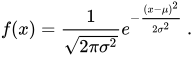
In probability theory and statistics, a normal distribution or Gaussian distribution is a type of continuous probability distribution for a real-valued random variable. The general form of its probability density function is

The parameter is the mean or expectation of the distribution (and also its median and mode), while the parameter is the variance. The standard deviation of the distribution is (sigma). A random variable with a Gaussian distribution is said to be normally distributed and is called a normal deviate.

View the full Wikipedia page for Normal distribution
↑ Return to Menu

Median in the context of Descriptive statistics

A descriptive statistic (in the count noun sense) is a summary statistic that quantitatively describes or summarizes features from a collection of information, while descriptive statistics (in the mass noun sense) is the process of using and analysing those statistics. Descriptive statistics is distinguished from inferential statistics (or inductive statistics) by its aim to summarize a sample, rather than use the data to learn about the population that the sample of data is thought to represent. This generally means that descriptive statistics, unlike inferential statistics, is not developed on the basis of probability theory, and are frequently nonparametric statistics. Even when a data analysis draws its main conclusions using inferential statistics, descriptive statistics are generally also presented. For example, in papers reporting on human subjects, typically a table is included giving the overall sample size, sample sizes in important subgroups (e.g., for each treatment or exposure group), and demographic or clinical characteristics such as the average age, the proportion of subjects of each sex, the proportion of subjects with related co-morbidities, etc.

Some measures that are commonly used to describe a data set are measures of central tendency and measures of variability or dispersion. Measures of central tendency include the mean, median and mode, while measures of variability include the standard deviation (or variance), the minimum and maximum values of the variables, kurtosis and skewness.

View the full Wikipedia page for Descriptive statistics
↑ Return to Menu

Median in the context of Average

An average of a collection or group is a value that is most central or most common in some sense, and represents its overall position.

In mathematics, especially in colloquial usage, it most commonly refers to the arithmetic mean, so the "average" of the list of numbers [2, 3, 4, 7, 9] is generally considered to be (2+3+4+7+9)/5 = 25/5 = 5. In situations where the data is skewed or has outliers, and it is desired to focus on the main part of the group rather than the long tail, "average" often instead refers to the median; for example, the average personal income is usually given as the median income, so that it represents the majority of the population rather than being overly influenced by the much higher incomes of the few rich people. In certain real-world scenarios, such computing the average speed from multiple measurements taken over the same distance, the average used is the harmonic mean. In situations where a histogram or probability density function is being referenced, the "average" could instead refer to the mode. Other statistics that can be used as an average include the mid-range and geometric mean, but they would rarely, if ever, be colloquially referred to as "the average".

View the full Wikipedia page for Average
↑ Return to Menu

Median in the context of Raw data

Raw data, also known as primary data, are data (e.g., numbers, instrument readings, figures, etc.) collected from a source. In the context of examinations, the raw data might be described as a raw score (after test scores).

If a scientist sets up a computerized thermometer which records the temperature of a chemical mixture in a test tube every minute, the list of temperature readings for every minute, as printed out on a spreadsheet or viewed on a computer screen are "raw data". Raw data have not been subjected to processing, "cleaning" by researchers to remove outliers, obvious instrument reading errors or data entry errors, or any analysis (e.g., determining central tendency aspects such as the average or median result). As well, raw data have not been subject to any other manipulation by a software program or a human researcher, analyst or technician. They are also referred to as primary data. Raw data is a relative term (see data), because even once raw data have been "cleaned" and processed by one team of researchers, another team may consider these processed data to be "raw data" for another stage of research. Raw data can be inputted to a computer program or used in manual procedures such as analyzing statistics from a survey. The term "raw data" can refer to the binary data on electronic storage devices, such as hard disk drives (also referred to as "low-level data").

View the full Wikipedia page for Raw data
↑ Return to Menu

Median in the context of Insulating materials

This is a list of insulation materials used around the world.

Typical R-values are given for various materials and structures as approximations based on the average of available figures and are sorted by lowest value. R-value at 1 m gives R-values normalised to a 1 metre (3 ft 3 in) thickness and sorts by median value of the range.

View the full Wikipedia page for Insulating materials
↑ Return to Menu

Median in the context of Median voter

In political science and social choice, Black's median voter theorem says that if voters and candidates are distributed along a political spectrum, any Condorcet consistent voting method will elect the candidate preferred by the median voter. The median voter theorem thus shows that under a realistic model of voter behavior, Arrow's theorem does not apply, and rational choice is possible for societies. The theorem was first derived by Duncan Black in 1948, and independently by Kenneth Arrow.

Similar median voter theorems exist for rules like score voting and approval voting when voters are either strategic and informed or if voters' ratings of candidates fall linearly with ideological distance.

View the full Wikipedia page for Median voter
↑ Return to Menu

Median in the context of Mental age

Mental age is a concept related to intelligence. It looks at how a specific individual, at a specific age, performs intellectually, compared to average intellectual performance for that individual's actual chronological age (i.e. time elapsed since birth). The intellectual performance is based on performance in tests and live assessments by a psychologist. The score achieved by the individual is compared to the median average scores at various ages, and the mental age (x, say) is derived such that the individual's score equates to the average score at age x.

However, mental age depends on what kind of intelligence is measured. For instance, a child's intellectual age can be average for their actual age, but the same child's emotional intelligence can be immature for their physical age. Psychologists often remark that girls are more emotionally mature than boys at around the age of puberty. Also, a six-year-old child intellectually gifted can remain a three-year-old child in terms of emotional maturity. Mental age can be considered a controversial concept.

View the full Wikipedia page for Mental age
↑ Return to Menu

Median in the context of Interquartile range

In descriptive statistics, the interquartile range (IQR) is a measure of statistical dispersion, which is the spread of the data. The IQR may also be called the midspread, middle 50%, fourth spread, or H‑spread. It is defined as the difference between the 75th and 25th percentiles of the data. To calculate the IQR, the data set is divided into quartiles, or four rank-ordered even parts via linear interpolation. These quartiles are denoted by Q1 (also called the lower quartile), Q2 (the median), and Q3 (also called the upper quartile). The lower quartile corresponds with the 25th percentile and the upper quartile corresponds with the 75th percentile, so IQR = Q3 −  Q1.

The IQR is an example of a trimmed estimator, defined as the 25% trimmed range, which enhances the accuracy of dataset statistics by dropping lower contribution, outlying points. It is also used as a robust measure of scale It can be clearly visualized by the box on a box plot.

View the full Wikipedia page for Interquartile range
↑ Return to Menu

Median in the context of Menstrual cycle

The menstrual cycle is a series of natural changes in hormone production and the structures of the uterus and ovaries of the female reproductive system that makes pregnancy possible. The ovarian cycle controls the production and release of eggs and the cyclic release of estrogen and progesterone. The uterine cycle governs the preparation and maintenance of the lining of the uterus (womb) to receive an embryo. These cycles are concurrent and coordinated, normally last between 21 and 35 days, with a median length of 28 days. Menarche (the onset of the first period) usually occurs around the age of 12 years; menstrual cycles continue for about 30–45 years.

Naturally occurring hormones drive the cycles; the cyclical rise and fall of the follicle stimulating hormone prompts the production and growth of oocytes (immature egg cells). The hormone estrogen stimulates the uterus lining (endometrium) to thicken to accommodate an embryo should fertilization occur. The blood supply of the thickened lining provides nutrients to a successfully implanted embryo. If implantation does not occur, the lining breaks down and blood is released. Triggered by falling progesterone levels, menstruation (commonly referred to as a "period") is the cyclical shedding of the lining, and is a sign that pregnancy has not occurred.

View the full Wikipedia page for Menstrual cycle
↑ Return to Menu

Median in the context of Personal income in the United States

Personal income is an individual's total earnings from wages, investment interest, and other sources. The Bureau of Labor Statistics reported a median weekly personal income of $1,196 for full-time workers in the United States in Q2 2025. For the year 2024, the U.S. Census Bureau estimates that the median annual earnings for all workers (people aged 15 and over with earnings) was $51,370; and more specifically estimates that median annual earnings for those who worked full-time, year round, was $63,360.

Income patterns are evident on the basis of age, sex, ethnicity and educational characteristics. In 2005 roughly half of all those with graduate degrees were among the nation's top 15% of income earners. Among different demographics (gender, marital status, ethnicity) for those over the age of 18, median personal income ranged from $3,317 for an unemployed, married Asian American female to $55,935 for a full-time, year-round employed Asian American male. According to the US Census, men tended to have higher income than women, while Asians and Whites earned more than African Americans and Hispanics.

View the full Wikipedia page for Personal income in the United States
↑ Return to Menu