Mechanical equilibrium in the context of "Pendulum"

Play Trivia Questions online!

or

Skip to study material about Mechanical equilibrium in the context of "Pendulum"

Ad spacer

>>>PUT SHARE BUTTONS HERE<<<

👉 Mechanical equilibrium in the context of Pendulum

A pendulum is a device made of a weight suspended from a pivot so that it can swing freely. When a pendulum is displaced sideways from its resting, equilibrium position, it is subject to a restoring force due to gravity that will accelerate it back toward the equilibrium position. When released, the restoring force acting on the pendulum's mass causes it to oscillate about the equilibrium position, swinging back and forth. The time for one complete cycle, a left swing and a right swing, is called the period. The period depends on the length of the pendulum and also to a slight degree on the amplitude, the width of the pendulum's swing. Pendulums were widely used in early mechanical clocks for timekeeping. The SI unit of the period of a pendulum is the second (s).

The regular motion of pendulums was used for timekeeping and was the world's most accurate timekeeping technology until the 1930s. The pendulum clock invented by Christiaan Huygens in 1656 became the world's standard timekeeper, used in homes and offices for 270 years, and achieved accuracy of about one second per year before it was superseded as a time standard by the quartz clock in the 1930s. Pendulums are also used in scientific instruments such as accelerometers and seismometers. Historically they were used as gravimeters to measure the acceleration of gravity in geo-physical surveys, and even as a standard of length. The word pendulum is Neo-Latin, from the Latin pendulus, meaning 'hanging'.

↓ Explore More Topics
In this Dossier

Mechanical equilibrium in the context of Statics

Statics is the branch of classical mechanics that is concerned with the analysis of force and torque acting on a physical system that does not experience an acceleration, but rather is in equilibrium with its environment.

If is the total of the forces acting on the system, is the mass of the system and is the acceleration of the system, Newton's second law states that (the bold font indicates a vector quantity, i.e. one with both magnitude and direction). If , then . As for a system in static equilibrium, the acceleration equals zero, the system is either at rest, or its center of mass moves at constant velocity.

↑ Return to Menu

Mechanical equilibrium in the context of Hydrostatics

Hydrostatics is the branch of fluid mechanics that studies fluids at hydrostatic equilibrium and "the pressure in a fluid or exerted by a fluid on an immersed body". The word "hydrostatics" is sometimes used to refer specifically to water and other liquids, but more often it includes both gases and liquids, whether compressible or incompressible. It encompasses the study of the conditions under which fluids are at rest in stable equilibrium. It is opposed to fluid dynamics, the study of fluids in motion.

Hydrostatics is fundamental to hydraulics, the engineering of equipment for storing, transporting and using fluids. It is also relevant to geophysics and astrophysics (for example, in understanding plate tectonics and the anomalies of the Earth's gravitational field), to meteorology, to medicine (in the context of blood pressure), and many other fields.

↑ Return to Menu

Mechanical equilibrium in the context of Wave

In physics, mathematics, engineering, and related fields, a wave is a propagating dynamic disturbance (change from equilibrium) of one or more quantities. Periodic waves oscillate repeatedly about an equilibrium (resting) value at some frequency. When the entire waveform moves in one direction, it is said to be a travelling wave; by contrast, a pair of superimposed periodic waves traveling in opposite directions makes a standing wave. In a standing wave, the amplitude of vibration has nulls at some positions where the wave amplitude appears smaller or even zero.

There are two types of waves that are most commonly studied in classical physics: mechanical waves and electromagnetic waves. In a mechanical wave, stress and strain fields oscillate about a mechanical equilibrium. A mechanical wave is a local deformation (strain) in some physical medium that propagates from particle to particle by creating local stresses that cause strain in neighboring particles too. For example, sound waves are variations of the local pressure and particle motion that propagate through the medium. Other examples of mechanical waves are seismic waves, gravity waves, surface waves and string vibrations. In an electromagnetic wave (such as light), coupling between the electric and magnetic fields sustains propagation of waves involving these fields according to Maxwell's equations. Electromagnetic waves can travel through a vacuum and through some dielectric media (at wavelengths where they are considered transparent). Electromagnetic waves, as determined by their frequencies (or wavelengths), have more specific designations including radio waves, infrared radiation, terahertz waves, visible light, ultraviolet radiation, X-rays and gamma rays.

↑ Return to Menu

Mechanical equilibrium in the context of Elastic energy

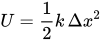
Elastic energy is the mechanical potential energy stored in the configuration of a material or physical system as it is subjected to elastic deformation by work performed upon it. Elastic energy occurs when objects are impermanently compressed, stretched or generally deformed in any manner. Elasticity theory primarily develops formalisms for the mechanics of solid bodies and materials. The elastic potential energy equation is used in calculations of positions of mechanical equilibrium. The energy is potential as it will be converted into other forms of energy, such as kinetic energy and sound energy, when the object is allowed to return to its original shape (reformation) by its elasticity.

↑ Return to Menu

Mechanical equilibrium in the context of Weighing scale

A scale or balance is a device used to measure weight or mass. These are also known as mass scales, weight scales, mass balances, massometers, and weight balances.

The traditional scale consists of two plates or bowls suspended at equal distances from a fulcrum. One plate holds an object of unknown mass (or weight), while objects of known mass or weight, called weights, are added to the other plate until mechanical equilibrium is achieved and the plates level off, which happens when the masses on the two plates are equal. The perfect scale rests at neutral. A spring scale will make use of a spring of known stiffness to determine mass (or weight). Suspending a certain mass will extend the spring by a certain amount depending on the spring's stiffness (or spring constant). The heavier the object, the more the spring stretches, as described in Hooke's law. Other types of scales making use of different physical principles also exist.

↑ Return to Menu

Mechanical equilibrium in the context of Lagrange point

In celestial mechanics, the Lagrange points (/ləˈɡrɑːn/), also called the Lagrangian points or libration points, are points of equilibrium for small-mass objects under the gravitational influence of two massive orbiting bodies. Mathematically, this involves the solution of the restricted three-body problem.

Normally, the two massive bodies exert an unbalanced gravitational force at a point, altering the orbit of whatever is at that point. At the Lagrange points, the gravitational forces of the two large bodies and the centrifugal force balance each other. This can make Lagrange points an excellent location for satellites, as orbit corrections, and hence fuel requirements, needed to maintain the desired orbit are kept at a minimum.

↑ Return to Menu

Mechanical equilibrium in the context of Oscillatory

Oscillation is the repetitive or periodic variation, typically in time, of some measure about a central value (often a point of equilibrium) or between two or more different states. Familiar examples of oscillation include a swinging pendulum and alternating current. Oscillations can be used in physics to approximate complex interactions, such as those between atoms.

Oscillations occur not only in mechanical systems but also in dynamic systems in virtually every area of science: for example the beating of the human heart (for circulation), business cycles in economics, predator–prey population cycles in ecology, geothermal geysers in geology, vibration of strings in guitar and other string instruments, periodic firing of nerve cells in the brain, and the periodic swelling of Cepheid variable stars in astronomy. The term vibration is precisely used to describe a mechanical oscillation.

↑ Return to Menu