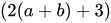
Mathematical expression in the context of Canonical form


Mathematical expression in the context of Canonical form

Mathematical expression Study page number 1 of 2

Play TriviaQuestions Online!

or

Skip to study material about Mathematical expression in the context of "Canonical form"


⭐ Core Definition: Mathematical expression

In mathematics, an expression is an arrangement of symbols following the context-dependent, syntactic conventions of mathematical notation. Symbols can denote numbers, variables, operations, and functions. Other symbols include punctuation marks and brackets, used for grouping where there is not a well-defined order of operations.

Expressions are commonly distinguished from formulas: expressions usually denote mathematical objects, whereas formulas are statements about mathematical objects. This is analogous to natural language, where a noun phrase refers to an object, and a whole sentence refers to a fact. For example, and are both expressions, while the inequality is a formula. However, formulas are often considered as expressions that can be evaluated to the Boolean values true or false.

↓ Menu
HINT:

👉 Mathematical expression in the context of Canonical form

In mathematics and computer science, a canonical, normal, or standard form of a mathematical object is a standard way of presenting that object as a mathematical expression. Often, it is one which provides the simplest representation of an object and allows it to be identified in a unique way. The distinction between "canonical" and "normal" forms varies from subfield to subfield. In most fields, a canonical form specifies a unique representation for every object, while a normal form simply specifies its form, without the requirement of uniqueness.

The canonical form of a positive integer in decimal representation is a finite sequence of digits that does not begin with zero. More generally, for a class of objects on which an equivalence relation is defined, a canonical form consists in the choice of a specific object in each class. For example:

↓ Explore More Topics
In this Dossier

Mathematical expression in the context of List of mathematical symbols

A mathematical symbol is a figure or a combination of figures that is used to represent a mathematical object, an action on mathematical objects, a relation between mathematical objects, or for structuring the other symbols that occur in a formula or a mathematical expression. More formally, a mathematical symbol is any grapheme used in mathematical formulas and expressions. As formulas and expressions are entirely constituted with symbols of various types, many symbols are needed for expressing all mathematics.

The most basic symbols are the decimal digits (0, 1, 2, 3, 4, 5, 6, 7, 8, 9), and the letters of the Latin alphabet. The decimal digits are used for representing numbers through the Hindu–Arabic numeral system. Historically, upper-case letters were used for representing points in geometry, and lower-case letters were used for variables and constants. Letters are used for representing many other types of mathematical object. As the number of these types has increased, the Greek alphabet and some Hebrew letters have also come to be used. For more symbols, other typefaces are also used, mainly boldface , script typeface (the lower-case script face is rarely used because of the possible confusion with the standard face), German fraktur , and blackboard bold (the other letters are rarely used in this face, or their use is unconventional). It is commonplace to use alphabets, fonts and typefaces to group symbols by type (for example, boldface is often used for vectors and uppercase for matrices).


View the full Wikipedia page for List of mathematical symbols
↑ Return to Menu

Mathematical expression in the context of Product (mathematics)

In mathematics, a product is the result of multiplication, or an expression that identifies objects (numbers or variables) to be multiplied, called factors. For example, 21 is the product of 3 and 7 (the result of multiplication), and is the product of and (indicating that the two factors should be multiplied together).When one factor is an integer, the product is called a multiple.

The order in which real or complex numbers are multiplied has no bearing on the product; this is known as the commutative law of multiplication. When matrices or members of various other associative algebras are multiplied, the product usually depends on the order of the factors. Matrix multiplication, for example, is non-commutative, and so is multiplication in other algebras in general as well.

View the full Wikipedia page for Product (mathematics)
↑ Return to Menu

Mathematical expression in the context of Identity (mathematics)

In mathematics, an identity is an equality relating one mathematical expression A to another mathematical expression B, such that A and B (which might contain some variables) produce the same value for all values of the variables within a certain domain of discourse. In other words, A = B is an identity if A and B define the same functions, and an identity is an equality between functions that are differently defined. For example, and are identities. Identities are sometimes indicated by the triple bar symbol instead of =, the equals sign. Formally, an identity is a universally quantified equality.

View the full Wikipedia page for Identity (mathematics)
↑ Return to Menu

Mathematical expression in the context of Quadratic function

In mathematics, a quadratic function of a single variable is a function of the form

where is its variable, and , , and are coefficients. The expression , especially when treated as an object in itself rather than as a function, is a quadratic polynomial, a polynomial of degree two. In elementary mathematics a polynomial and its associated polynomial function are rarely distinguished and the terms quadratic function and quadratic polynomial are nearly synonymous and often abbreviated as quadratic.

View the full Wikipedia page for Quadratic function
↑ Return to Menu

Mathematical expression in the context of Leading coefficient

In mathematics, a coefficient is a multiplicative factor involved in some term of a polynomial, a series, or any other type of expression. It may be a number without units, in which case it is known as a numerical factor. It may also be a constant with units of measurement, in which it is known as a constant multiplier. In general, coefficients may be any expression (including variables such as a, b and c). When the combination of variables and constants is not necessarily involved in a product, it may be called a parameter. For example, the polynomial has coefficients 2, −1, and 3, and the powers of the variable in the polynomial have coefficient parameters , , and .

A constant coefficient, also known as constant term or simply constant, is a quantity either implicitly attached to the zeroth power of a variable or not attached to other variables in an expression; for example, the constant coefficients of the expressions above are the number 3 and the parameter c, involved in 3=cx. The coefficient attached to the highest degree of the variable in a polynomial of one variable is referred to as the leading coefficient; for example, in the example expressions above, the leading coefficients are 2 and a, respectively.

View the full Wikipedia page for Leading coefficient
↑ Return to Menu

Mathematical expression in the context of Dimensional analysis

In engineering and science, dimensional analysis of different physical quantities is the analysis of their physical dimension or quantity dimension, defined as a mathematical expression identifying the powers of the base quantities involved (such as length, mass, time, etc.), and tracking these dimensions as calculations or comparisons are performed.The concepts of dimensional analysis and quantity dimension were introduced by Joseph Fourier in 1822.

Commensurable physical quantities have the same dimension and are of the same kind, so they can be directly compared to each other, even if they are expressed in differing units of measurement; e.g., metres and feet, grams and pounds, seconds and years. Incommensurable physical quantities have different dimensions, so can not be directly compared to each other, no matter what units they are expressed in, e.g. metres and grams, seconds and grams, metres and seconds. For example, asking whether a gram is larger than an hour is meaningless.

View the full Wikipedia page for Dimensional analysis
↑ Return to Menu

Mathematical expression in the context of Closed-form expression

In mathematics, an expression or formula (including equations and inequalities) is in closed form if it is formed with constants, variables, and a set of functions considered as basic and connected by arithmetic operations (+, −, ×, /, and integer powers) and function composition. Commonly, the basic functions that are allowed in closed forms are nth root, exponential function, logarithm, and trigonometric functions. However, the set of basic functions depends on the context. For example, if one adds polynomial roots to the basic functions, the functions that have a closed form are called elementary functions.

View the full Wikipedia page for Closed-form expression
↑ Return to Menu

Mathematical expression in the context of Symbols of grouping

In mathematics and related subjects, understanding a mathematical expression depends on an understanding of symbols of grouping, such as parentheses (), square brackets [], and braces {} (see note on terminology below). These same symbols are also used in ways where they are not symbols of grouping. For example, in the expression 3(x+y) the parentheses are symbols of grouping, but in the expression (3, 5) the parentheses may indicate an open interval.

The most common symbols of grouping are the parentheses and the square brackets, and the latter are usually used to avoid too many repeated parentheses. For example, to indicate the product of binomials, parentheses are usually used, thus: . But if one of the binomials itself contains parentheses, as in one or more pairs of () may be replaced by [], thus: . Beyond elementary mathematics, [] are mostly used for other purposes, e.g. to denote a closed interval, or an equivalence class, so they appear rarely for grouping.

View the full Wikipedia page for Symbols of grouping
↑ Return to Menu

Mathematical expression in the context of Order of operations

In mathematics and computer programming, the order of operations is a collection of conventions about which arithmetic operations to perform first in order to evaluate a given mathematical expression.

These conventions are formalized with a ranking of the operations. The rank of an operation is called its precedence, and an operation with a higher precedence is performed before operations with lower precedence. Calculators generally perform operations with the same precedence from left to right, but some programming languages and calculators adopt different conventions.

View the full Wikipedia page for Order of operations
↑ Return to Menu

Mathematical expression in the context of Vinculum (symbol)

A vinculum (from Latin vinculum 'fetter, chain, tie') is a horizontal line used in mathematical notation for various purposes. It may be placed as an overline or underline above or below a mathematical expression to group the expression's elements. Historically, vincula were extensively used to group items together, especially in written mathematics, but in modern mathematics its use for this purpose has almost entirely been replaced by the use of parentheses. It was also used to mark Roman numerals whose values are multiplied by 1,000. Today, however, the common usage of a vinculum to indicate the repetend of a repeating decimal is a significant exception and reflects the original usage.

View the full Wikipedia page for Vinculum (symbol)
↑ Return to Menu

Mathematical expression in the context of PK/PD models

PKPD modeling (pharmacokinetic pharmacodynamic modeling) (alternatively abbreviated as PK/PD or PK-PD modeling) is a technique that combines the two classical pharmacologic disciplines of pharmacokinetics and pharmacodynamics. It integrates a pharmacokinetic and a pharmacodynamic model component into one set of mathematical expressions that allows the description of the time course of effect intensity in response to administration of a drug dose. PKPD modeling is related to the field of pharmacometrics.

Central to PKPD models is the concentration-effect or exposure-response relationship. A variety of PKPD modeling approaches exist to describe exposure-response relationships. PKPD relationships can be described by simple equations such as linear model, Emax model or sigmoid Emax model. However, if a delay is observed between the drug administration and the drug effect, a temporal dissociation needs to be taken into account and more complex models exist:

View the full Wikipedia page for PK/PD models
↑ Return to Menu