Mathematical economics in the context of "Numéraire"

Play Trivia Questions online!

or

Skip to study material about Mathematical economics in the context of "Numéraire"

Ad spacer

⭐ Core Definition: Mathematical economics

Mathematical economics is the application of mathematical methods to represent theories and analyze problems in economics. Often, these applied methods are beyond simple geometry, and may include differential and integral calculus, difference and differential equations, matrix algebra, mathematical optimization, or other computational methods. Proponents of this approach claim that it allows the formulation of theoretical relationships with rigor, generality, and simplicity.

Mathematics allows economists to form meaningful, testable propositions about wide-ranging and complex subjects which could less easily be expressed informally. Further, the language of mathematics allows economists to make specific, positive claims about controversial or contentious subjects that would be impossible without mathematics. Much of economic theory is currently presented in terms of mathematical economic models, a set of stylized and simplified mathematical relationships asserted to clarify assumptions and implications.

↓ Menu

>>>PUT SHARE BUTTONS HERE<<<

👉 Mathematical economics in the context of Numéraire

The numéraire (or numeraire) is a basic standard by which value is computed. In mathematical economics it is a tradable economic entity in terms of whose price the relative prices of all other tradables are expressed. In a monetary economy, one of the functions of money is to act as the numéraire, i.e. to serve as a unit of account and therefore provide a common benchmark relative to which the value of various goods and services can be measured against.

Using a numeraire, whether monetary or some consumable good, facilitates value comparisons when only the relative prices are relevant, as in general equilibrium theory. When economic analysis refers to a particular good as the numéraire, one says that all other prices are normalized by the price of that good. For example, if a unit of good g has twice the market value of a unit of the numeraire, then the (relative) price of g is 2. Since the value of one unit of the numeraire relative to one unit of itself is 1, the price of the numeraire is always 1.

↓ Explore More Topics
In this Dossier

Mathematical economics in the context of Game theory

Game theory is the study of mathematical models of strategic interactions. It has applications in many fields of social science, and is used extensively in economics, logic, systems science and computer science. Initially, game theory addressed two-person zero-sum games, in which a participant's gains or losses are exactly balanced by the losses and gains of the other participant. In the 1950s, it was extended to the study of non zero-sum games, and was eventually applied to a wide range of behavioral relations. It is now an umbrella term for the science of rational decision making in humans, animals, and computers.

Modern game theory began with the idea of mixed-strategy equilibria in two-person zero-sum games and its proof by John von Neumann. Von Neumann's original proof used the Brouwer fixed-point theorem on continuous mappings into compact convex sets, which became a standard method in game theory and mathematical economics. His paper was followed by Theory of Games and Economic Behavior (1944), co-written with Oskar Morgenstern, which considered cooperative games of several players. The second edition provided an axiomatic theory of expected utility, which allowed mathematical statisticians and economists to treat decision-making under uncertainty.

↑ Return to Menu

Mathematical economics in the context of Expected utility hypothesis

The expected utility hypothesis is a foundational assumption in mathematical economics concerning decision making under uncertainty. It postulates that rational agents maximize utility, meaning the subjective desirability of their actions. Rational choice theory, a cornerstone of microeconomics, builds this postulate to model aggregate social behaviour.

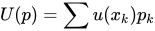
The expected utility hypothesis states an agent chooses between risky prospects by comparing expected utility values (i.e., the weighted sum of adding the respective utility values of payoffs multiplied by their probabilities). The summarised formula for expected utility is where is the probability that outcome indexed by with payoff is realized, and function u expresses the utility of each respective payoff. Graphically the curvature of the u function captures the agent's risk attitude.

↑ Return to Menu

Mathematical economics in the context of Economist

An economist is a professional and practitioner in the social science discipline of economics.

The individual may also study, develop, and apply theories and concepts from economics and write about economic policy. Within this field there are many sub-fields, ranging from the broad philosophical theories to the focused study of minutiae within specific markets, macroeconomic analysis, microeconomic analysis or financial statement analysis, involving analytical methods and tools such as econometrics, statistics, economics computational models, financial economics, regulatory impact analysis and mathematical economics.

↑ Return to Menu

Mathematical economics in the context of Kelvin Lancaster

Kelvin John Lancaster (10 December 1924 – 23 July 1999) was an Australian mathematical economist and John Bates Clark professor of economics at Columbia University. He is best known for the development of the Theory of the Second Best with Richard Lipsey. Lancaster was also active in developing the calculus of qualitative economics, formulating the household production function, and applying the hedonic model to the estimation of housing prices.

In a 1966 paper, Lancaster developed what he called a "new theory of consumer demand", in which the then standard microeconomic demand theory was modified by stipulating that what consumers are seeking to acquire is not goods themselves (e.g. cars or train journeys) but the characteristics they contain (e.g. transport from A to B, display of fashion sense). As Palda (2013) explains

↑ Return to Menu

Mathematical economics in the context of Léon Walras

Marie-Esprit-Léon Walras (French: [valʁas]; 16 December 1834 – 5 January 1910) was a French mathematical economist and Georgist. He formulated the marginal theory of value (independently of William Stanley Jevons and Carl Menger) and pioneered the development of general equilibrium theory. Walras is best known for his book Éléments d'économie politique pure, a work that has contributed greatly to the mathematization of economics through the concept of general equilibrium.

For Walras, exchanges only take place after a Walrasian tâtonnement (French for "trial and error"), guided by the auctioneer, has made it possible to reach market equilibrium. It was the general equilibrium obtained from a single hypothesis, rarity, that led Joseph Schumpeter to consider him "the greatest of all economists". The notion of general equilibrium was very quickly adopted by major economists such as Vilfredo Pareto, Knut Wicksell and Gustav Cassel. John Hicks and Paul Samuelson used the Walrasian contribution in the elaboration of the neoclassical synthesis. For their part, Kenneth Arrow and Gérard Debreu, from the perspective of a logician and a mathematician, determined the conditions necessary for equilibrium.

↑ Return to Menu