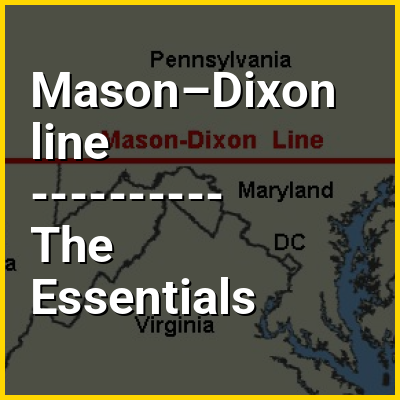
The Mason–Dixon line, sometimes referred to as Mason and Dixon's Line, is a demarcation line separating four U.S. states: Pennsylvania, Maryland, Delaware and West Virginia. It was surveyed between 1763 and 1767 by English surveyors and astronomers Charles Mason and Jeremiah Dixon as part of the resolution to Cresap's War, a border conflict involving Maryland, Pennsylvania, and Delaware (then a part of Pennsylvania) in the colonial United States.
The largest portion of the Mason–Dixon line, along the southern Pennsylvanian border, later became informally known as the boundary between the Southern slave states and Northern free states. This usage came to prominence during the debate around the Missouri Compromise of 1820, when drawing boundaries between slave and free territory, and resurfaced during the American Civil War, with border states also coming into play. The Confederate States of America claimed the Virginian (now West Virginia) portion of the line as part of its northern border, although it never exercised meaningful control that far north – especially after West Virginia separated from Virginia and joined the Union as a separate state in 1863. It is still used today in the figurative sense of a line that separates the Northeast and South regionally, politically, and socially .