Mask of Tutankhamun in the context of "Valley of the Kings"

Play Trivia Questions online!

or

Skip to study material about Mask of Tutankhamun in the context of "Valley of the Kings"

Ad spacer

⭐ Core Definition: Mask of Tutankhamun

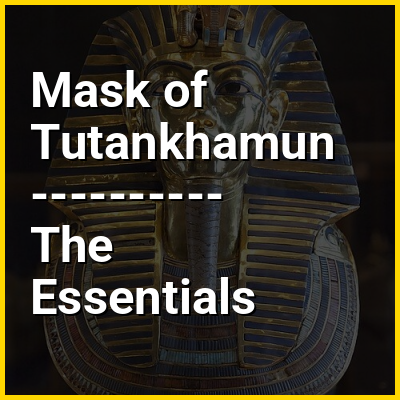
The mask of Tutankhamun is a gold funerary mask that belonged to Tutankhamun, who reigned over the New Kingdom of Egypt from 1332 BC to 1323 BC, during the Eighteenth Dynasty. After being buried with Tutankhamun's mummy for over 3,000 years, it was found in 1925 following the discovery of Tutankhamun's tomb three years earlier by the British archaeologist Howard Carter at the Valley of the Kings. It is on public display at the Grand Egyptian Museum in Cairo.

Bearing the likeness of Tutankhamun in the form of Osiris, the Egyptian god of the afterlife, the mask is 54 centimetres (21.3 in) tall, weighs over 10 kilograms (22 lb) or 321.5 troy ounces, and is decorated with semi-precious stones. A spell from the Book of the Dead is inscribed in Egyptian hieroglyphs on its shoulders. In 2015, it was restored after its 2.5-kilogram (5.5 lb) plaited beard fell off and was hastily glued back on by museum workers.

↓ Menu

>>>PUT SHARE BUTTONS HERE<<<
In this Dossier

Mask of Tutankhamun in the context of 2nd millennium BC

The 2nd millennium BC spanned the years 2000 BC to 1001 BC. In the Ancient Near East, it marks the transition from the Middle to the Late Bronze Age.The Ancient Near Eastern cultures are well within the historical era:The first half of the millennium is dominated by the Middle Kingdom of Egypt and Babylonia. The alphabet develops. At the center of the millennium, a new order emerges with Mycenaean Greek dominance of the Aegean and the rise of the Hittite Empire. The end of the millennium sees the Bronze Age collapse and the transition to the Iron Age.

Other regions of the world are still in the prehistoric period. In Europe, the Beaker culture introduces the Bronze Age, presumably associated with Indo-European expansion. The Indo-Iranian expansion reaches the Iranian plateau and onto the Indian subcontinent (Vedic India), propagating the use of the chariot. Mesoamerica enters the Pre-Classic (Olmec) period. North America is in the late Archaic stage. In Maritime Southeast Asia, the Austronesian expansion reaches Micronesia. In Sub-Saharan Africa, the Bantu expansion begins.

↑ Return to Menu

Mask of Tutankhamun in the context of Repoussé and chasing

Repoussé (French: [ʁəpuse] ) or repoussage ([ʁəpusaʒ] ) is a metalworking technique in which a malleable metal is shaped by hammering from the reverse side to create a design in low relief. Chasing (French: ciselure) or embossing is a similar technique in which the piece is hammered on the front side, sinking the metal. The two techniques are often used in conjunction.

Many metals can be used for chasing and repoussé work, including gold, silver, copper, and alloys such as steel, bronze, and pewter.

↑ Return to Menu

Mask of Tutankhamun in the context of KV62

The tomb of Tutankhamun (reigned c. 1332–1323 BC), a pharaoh of the Eighteenth Dynasty of ancient Egypt, is located in the Valley of the Kings. The tomb, also known by its tomb number KV62, consists of four chambers and an entrance staircase and corridor. It is smaller and less extensively decorated than other Egyptian royal tombs of its time, and it probably originated as a tomb for a non-royal individual that was adapted for Tutankhamun's use after his premature death. Like other pharaohs, Tutankhamun was buried with a wide variety of funerary objects and personal possessions, such as coffins, furniture, clothing and jewelry, though in the unusually limited space these goods had to be densely packed. Robbers entered the tomb twice in the years immediately following the burial, but Tutankhamun's mummy and most of the burial goods remained intact. The tomb's low position, dug into the floor of the valley, allowed its entrance to be hidden by debris deposited by flooding and tomb construction. Thus, unlike other tombs in the valley, it was not stripped of its valuables during the Third Intermediate Period (c. 1070–664 BC).

Tutankhamun's tomb was discovered in 1922 by excavators led by Howard Carter and his patron, George Herbert, 5th Earl of Carnarvon. As a result of the quantity and spectacular appearance of the burial goods, the tomb attracted a media frenzy and became the most famous find in the history of Egyptology. The discovery produced only limited evidence about the history of Tutankhamun's reign and the Amarna Period that preceded it, but it provided insight into the material culture of wealthy ancient Egyptians as well as patterns of ancient tomb robbery. Tutankhamun became one of the best-known pharaohs, and some artefacts from his tomb, such as his golden funerary mask, are among the best-known artworks from ancient Egypt.
↑ Return to Menu

Mask of Tutankhamun in the context of Tutankhamun's mummy

Tutankhamun's mummy was discovered by English Egyptologist Howard Carter and his team on 28 October 1925 in tomb KV62 in the Valley of the Kings. Tutankhamun was the 13th pharaoh of the 18th Dynasty of the New Kingdom of Egypt, making his mummy over 3,300 years old. Tutankhamun's mummy is the only royal mummy to have been found entirely undisturbed.

The burial chamber was found in 1922, but was not opened until a year later. Two years passed between the discovery of the tomb and that of the mummy and its famous death mask. The discovery of the tomb was one of the most significant archaeological discoveries in modern times. There has been much speculation about the king's life and cause of death since very little about him is known.

↑ Return to Menu

Mask of Tutankhamun in the context of Death mask

A death mask is a likeness (typically in wax or plaster cast) of a person's face after their death, usually made by taking a cast or impression from the corpse. Death masks may be mementos of the dead or be used for creation of portraits. The main purpose of the death mask from the Middle Ages until the 19th century was to serve as a model for sculptors in creating statues and busts of the deceased person. Not until the 1800s did such masks become valued for themselves.

In other cultures a death mask may be a funeral mask, an image placed on the face of the deceased before burial rites, and normally buried with them. The best known of these are the masks used in ancient Egypt as part of the mummification process, such as the mask of Tutankhamun, and those from Mycenaean Greece such as the Mask of Agamemnon. When taken from a living subject, such a cast is called a life mask.

↑ Return to Menu