Martial law in Poland in the context of Patriotic Movement for National Rebirth


Martial law in Poland in the context of Patriotic Movement for National Rebirth

⭐ Core Definition: Martial law in Poland

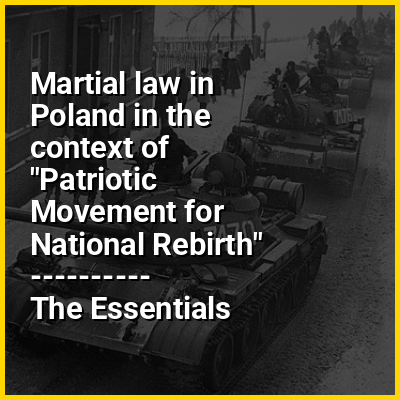
Martial law in Poland (Polish: Stan wojenny w Polsce) existed between 13 December 1981 and 22 July 1983. The government of the Polish People's Republic drastically restricted everyday life by introducing martial law and a military junta in an attempt to counter political opposition, in particular the Solidarity movement.

Since the late 1970s, Poland had been in a deep economic recession. Edward Gierek, First Secretary of the Polish United Workers' Party (PZPR), had obtained a series of large loans from foreign creditors to achieve better economic output. This instead resulted in a domestic crisis. Essential goods were heavily rationed, which acted as a stimulus to establishing the first anticommunist trade union in the Eastern Bloc, known as Solidarity (Polish: Solidarność), in 1980. Gierek, who permitted the trade union to appear per the Gdańsk Agreement, was dismissed from his post less than a month later and confined to house arrest. Following countless strikes and demonstrations by employees of chief industrial regions, Poland was heading towards bankruptcy. The new First Secretary, General Wojciech Jaruzelski, was determined to end the demonstrations by force if necessary.
↓ Menu
HINT:

👉 Martial law in Poland in the context of Patriotic Movement for National Rebirth

Patriotyczny Ruch Odrodzenia Narodowego (PRON, English: Patriotic Movement for National Rebirth or National Renaissance Patriotic Movement) was a Polish popular front that ruled the Polish People's Republic. It was created in the aftermath of the martial law in Poland (1982). Gathering various pro-communist and pro-government organizations, it was attempted to show unity and support for the government and the Polish United Workers' Party (PZPR). PRON was created in July 1982 and dissolved in November 1989.

The Patriotic Movement for National Rebirth replaced the previous communist-led coalition, Front of National Unity, and was marked by a different and broader rhetoric. Communist activists resorted to nationalist, patriotic and Catholic rhetoric, trying to improve the public image of the Polish communist regime and appeal to nationalist and left-leaning religious voters. However, the coalition was not ideologically diverse and was completely dominated by the communist PZPR, with other members of the coalition submitting to its dominance. As such, the PRON was left-wing and did not question the communist regime in any way.

↓ Explore More Topics
In this Dossier

Martial law in Poland in the context of Agnieszka Holland

Agnieszka Holland (Polish: [aɡˈɲɛʂka ˈxɔlant]; born 28 November 1948) is a Polish film and television director and screenwriter, best known for her cultural and political contributions to Polish cinema. She began her career as an assistant to directors Krzysztof Zanussi and Andrzej Wajda, and emigrated to France shortly before the 1981 imposition of the martial law in Poland.

Holland is best known for her films Europa Europa (1990), for which she received a Golden Globe Award as well as an Academy Award for Best Adapted Screenplay nomination, The Secret Garden (1993), Angry Harvest and the Holocaust drama In Darkness, the last two of which were nominated for the Academy Award for Best Foreign Language Film. In 2017, she received the Alfred Bauer Prize (Silver Bear) for her film Spoor at the Berlin International Film Festival. She is also a four-time winner of the Grand Prix at the Gdynia Film Festival. In 2020, she was elected President of the European Film Academy. In 2023, her film Green Border won the Special Jury Prize at the Venice International Film Festival.

View the full Wikipedia page for Agnieszka Holland
↑ Return to Menu