Marine isotope stage in the context of Holstein interglacial


Marine isotope stage in the context of Holstein interglacial

⭐ Core Definition: Marine isotope stage

Marine isotope stages (MIS), marine oxygen-isotope stages, or oxygen isotope stages (OIS), are alternating warm and cool periods in the Earth's paleoclimate, deduced from oxygen isotope data derived from deep sea core samples. Working backwards from the present, which is MIS 1 in the scale, stages with even numbers have high levels of oxygen-18 and represent cold glacial periods, while the odd-numbered stages are lows in the oxygen-18 figures, representing warm interglacial intervals. The data are derived from pollen and foraminifera (plankton) remains in drilled marine sediment cores, sapropels, and other data that reflect historic climate; these are called proxies.

The MIS timescale was developed from the pioneering work of Cesare Emiliani in the 1950s, and is now widely used in archaeology and other fields to express dating in the Quaternary period (the last 2.6 million years), as well as providing the fullest and best data for that period for paleoclimatology or the study of the early climate of the Earth, representing "the standard to which we correlate other Quaternary climate records". Emiliani's work in turn depended on Harold Urey's prediction in a paper of 1947 that the ratio between oxygen-18 and oxygen-16 isotopes in calcite, the main chemical component of the shells and other hard parts of a wide range of marine organisms, should vary depending on the prevailing water temperature in which the calcite was formed.
↓ Menu
HINT:

In this Dossier

Marine isotope stage in the context of Marine Isotope Stage 5

Marine Isotope Stage 5 or MIS 5 is a marine isotope stage in the geologic temperature record, between 130,000 and 80,000 years ago. Sub-stage MIS 5e corresponds to the Last Interglacial, also called the Eemian (in Europe) or Sangamonian (in North America), the last major interglacial period before the Holocene, which extends to the present day. Interglacial periods which occurred during the Pleistocene are investigated to better understand present and future climate variability. Thus, the present interglacial, the Holocene, is compared with MIS 5 or the interglacials of Marine Isotope Stage 11.

View the full Wikipedia page for Marine Isotope Stage 5
↑ Return to Menu

Marine isotope stage in the context of Cesare Emiliani

Cesare Emiliani (8 December 1922 – 20 July 1995) was an Italian-American scientist, geologist, micropaleontologist, and founder of paleoceanography, developing the timescale of marine isotope stages, which despite modifications remains in use today.

He established that the ice ages of the last half million years or so are a cyclic phenomenon, which gave strong support to the hypothesis of Milankovitch and revolutionized ideas about the history of the oceans and of the glaciations. He was also the proponent of Project "LOCO" (for Long Cores) to the U.S. National Science Foundation. The project was a success providing evidence of the history of the oceans and also serving to test the hypotheses of seafloor spreading and plate tectonics.

View the full Wikipedia page for Cesare Emiliani
↑ Return to Menu

Marine isotope stage in the context of Holstein Interglacial

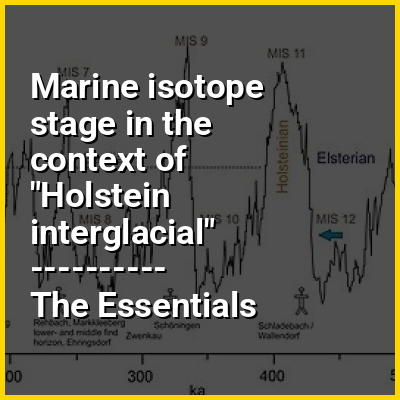
The Holstein or Holsteinian interglacial (German: Holstein-Warmzeit or Holstein-Interglazial), also called the Mindel-Riss interglacial (Mindel-Riß-Interglazial) in the Alpine region, is the third to last major interglacial in Europe before the Holocene, the present warm period. It followed directly after the Elster glaciation and came before the Saale glaciation, during the Middle Pleistocene. The more precise timing was historically controversial since Holstein was commonly correlated to two different marine isotope stages, MIS 11 (424–374 thousand years ago) and MIS 9 (337–300 thousand years ago). Recent scholarship has supported a MIS 11 date, spanning approximately 421-395,000 years ago.

View the full Wikipedia page for Holstein Interglacial
↑ Return to Menu

Marine isotope stage in the context of Stadial

Stadials and interstadials are phases dividing the Quaternary period, or the last 2.6 million years. Stadials are periods of colder climate, and interstadials are periods of warmer climate.

Each Quaternary climate phase has been assigned with a marine isotope stage (MIS) number, which describes the alternation between warmer and cooler temperatures, as measured by oxygen isotope data. Stadials have even MIS numbers, and interstadials have odd MIS numbers. The current Holocene interstadial is MIS 1, and the Last Glacial Maximum stadial is MIS 2.

View the full Wikipedia page for Stadial
↑ Return to Menu

Marine isotope stage in the context of List of periods and events in climate history

The list of periods and events in climate history includes some notable climate events known to paleoclimatology. Knowledge of precise climatic events decreases as the record goes further back in time. The timeline of glaciation covers ice ages specifically, which tend to have their own names for phases, often with different names used for different parts of the world. The names for earlier periods and events come from geology and paleontology. The marine isotope stages (MIS) are often used to express dating within the Quaternary.

View the full Wikipedia page for List of periods and events in climate history
↑ Return to Menu