Marie de' Medici in the context of "Louis XIII"

Play Trivia Questions online!

or

Skip to study material about Marie de' Medici in the context of "Louis XIII"

Ad spacer

⭐ Core Definition: Marie de' Medici

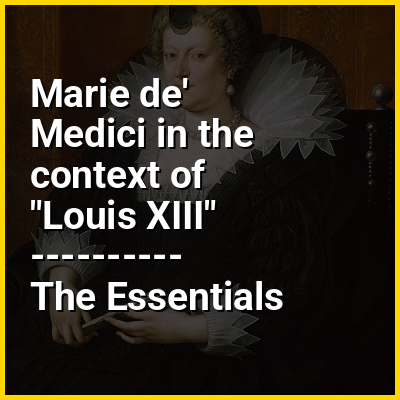
Marie de' Medici (French: Marie de Médicis; Italian: Maria de' Medici; 26 April 1575 – 3 July 1642) was Queen of France and Navarre as the second wife of King Henry IV. Marie served as regent of France between 1610 and 1617 during the minority of her son Louis XIII. Her mandate as regent legally expired in 1614, when her son reached the age of majority, but she refused to resign and continued as regent until she was removed by a coup in 1617.

Marie was a member of the powerful House of Medici in the branch of the grand dukes of Tuscany. Her family's wealth inspired Henry IV to choose Marie as his second wife after his divorce from his previous wife, Margaret of Valois. The assassination of her husband in 1610, which occurred the day after her coronation, caused her to act as regent for her son, Louis XIII, until 1614, when he officially attained his legal majority, but as the head of the Conseil du Roi, she retained the power.
↓ Menu

>>>PUT SHARE BUTTONS HERE<<<

👉 Marie de' Medici in the context of Louis XIII

Louis XIII (French pronunciation: [lwi tʁɛz]; sometimes called the Just; 27 September 1601 – 14 May 1643) was King of France from 1610 until his death in 1643 and King of Navarre (as Louis II) from 1610 to 1620, when the crown of Navarre was merged with the French crown.

Shortly before his ninth birthday, Louis became king of France and Navarre after his father Henry IV was assassinated. His mother, Marie de' Medici, acted as regent during his minority. Mismanagement of the kingdom and ceaseless political intrigues by Marie and her Italian favourites led the young king to take power in 1617 by exiling his mother and executing her followers, including Concino Concini, the most influential Italian at the French court.

↓ Explore More Topics
In this Dossier

Marie de' Medici in the context of Medici

The House of Medici (English: /ˈmɛdɪi/ MED-itch-ee, UK also /məˈdi/ mə-DEE-chee; Italian: [ˈmɛːditʃi]) was an Italian banking family and political dynasty that first consolidated power in the Republic of Florence under Cosimo de' Medici and his grandson Lorenzo "the Magnificent" during the first half of the 15th century. The family originated in the Mugello region of Tuscany, and prospered gradually in trade until it was able to fund the Medici Bank. This bank was the largest in Europe in the 15th century and facilitated the Medicis' rise to political power in Florence, although they officially remained citizens rather than monarchs until the 16th century.

In 1532, the family acquired the hereditary title Duke of Florence. In 1569, the duchy was elevated to the Grand Duchy of Tuscany after territorial expansion. The Medici ruled the Grand Duchy from its inception under the builder Cosimo I until 1737, with the death of Gian Gastone de' Medici. The Medici produced four popes of the Catholic Church—Pope Leo X (1513–1521), Pope Clement VII (1523–1534), Pope Pius IV (1559–1565) and Pope Leo XI (1605)—and two queens of France—Catherine de' Medici (1547–1559) and Marie de' Medici (1600–1610). The Medici's grand duchy witnessed degrees of economic growth under the early grand dukes, but was bankrupt by the time of Cosimo III de' Medici (r. 1670–1723).

↑ Return to Menu

Marie de' Medici in the context of Cardinal Richelieu

Armand Jean du Plessis, 1st Duke of Richelieu (9 September 1585 – 4 December 1642), commonly known as Cardinal Richelieu, was a French Catholic prelate and statesman who had an outsized influence in civil and religious affairs. He became known as the Red Eminence (French: l'Éminence Rouge), a term derived from the style of Eminence applied to cardinals and their customary red robes.

Consecrated a bishop in 1607, Richelieu was appointed Foreign Secretary in 1616. He continued to rise through the hierarchy of both the Catholic Church and the French government, becoming a cardinal in 1622 and chief minister to King Louis XIII in 1624. He retained that office until his death in 1642, when he was succeeded by Cardinal Jules Mazarin, whose career the cardinal had fostered. Richelieu became engaged in a bitter dispute with Marie de Médici, the king's mother, and formerly his close ally.

↑ Return to Menu

Marie de' Medici in the context of Huguenot rebellions

The Huguenot rebellions, sometimes called the Rohan Wars after the Huguenot leader Henri de Rohan, were a series of rebellions of the 1620s in which French Calvinist Protestants (Huguenots), mainly located in southwestern France, revolted against royal authority. The uprising occurred a decade after the death of Henry IV who, himself originally a Huguenot before converting to Catholicism, had protected Protestants through the Edict of Nantes. His successor Louis XIII, under the regency of his Italian Catholic mother Marie de' Medici, became more intolerant of Protestantism. The Huguenots responded by establishing independent political and military structures, establishing diplomatic contacts with foreign powers, and openly revolting against central power. The Huguenot rebellions came after two decades of internal peace under Henry IV, following the intermittent French Wars of Religion of 1562–1598.

↑ Return to Menu

Marie de' Medici in the context of Jardin du Luxembourg

The Jardin du Luxembourg (French pronunciation: [ʒaʁdɛ̃ dy lyksɑ̃buʁ]), known in English as the Luxembourg Garden, colloquially referred to as the Jardin du Sénat (Senate Garden), is located in the 6th arrondissement of Paris, France. The creation of the garden began in 1612 when Marie de' Medici, the widow of King Henry IV, constructed the Luxembourg Palace as her new residence. The garden today is owned by the French Senate, which meets in the palace. It covers 23 hectares (56.8 acres) and is known for its lawns, tree-lined promenades, tennis courts, flowerbeds, model sailboats on its octagonal Grand Bassin, as well as picturesque Medici Fountain, built in 1620. The name Luxembourg comes from the Latin Mons Lucotitius, the name of the hill where the garden is located, and locally the garden is informally called "le Luco".

↑ Return to Menu

Marie de' Medici in the context of Orazio Gentileschi

Orazio Lomi Gentileschi (Italian pronunciation: [oˈrattsjo ˈlɔːmi dʒentiˈleski]; 1563 – 7 February 1639) was an Italian painter. Born in Tuscany, he began his career in Rome, painting in a Mannerist style, much of his work consisting of painting the figures within the decorative schemes of other artists.

After 1600, he came under the influence of the more naturalistic style of Caravaggio. He received important commissions in Fabriano and Genoa before moving to Paris to the court of Marie de' Medici. He spent the last part of his life at the court of Charles I of England and died in London. He was the father of the painter Artemisia Gentileschi.

↑ Return to Menu

Marie de' Medici in the context of Luxembourg Palace

The Luxembourg Palace (French: Palais du Luxembourg, pronounced [palɛ dy lyksɑ̃buʁ]) is at 15 Rue de Vaugirard in the 6th arrondissement of Paris, France. It was originally built (1615–1645) to the designs of the French architect Salomon de Brosse to be the royal residence of the regent Marie de' Medici, mother of King Louis XIII. After the Revolution it was refashioned (1799–1805) by Jean-François Chalgrin into a legislative building and subsequently greatly enlarged and remodeled (1835–1856) by Alphonse de Gisors. The palace has been the seat of the upper houses of the various French national legislatures (excepting only the unicameral National Assembly of the Second Republic) since the establishment of the Sénat conservateur during the Consulate; as such, it has been home to the Senate of the Fifth Republic since its establishment in 1958.

Immediately west of the palace on the Rue de Vaugirard is the Petit Luxembourg, now the residence of the Senate President; and slightly further west, the Musée du Luxembourg, in the former orangery. On the south side of the palace, the formal Luxembourg Garden presents a 25-hectare (62-acre) green parterre of gravel and lawn populated with statues and large basins of water where children sail model boats.

↑ Return to Menu

Marie de' Medici in the context of Comédie-Italienne

Comédie-Italienne (French pronunciation: [kɔmedi italjɛn]) or Théâtre-Italien (pronounced [teɑtʁ italjɛ̃]) are French names which have been used to refer to Italian-language theatre and opera when performed in France.

The earliest recorded visits by Italian players were commedia dell'arte companies employed by the French court under the Italian-born queens Catherine de' Medici and Marie de' Medici. These troupes also gave public performances in Paris at the theatre of the Hôtel de Bourgogne, probably the earliest public theatre to be built in France.

↑ Return to Menu