Manuel Godoy in the context of "Tumult of Aranjuez"

Play Trivia Questions online!

or

Skip to study material about Manuel Godoy in the context of "Tumult of Aranjuez"


⭐ Core Definition: Manuel Godoy

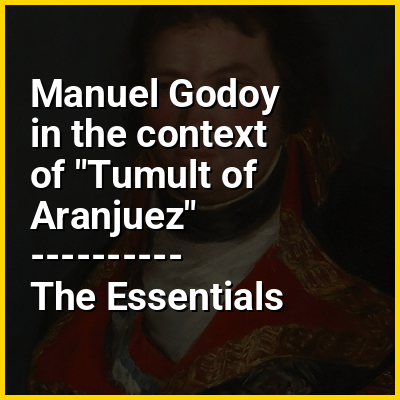
Manuel de Godoy y Álvarez de Faria Ríos (12 May 1767 – 4 October 1851), 1st Prince of the Peace, 1st Duke of Alcudia, 1st Duke of Sueca, 1st Baron of Mascalbó, was the First Secretary of State of the Kingdom of Spain from 1792 to 1797 and then from 1801 to 1808, and as such, one of the central Spanish political figures during the rise of Napoleon and his invasion of Spain. Godoy came to power at a young age as the favourite of King Charles IV and Queen Maria Luisa whom he had a sexual relationship with. He has been partly blamed for the Anglo-Spanish War of 1796–1808 that weakened the Spanish Empire. Godoy's unmatched power ended in 1808 with the Tumult of Aranjuez, which forced him into a long exile. He died in Paris in 1851.

↓ Menu

👉 Manuel Godoy in the context of Tumult of Aranjuez

The Tumult of Aranjuez (Spanish: Motín de Aranjuez), also known as the Mutiny of Aranjuez, was an uprising against Prime Minister Manuel Godoy and Charles IV of Spain that took place in the town of Aranjuez on 17–19 March 1808. It was instigated by disgruntled citizens and Ferdinand's supporters. Celebrated annually in the first week of September, the event led to the fall of Godoy and abdication of Charles IV and the subsequent accession of his son Ferdinand VII. It is celebrated in September rather than in March as the revived celebrations in Aranjuez that began in 1988 were added on top of pre-existing September festivals.

↓ Explore More Topics
In this Dossier

Manuel Godoy in the context of Charles IV of Spain

Charles IV (Spanish: Carlos Antonio Pascual Francisco Javier Juan Nepomuceno José Januario Serafín Diego de Borbón y Sajonia; 11 November 1748 – 20 January 1819) was King of Spain and ruler of the Spanish Empire from 1788 to 1808.

The Spain inherited by Charles IV gave few indications of instability, but during his reign, Spain entered a series of disadvantageous alliances and his regime constantly sought cash to deal with the exigencies of war. He detested his son and heir Ferdinand, who led the unsuccessful El Escorial Conspiracy and later forced Charles's abdication after the Tumult of Aranjuez in March 1808, along with ousting Charles's widely hated first minister Manuel Godoy. Summoned to Bayonne by Napoleon Bonaparte, who forced Ferdinand VII to abdicate, Charles IV also abdicated, paving the way for Napoleon to place his elder brother Joseph Bonaparte on the throne of Spain. The reign of Charles IV turned out to be a major negative turning point in Spanish history.

↑ Return to Menu

Manuel Godoy in the context of Treaty of Fontainebleau (October 1807)

The Treaty of Fontainebleau was a secret agreement signed on 27 October 1807 in Fontainebleau, France between King Charles IV of Spain and the French Emperor Napoleon. Under the treaty, the House of Braganza was to be driven from the Kingdom of Portugal with the country subsequently divided into three regions, the north and south to be ruled by Louis II, King of Etruria and Spanish minister Manuel Godoy respectively, while the provinces of Beira, Tras-os-Montes and Portuguese Estremadura would remain in abeyance until a later peace. Within seven months the government of Spain had collapsed and two Spanish kings abdicated. In August 1808 Napoleon imposed his brother Joseph as King of Spain.

Negotiated and agreed between Don Eugenio Izquierdo [es], plenipotentiary of Charles IV, and Marshal Géraud Duroc as the representative of Napoleon, the accord contained 14 articles along with supplementary provisions relating to troop allocations for the planned invasion of Portugal.

↑ Return to Menu

Manuel Godoy in the context of Treaty of Aranjuez (1801)

The Treaty of Aranjuez (1801) was signed on 21 March 1801 between France and Spain. It confirmed a previous secret agreement in which Spain agreed to exchange Louisiana for territories in Tuscany. The treaty also stipulated Spain's cession of Louisiana to be a "restoration", not a retrocession.

Napoleon wanted Louisiana as the hub of a new French empire in North America, to replace that lost after the 1763 Treaty of Paris. While Spanish chief minister Manuel Godoy was happy to transfer the territory, he demanded six French ships of the line and compensation in Italy to make it politically acceptable to Charles IV of Spain.

↑ Return to Menu

Manuel Godoy in the context of Maria Luisa of Parma

Maria Luisa of Parma (Luisa Maria Teresa Anna; 9 December 1751 – 2 January 1819) was, by marriage to King Charles IV of Spain, Queen of Spain from 1788 to 1808 leading up to the Peninsular War. Her relationship with Manuel Godoy and influence over the King made her unpopular among the people and aristocrats. She was rivals with the Duchess of Alba and the Duchess of Osuna. The death of her daughter-in-law Princess Maria Antonia of Naples and Sicily, whom she disliked, was said to be the result of poisoning by the Queen.

↑ Return to Menu