Mansi people in the context of "Mansi language"

Play Trivia Questions online!

or

Skip to study material about Mansi people in the context of "Mansi language"

Ad spacer

⭐ Core Definition: Mansi people

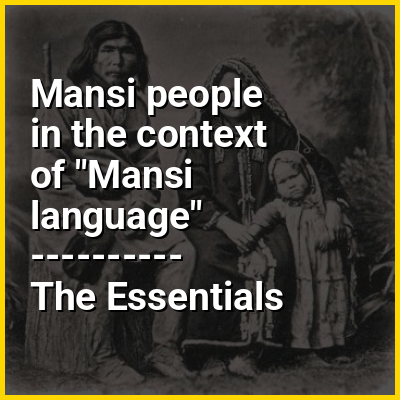
The Mansi (Mansi: Мāньси / Мāньси мāхум, Māńsi / Māńsi māhum, [ˈmaːnʲsʲi, ˈmaːnʲsʲi ˈmaːxʊm]) are an Ob-Ugric Indigenous people living in Khanty–Mansia, an autonomous okrug within Tyumen Oblast in Russia. In Khanty–Mansia, the Khanty and Mansi languages have co-official status with Russian. The Mansi language is one of the postulated Ugric languages of the Uralic family. The Mansi people were formerly known as the Voguls.

Together with the Khanty people, the Mansi are politically represented by the Association to Save Yugra, an organisation founded during Perestroika in the late 1980s. This organisation was among the first regional indigenous associations in Russia.

↓ Menu

>>>PUT SHARE BUTTONS HERE<<<
In this Dossier

Mansi people in the context of Khanate of Sibir

The Khanate of Sibir (Siberian Tatar: Себер Ҡаннығы, romanized: Seber Qannïq; Russian: Сибирское царство, Сибирский юрт, romanizedSibirskoye tsarstvo, Sibirsky yurt) was a Tatar state in western Siberia. It was founded at the end of the 15th century, following the break-up of the Golden Horde. Throughout its history, members of the Shaybanid and Taibugid dynasties often contested the rulership over the Khanate between each other; both of these competing tribes were direct patrilineal descendants of Genghis Khan through his eldest son Jochi and Jochi's fifth son Shayban (Shiban) (died 1266). The area of the Khanate had once formed an integral part of the Mongol Empire, and later came under the control of the White Horde, and under the Golden Horde from 1242 to 1468.

The Khanate of Sibir had an ethnically diverse population of Turkic peoplesSiberian Tatars and various Uralic peoples – including the Khanty, the Mansi, and the Selkup. The Sibir Khanate was the northernmost Muslim state in recorded history. Its defeat by Yermak Timofeyevich in 1582 marked the beginning of the Russian conquest of Siberia.

↑ Return to Menu

Mansi people in the context of Mansi languages

The Mansi languages are spoken by the Mansi people in Siberia, Russia along the Ob River and its tributaries, in the Khanty–Mansi Autonomous Okrug, and Sverdlovsk Oblast. Traditionally considered a single language, they constitute a branch of the Ugric languages, within the broader Uralic language family. They are often considered most closely related to neighbouring Khanty and then to Hungarian.

The base dialect of the Mansi literary language is the Sosva dialect, a representative of the northern language. Fixed word order is typical in Mansi. Adverbials and participles play an important role in sentence construction.

↑ Return to Menu

Mansi people in the context of Finnic peoples

The Finnic peoples, or simply Finns, are the nations who speak languages traditionally classified in the Finnic language family, and which are thought to have originated in the region of the Volga River. Currently, the largest Finnic peoples by population are the Finns (6 million), the Estonians (1 million), the Mordvins (800,000), the Mari (570,000), the Udmurts (550,000), the Komis (330,000) and the Sámi (100,000).

The scope of the term "Finnic peoples" (or "Finns") varies by context. It can be as narrow as the Baltic Finns of Finland, Scandinavia, Estonia, and Northwest Russia. In Russian academic literature, the term typically comprises the Baltic Finns and the Volga Finns, the indigenous peoples living near the Volga and Kama Rivers; the Perm Finns are sometimes distinguished as a third group. These eastern groups include the Finnic peoples of the Komi-Permyak Okrug and the four Russian republics of Komi, Mari El, Mordovia and Udmurtia. The broadest sense in the contemporary usage includes the Sámi of northern Fennoscandia as well. In older literature, the term sometimes includes the Ugrian Finns (the Khanty, Mansi and Hungarians), and thus all speakers of Finno-Ugric languages.Based on linguistic connections, the Finnic peoples are sometimes subsumed under Uralic-speaking peoples, uniting them also with the Samoyeds. The linguistic connections to the Hungarians and Samoyeds were discovered between the end of the eighteenth and beginning of the twentieth centuries.
↑ Return to Menu

Mansi people in the context of Khanty–Mansi Autonomous Okrug

Khanty-Mansi Autonomous Okrug–Yugra, also known as Khanty-Mansia (Khantia-Mansia), is a federal subject of Russia (an autonomous okrug of Tyumen Oblast). It has a population of 1,532,243 as of the 2010 Census. Its administrative center is located at Khanty-Mansiysk.

The peoples native to the region are the Khanty and the Mansi, known collectively as Ob-Ugric peoples, but today the two groups only constitute 2.5% of the region's population. The local languages, Khanty and Mansi, are part of the Ugric branch of the Finno-Ugric language family, and enjoy a special status in the autonomous okrug. Russian remains the only official language.

↑ Return to Menu

Mansi people in the context of Ugrians

Yugra or Yugor Land (Russian: Югра, Югорский край; also spelled Iuhra in contemporary sources) was a collective name for lands and peoples in the region east of the northern Ural Mountains in modern Russia given by Russian chroniclers in the 12th to 17th centuries. During this period, the region was inhabited by the Khanty (Ostyaks) and Mansi (Voguls) peoples.

In a modern context, the term Yugra generally refers to a political constituent of the Russian Federation formally known as Khanty-Mansi Autonomous Okrug–Yugra, located in the lands historically known as Ioughoria. In modern Russian, this word is rendered "Югория" (Yugoria), and is used as a poetic synonym of the region.

↑ Return to Menu

Mansi people in the context of Khanty people

The Khanty (Khanty: ха́нты, romanized: khanty), also known in older literature as Ostyaks (Russian: остяки), are a Ugric Indigenous people, living in Khanty–Mansi Autonomous Okrug, a region historically known as "Yugra" in Russia, together with the Mansi. In the autonomous okrug, the Khanty and Mansi languages are given co-official status with Russian. In the 2021 Census, 31,467 persons identified themselves as Khanty. Of those, 30,242 were resident in Tyumen Oblast, of whom 19,568 were living in Khanty-Mansi Autonomous Okrug and 9,985—in Yamalo-Nenets Autonomous Okrug. 495 were residents of neighbouring Tomsk Oblast, and 109 lived in Sverdlovsk Oblast.

↑ Return to Menu