Major chord in the context of "Subdominant"

Play Trivia Questions online!

or

Skip to study material about Major chord in the context of "Subdominant"

Ad spacer

⭐ Core Definition: Major chord

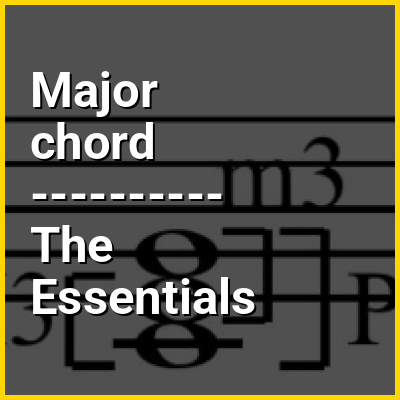
In music theory, a major chord is a chord that has a root, a major third, and a perfect fifth. When a chord comprises only these three notes, it is called a major triad. For example, the major triad built on C, called a C major triad, has pitches C–E–G:

In harmonic analysis and on lead sheets, a C major chord can be notated as C, CM, CΔ, or Cmaj. A major triad is represented by the integer notation {0, 4, 7}.

↓ Menu

>>>PUT SHARE BUTTONS HERE<<<

👉 Major chord in the context of Subdominant

In music, the subdominant is the fourth tonal degree (scale degree 4) of the diatonic scale. It is so called because it is the same distance below the tonic as the dominant is above the tonic – in other words, the tonic is the dominant of the subdominant. It also happens to be the note one step below the dominant. In the movable do solfège system, the subdominant note is sung as fa.

The triad built on the subdominant note is called the subdominant chord. In Roman numeral analysis, the subdominant chord is typically symbolized by the Roman numeral "IV" in a major key, indicating that the chord is a major triad. In a minor key, it is symbolized by "iv", indicating that the chord is a minor triad.

↓ Explore More Topics
In this Dossier

Major chord in the context of Chord progression

In a musical composition, a chord progression or harmonic progression (informally chord changes, used as a plural, or simply changes) is a succession of chords. Chord progressions are the foundation of harmony in Western musical tradition from the common practice era of classical music to the 21st century. Chord progressions are the foundation of popular music styles (e.g., pop music, rock music), traditional music, as well as genres such as blues and jazz. In these genres, chord progressions are the defining feature on which melody and rhythm are built.

In tonal music, chord progressions have the function of either establishing or otherwise contradicting a tonality, the technical name for what is commonly understood as the "key" of a song or piece. Chord progressions, such as the extremely common chord progression I-V-vi-IV, are usually expressed by Roman numerals in classical music theory. In many styles of popular and traditional music, chord progressions are expressed using the name and "quality" of the chords. For example, the previously mentioned chord progression, in the key of E major, would be written as E major–B major–C minor–A major in a fake book or lead sheet. In the first chord, E major, the "E" indicates that the chord is built on the root note "E" and the word "major" indicates that a major chord is built on this "E" note.

↑ Return to Menu

Major chord in the context of Roman numeral analysis

In music theory, Roman numeral analysis is a type of harmonic analysis in which chords are represented by Roman numerals, which encode the chord's degree and harmonic function within a given musical key.

Specific notation conventions vary: some theorists use uppercase numerals (e.g. I, IV, V) to represent major chords, and lowercase numerals (e.g. ii, iii, vi) to represent minor chords. Others use uppercase numerals for all chords regardless of their quality. (As the II, III, and VI chords always are minor chords and the VII always diminished, a further distinguishment is thought unneeded, see table for Major Diatonic scale below)

↑ Return to Menu

Major chord in the context of Root (chord)

In the music theory of harmony, the root is a specific note that names and typifies a given chord. Chords are often spoken about in terms of their root, their quality, and their extensions. When a chord is named without reference to quality, it is assumed to be major—for example, a "C chord" refers to a C major triad, containing the notes C, E, and G. In a given harmonic context, the root of a chord need not be in the bass position, as chords may be inverted while retaining the same name, and therefore the same root.

In tertian harmonic theory, wherein chords can be considered stacks of third intervals (e.g. in common practice tonality), the root of a chord is the note on which the subsequent thirds are stacked. For instance, the root of a triad such as E Minor is E, independently of the vertical order in which the three notes (E, G and B) are presented. A triad can be in three possible positions, a "root position" with the root in the bass (i.e., with the root as the lowest note, thus E, G, B or E, B, G from lowest to highest notes), a first inversion, e.g. G, B, E or G, E, B (i.e., with the note which is a third interval above the root, G, as the lowest note) and a second inversion, e.g. B, E, G or B, G, E, in which the note that is a fifth interval above the root (B) is the lowest note.
↑ Return to Menu

Major chord in the context of Fifth (chord)

In music, the fifth factor of a chord is the note or pitch that is the fifth scale degree, counting the root or tonal center. When the fifth is the bass note, or lowest note, of the expressed chord, the chord is in second inversion Play.

Conventionally, the fifth is second in importance to the root, with the fifth being perfect in all primary triads (I, IV, V and i, iv, v). In jazz chords and theory however, the fifth is often omitted, or assumed, in preference for the chord quality determining third and chord extensions and additions.

↑ Return to Menu

Major chord in the context of Factor (chord)

In music, a factor or chord factor is a member or component of a chord. These are named root, third, fifth, sixth, seventh, ninth (compound 2nd), eleventh (compound 4th), thirteenth (compound 6th), and so on, for their generic interval above the root.In harmony, the consonance and dissonance of a chord factor and a nonchord tone are distinguished, respectively.

Chord factors are taken into consideration in voicing and voice leading. A chord contains exactly as many factors as it contains unique pitch names (octaves don't matter), while a voicing can have any number of voices that draw from and represent some or all the factors of a chord in various octaves. Thus, a chord with three unique pitch names always has three factors, even if some of those pitches are doubled or omitted in a particular voicing. For example, the figure to the right shows a four-note voicing of a C Major triad, which has three chord factors. The "root" chord factor (pitch name "C"), is represented twice in the voicing by voices 1 and 4 in different octaves. The chord factor called the "fifth" (pitch name "G") is represented in voice 2 (shown in red).

↑ Return to Menu

Major chord in the context of Natural minor

In Western classical music theory, the minor scale refers to three scale patterns – the natural minor scale (or Aeolian mode), the harmonic minor scale, and the melodic minor scale (ascending or descending).

These scales contain all three notes of a minor triad: the root, a minor third (rather than the major third, as in a major triad or major scale), and a perfect fifth (rather than the diminished fifth, as in a diminished scale or half diminished scale).

↑ Return to Menu