Macedonia naming dispute in the context of "2008 Bucharest Summit"

Play Trivia Questions online!

or

Skip to study material about Macedonia naming dispute in the context of "2008 Bucharest Summit"

Ad spacer

⭐ Core Definition: Macedonia naming dispute

The use of the country name "Macedonia" was disputed between Greece and the Republic of Macedonia (now North Macedonia) between 1991 and 2019. The dispute was a source of instability in the Western Balkans for 25 years. It was resolved through negotiations between the two countries, mediated by the United Nations, resulting in the Prespa Agreement, which was signed on 17 June 2018. Pertinent to its background is an early 20th-century multifaceted dispute and armed conflict that formed part of the background to the Balkan Wars. The specific naming dispute, although an existing issue in Yugoslav–Greek relations since World War II, was reignited after the breakup of Yugoslavia and the newly-gained independence of the former Socialist Republic of Macedonia in 1991. Since then, it was an ongoing issue in bilateral and international relations until it was settled with the Prespa agreement in June 2018, the subsequent ratification by the Macedonian and Greek parliaments in late 2018 and early 2019 respectively, and the official renaming of Macedonia to North Macedonia in February 2019.

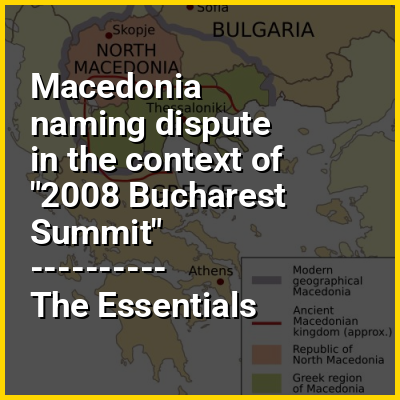
The dispute arose from the ambiguity in nomenclature between the Republic of Macedonia, the adjacent Greek region of Macedonia and the ancient Greek kingdom of Macedon. Citing historical and irredentist concerns, Greece opposed the use of the name "Macedonia" without a geographical qualifier such as "Northern Macedonia" for use "by all ... and for all purposes". As a significant contingent of ethnic Greeks identify themselves as Macedonians and view themselves as unrelated to ethnic Macedonians, Greece further objected to the use of the term "Macedonian" for the neighboring country's largest ethnic group and language. North Macedonia was accused by Greece of appropriating symbols and figures that are historically considered part of Greek culture such as the Vergina Sun and Alexander the Great, and of promoting the irredentist concept of a United Macedonia, which involves territorial claims on Greece, Bulgaria, Albania, and Serbia.
↓ Menu

>>>PUT SHARE BUTTONS HERE<<<

👉 Macedonia naming dispute in the context of 2008 Bucharest Summit

The 2008 Bucharest Summit was a NATO summit organized in the Palace of the Parliament, Bucharest, Romania on 2 – 4 April 2008.

Among other business, Croatia and Albania were invited to join the Alliance. The Republic of Macedonia (now North Macedonia) was not invited to join NATO due to its ongoing naming dispute with Greece. Georgia and Ukraine had hoped to join the NATO Membership Action Plan, but, while welcoming the two countries’ aspirations for membership and agreeing that "these countries will become members of NATO", the NATO members decided to review their request in December 2008.

↓ Explore More Topics
In this Dossier

Macedonia naming dispute in the context of Yugoslav Wars

The Yugoslav Wars were a series of separate but related ethnic conflicts, wars of independence and insurgencies that took place from 1991 to 2001 in what had been the Socialist Federal Republic of Yugoslavia (SFR Yugoslavia). The conflicts both led up to and resulted from the breakup of Yugoslavia, which began in mid-1991, into six independent countries matching the six entities known as republics that had previously constituted Yugoslavia: Slovenia, Croatia, Bosnia and Herzegovina, Montenegro, Serbia, and Macedonia (now called North Macedonia). SFR Yugoslavia's constituent republics declared independence due to rising nationalism. Unresolved tensions between ethnic minorities in the new countries led to the wars. While most of the conflicts ended through peace accords that involved full international recognition of new states, they resulted in a massive number of deaths as well as severe economic damage to the region.

During the initial stages of the breakup of Yugoslavia, the Yugoslav People's Army (JNA) sought to preserve the unity of the Yugoslav nation by eradicating all nationalists in the governments of the republics. However, it increasingly came under the influence of Slobodan Milošević, whose government invoked Serbian nationalism as an ideological replacement for the weakening communist system. As a result, the JNA began to lose Slovenes, Croats, Kosovar Albanians, Bosniaks, and Macedonians, and effectively became a fighting force of only Serbs and Montenegrins. According to a 1994 report by the United Nations (UN), the Serb side did not aim to restore Yugoslavia; instead, it aimed to create a "Greater Serbia" from parts of Croatia and Bosnia. Other irredentist movements have also been brought into connection with the Yugoslav Wars, such as "Greater Albania" (from Kosovo, idea abandoned following international diplomacy) and "Greater Croatia" (from parts of Herzegovina, abandoned in 1994 with the Washington Agreement).

↑ Return to Menu