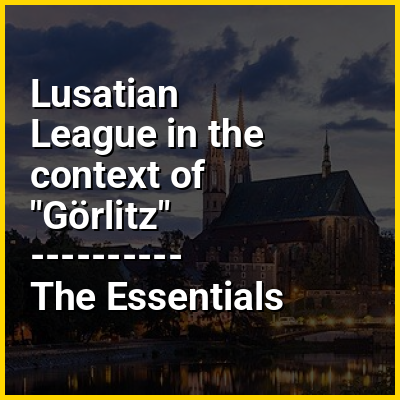
Görlitz ([ˈɡœʁlɪts] ; Lower Sorbian: Zgórjelc; Upper Sorbian: Zhorjelc [ˈzhɔʁʲɛlts] ; Polish: Zgorzelec [zɡɔˈʐɛ.lɛt͡s] ; Czech: Zhořelec [ˈzɦor̝ɛlɛt͡s]; East Lusatian: Gerlz, Gerltz, Gerltsch) is a town in the German state of Saxony. It is on the river Lusatian Neisse and is the largest town in Upper Lusatia, the second-largest town in the region of Lusatia after Cottbus, and the largest town in the German part of the region of Silesia. Görlitz is the easternmost town in Germany and lies opposite the Polish town of Zgorzelec, which was the eastern part of Görlitz until 1945. The town has approximately 56,000 inhabitants, which make Görlitz the sixth-largest town in Saxony. It is the seat of the district of Görlitz. Together with Zgorzelec it forms the Euro City of Görlitz/Zgorzelec, which has a combined population of around 86,000.
Görlitz, first mentioned in 1071, developed as a key trading town on the Via Regia route linking Western and Eastern Europe. In the Late Middle Ages, it prospered through the cloth trade and became a member of the Lusatian League, enjoying considerable autonomy. The town came under Bohemian, Hungarian, Austrian and Saxon rule before becoming part of Prussia in 1815 after the Congress of Vienna. During World War II, Görlitz was spared major destruction, but the new Oder–Neisse line in 1945 divided it from its eastern districts, which became Zgorzelec in Poland. In the GDR era, Görlitz was a border town with limited cross-border contact, but after German reunification and Poland’s EU accession, cooperation with Zgorzelec increased. Today, Görlitz is renowned for its well-preserved historic architecture and frequent use as a film location.